- 21 April 2026
- Dr Miglė Kuliešaitė, Assoc. Prof. Dr Julius Vengelis, Faculty of Physics
A New Laser System Uncovers an Ultrafast World Invisible to the Naked Eye
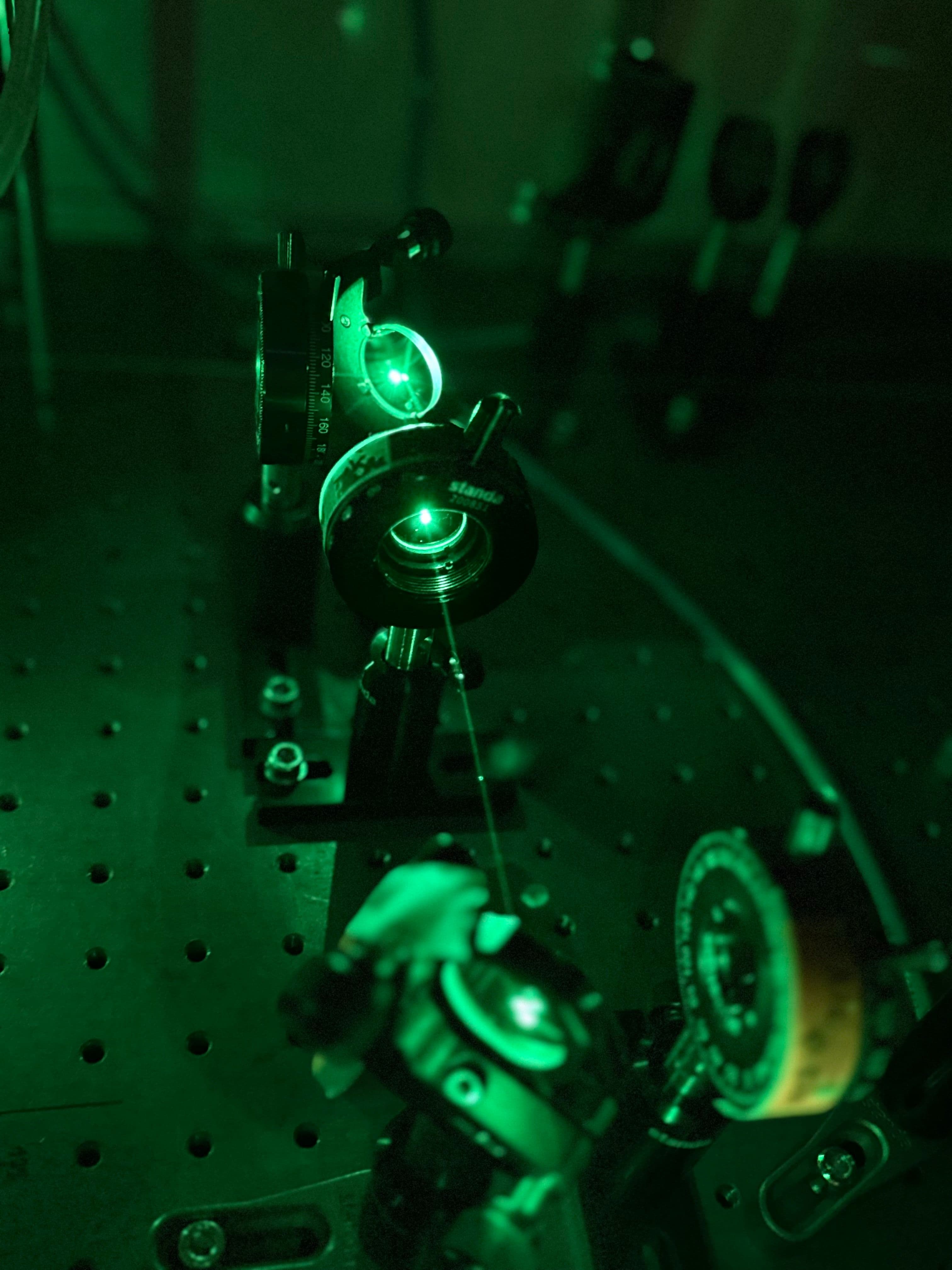
Lasers have become an indispensable part of modern infrastructure – often operating out of sight, yet essential to countless technological processes. Without lasers, today’s world would simply come to a standstill. Their applications span everyday technologies, medical and industrial equipment, and fundamental research laboratories. However, it is not widely recognised that one of the most remarkable success stories in this field is being written in Lithuania.
Lithuanian researchers have contributed to numerous significant international breakthroughs in laser science, allowing us to say, without exaggeration, that Lithuania ranks among the leading countries shaping global trends in this area. The latest proof of this is the development of a new hybrid femtosecond laser system that opens up new opportunities in both fundamental research and industrial applications.
What makes femtosecond lasers special?
Femtosecond lasers emit pulses of light so short that, when compared to a single femtosecond, one second would seem like an eternity to the human mind. In one second, light travels a distance equivalent to seven and a half trips around the Earth. Meanwhile, in a single femtosecond, it would cover only a tiny fraction of that distance – shorter than the thickness of a human hair. One second contains as many femtoseconds as there are seconds in 31.7 million years. Such ultra-short light pulses allow scientists to observe, in real time, phenomena that are completely invisible to the human eye or any conventional measurement instruments.

Laser systems developed in Lithuania are exported successfully to more than 90 countries and are used by organisations such as NASA and the Extreme Light Infrastructure (ELI). However, this success and international recognition were not achieved overnight. Instead, they are the outcome of more than five decades of consistent scientific work. Strong research traditions encourage the search for ever more advanced technological solutions and the development of unique laser systems. Femtosecond lasers represent the latest stage in this long-standing tradition.
Despite major progress in femtosecond laser development, creating high repetition rate, high power femtosecond lasers remains technically demanding. Their performance is determined not only by pulse duration but also by how frequently these pulses interact with the material and by the amount of energy emitted over a given time. High repetition rates lead to heat accumulation, which can impair beam quality and damage sensitive system components. For this reason, achieving the simultaneous combination of ultra-short pulse duration, high repetition rate, and high power remains one of the most complex challenges in laser physics. Although commercial femtosecond laser systems have existed for more than three decades, their potential has not yet been fully exploited.
A new femtosecond laser system
Scientists at the Laser Research Center of the Faculty of Physics at Vilnius University are working to overcome the challenges associated with high repetition rate and high average power femtosecond systems. Their latest achievement is a hybrid laser system that combines the advantages of several technologies and paves the way for even more powerful femtosecond lasers.
The new system generates ultra-short pulses with a duration of just 114 femtoseconds (i.e. 114 trillionths of a second), at an extremely high frequency of 76 MHz. This means that 76 million individual pulses are emitted every second. By analogy, if the same number of raindrops were to fall each second over a 10‑square‑metre area, they would appear as a continuous stream of water. Although each pulse is incredibly short, their sheer number results in a high total emitted power over time – referred to as the average laser power – reaching as much as 72 watts. This is almost four times more than what commercially available systems of this type can offer.

To generate laser pulses with such high average power, high repetition rates, and femtosecond durations, several different technologies must be combined within a single system.
One of these, known as fibre chirped pulse amplification (FCPA), allows laser pulses to be amplified while maintaining beam quality and avoiding damage to the gain medium, but it limits the ability to achieve extremely short pulse durations.
The second technology, referred to as pre-chirp managed amplification (PCMA), determines how much the laser pulse is stretched in time before amplification. Instead of being stretched to the maximum possible duration, the pulse is extended to an optimal length tailored to specific amplification conditions. This enables amplification of laser pulses to high power while maintaining beam quality and preserving pulse compressibility. In practical terms, this means that the amplified pulse can retain a duration close to, or even shorter than, the original pulse.
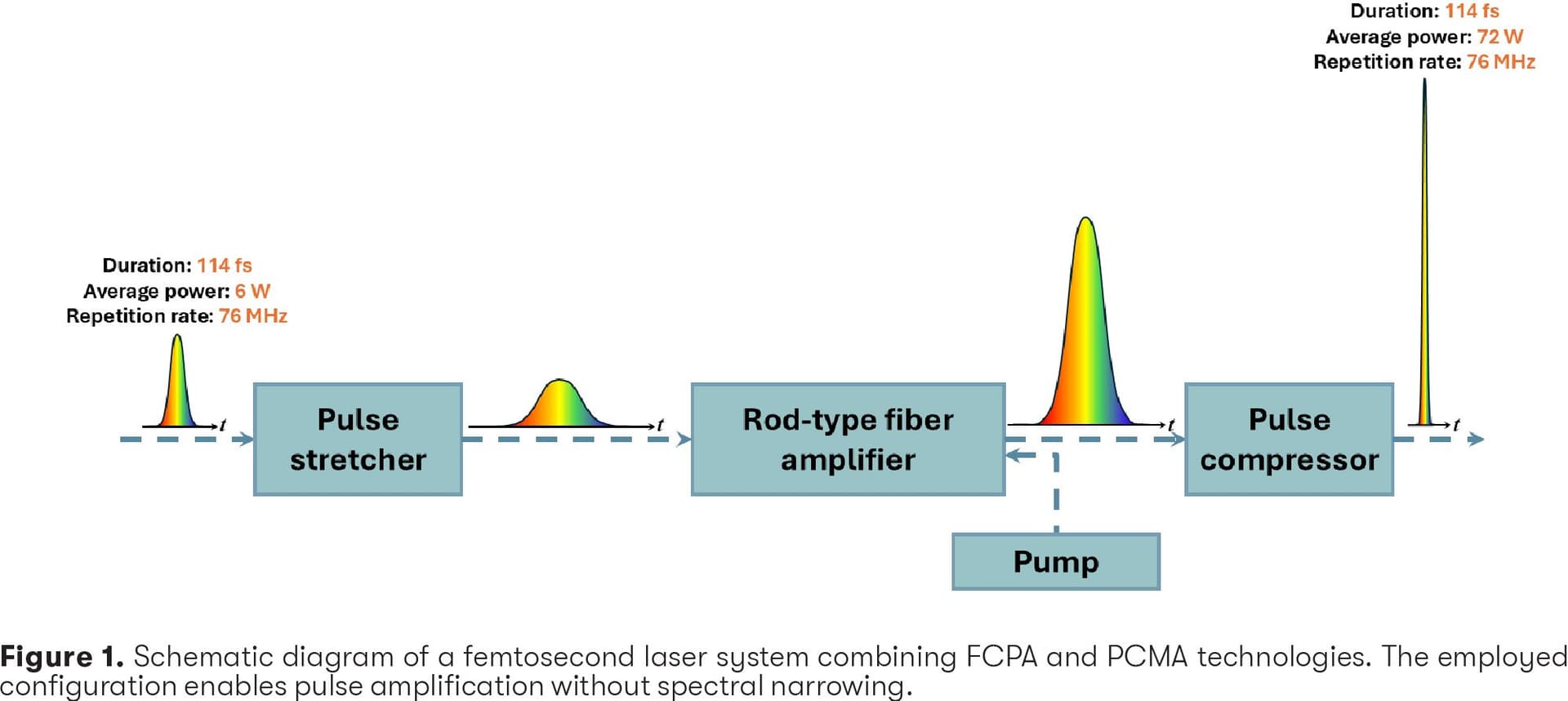
Researchers at the Laser Research Center have developed a hybrid fibre-based laser amplification system that integrates the key strengths of both technologies. The operation of the new system is based on a sequence of carefully coordinated stages designed to amplify laser pulses to high average power while preserving the original pulse duration, excellent beam quality, and favourable spectral properties (see Figure 1). First, the laser source generates ultra-short, low-energy pulses with a duration of 114 femtoseconds at a high repetition rate. These pulses are then stretched in time – their duration is increased by an order of magnitude to an optimal value defined by the amplification conditions. This enables efficient amplification without losing pulse compressibility, while significantly reducing peak intensity and preventing damage to the gain medium. In the next stage, the system employs an approximately 80‑cm‑long fibre rod, where the pulses are amplified by transferring energy from an external source. The rod-type geometry helps maintain high beam quality even at very high power levels. Finally, the amplified pulses are compressed back to their original duration (114 fs). Concentrating a large amount of energy into such a short time interval results in extremely high peak intensities while preserving excellent spectral and spatial performance.
The result is ultra-short, high-repetition-rate, and high-power light pulses. Such lasers open the door to new scientific research and offer a wide range of practical applications.
Why are these laser characteristics important?
The performance achieved by the hybrid laser system represents more than a purely technical achievement. It directly determines which processes can be studied and how precisely they can be controlled. For example, very short – femtosecond-duration – light pulses make it possible to monitor with high precision where light interacts with matter and minimise unwanted thermal effects in surrounding areas. Such ultra-short pulses also enable the observation of extremely fast processes, such as atomic motion or chemical reactions, which cannot be captured by any other measurement methods.
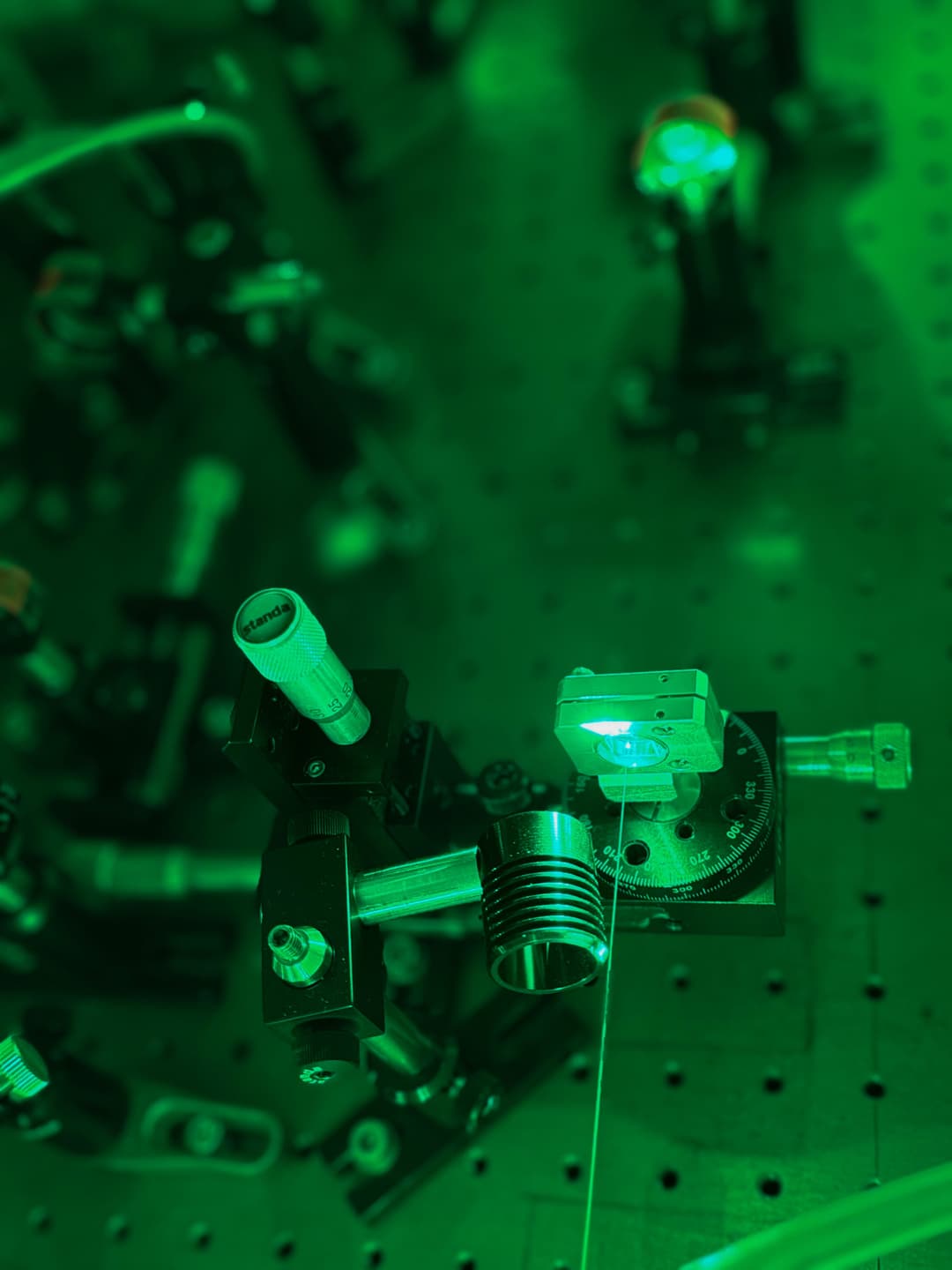
The high average power of the laser system also ensures sufficient signal strength even in cases where part of the light is lost due to scattering or absorption. A large number of pulses (i.e. a high repetition rate) allows large amounts of measurement data to be collected in a short time. This enables rapid signal averaging, reliable separation of useful signals from background noise, and highly accurate results. In addition, high beam quality allows laser radiation to be focused into a very small spot, where exceptionally high peak light intensity can be achieved. This enables energy to be delivered precisely where it is needed, ensuring high spatial accuracy, efficient energy use, and reduced unintended effects on surrounding areas.
Where can this laser system be applied?
The characteristics of such hybrid laser systems are particularly important for advanced imaging, including nonlinear microscopy. In this field, scientists and physicians can observe processes in real time without damaging the tissues under examination. This requires a laser source capable of rapidly acquiring reliable information while maintaining high sensitivity and spatial precision.
The new hybrid laser system provides exactly this – it enables fast acquisition of high-quality images and detection of even weak or short-lived cellular changes. Such images can help in early disease detection and allow precise monitoring of processes taking place within cells.
Beyond advanced imaging, the characteristics of the newly developed laser system are also crucial for generating terahertz (THz) radiation. THz radiation is a special type of electromagnetic radiation whose frequency is higher than that of radio waves and microwaves but lower than that of infrared light. Such radiation can penetrate many materials that are opaque to visible light and reveal their internal structure and composition.
THz radiation is widely used for non-destructive imaging and material identification, for example, in quality control of layered materials in industry, studies of historical artworks, security screening, and the detection of counterfeit medicines without opening their packaging. Since THz radiation is most commonly generated through nonlinear processes driven by femtosecond laser pulses, achieving a strong and stable THz signal requires high average laser power, high pulse-repetition rates, and extremely short pulse durations.
The path toward new laser solutions
The hybrid femtosecond laser amplification system developed by Vilnius University scientists represents the first stage and a foundation for further development of the laser system. Work is currently underway on a high repetition rate, average-power femtosecond laser source capable of wide wavelength tuning in the ultraviolet and visible spectral ranges. Such a laser system would be highly useful in many areas of materials processing and fundamental science, for instance, in nonlinear microscopy for cell studies or in determining the composition and properties of materials.
The system under development will not only further expand research capabilities but will also enable scientific and applied work to be carried out faster, more accurately, and more efficiently.
In the future, the entire system or individual components may be further developed into commercial products offered alongside femtosecond lasers or as standalone devices, contributing to the continued growth of Lithuania’s laser industry.
This research was funded by the Research Council of Lithuania, Grand No. S-MIP-23-23.