- 5 May 2026
- Prof. Jurgita Lazauskaitė-Zabielskė, Vilnius University Faculty of Philosophy
Burnout Up Close: How Employees in Lithuania Experience, Recognise, and Cope With Burnout Risks

Have you ever felt physically and mentally exhausted, emotionally overwhelmed, or found it difficult to concentrate at work? A recent study of Lithuanian employees has revealed that such symptoms may be a serious sign of burnout. A survey of nearly 150 employees showed that more than half of those who suspect they are experiencing burnout actually belong to a high-risk group, yet as many as 85% of all participants did not seek help. Most respondents believe they can overcome burnout on their own, and that the most effective preventive measures would be support from supervisors and colleagues, more manageable workloads and working conditions, positive feedback, teamwork, and a healthy work-life balance.
Different degrees of burnout
In the scientific literature, there are as many as thirteen definitions of burnout, but in essence, they can be reduced to one that encompasses two key aspects: the first is an objective inability to work due to a lack of mental and physical energy; the second is a subjective reluctance to work or a desire to avoid activities that drain one’s strength and, in extreme cases, even undermine the will to live. In other words, burnout can be suspected when a person has neither the energy nor the desire to work.
Recently, there has been increasing public discussion about a growing number of burnout cases, often described as a ‘burnout pandemic’. However, existing research shows that no such pandemic exists. This raises the question: where does this widespread belief come from?
First, it is essential to understand that burnout is not a uniform condition. It has degrees, and therefore it is more accurate to describe it as a continuum – a continuous spectrum where change occurs gradually – ranging from burnout symptoms at one end to burnout syndrome at the other.
Burnout symptoms are relatively widespread. People who experience them report that, at the end of the working day, they often feel tired or emotionally drained and need more time to rest and recover their energy. When such symptoms are severe and long-lasting, the risk of burnout is considered high. A representative study of Lithuanian employees conducted several years ago found that 14% of the working population in Lithuania are at high risk of burnout (Figure 1). By comparison, the proportion is 26% in Japan, 16% in the Netherlands, and 13% in Norway. In other words, Lithuania ranks among the top three countries with the highest burnout risk.
Nevertheless, although burnout symptoms can be unpleasant and harmful to health and work quality, they are not the same as burnout itself or burnout syndrome. The latter is a much more serious condition that can be diagnosed only by health professionals. In cases of burnout syndrome, an individual’s psychological system is exhausted, they are unable to work for extended periods, and recovery may take months or even years. Burnout syndrome is fundamentally different from temporary fatigue following a demanding period at work. The problem is that burnout syndrome is officially recognised in only five out of the 23 countries surveyed, and only three of these grant sick leave and financial benefits to employees affected by burnout.
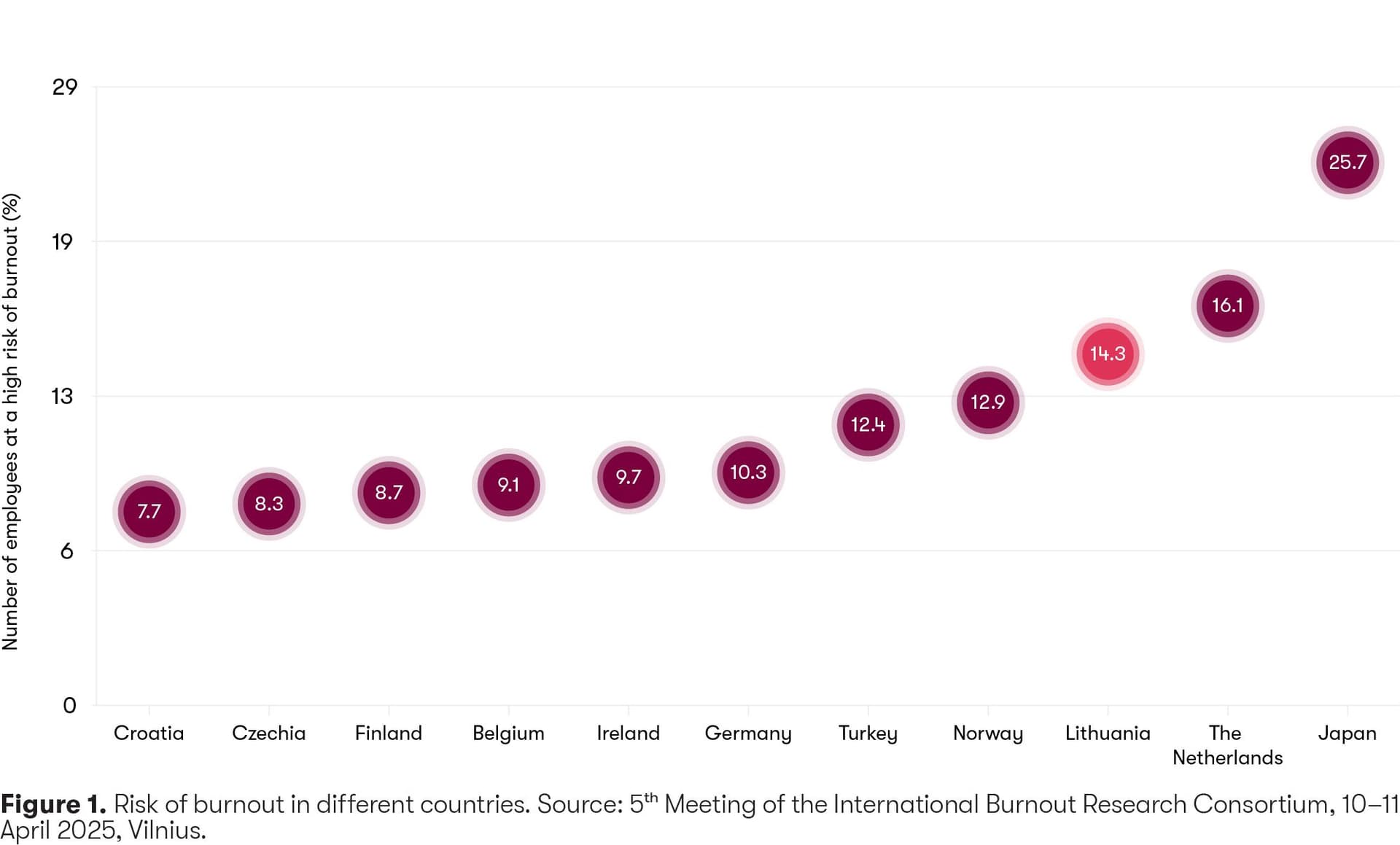
Thus, when people speak of a pandemic, they are usually referring to the number of employees experiencing burnout symptoms. Current research indicates that the increase in such symptoms is very slight; in other words, there is no perceived surge.
Why do we talk about burnout?
It is not surprising that burnout receives so much attention, as its consequences not only affect employees themselves but also organisations as a whole. Reviews of scientific research show that burnout is associated with a range of mental and physical health problems, including anxiety and mood disorders, sleep disturbances, headaches and neck pain, digestive disorders, more frequent respiratory infections, cardiovascular diseases, and increased alcohol consumption.
Employees experiencing burnout tend to perform worse at work, are ill more often, and are more likely to leave their organisations. This leads to higher costs and long-term challenges to team stability and work quality. Therefore, in recent years, burnout has become a central topic not only in academic research but also in public discourse, with attention to its causes, coping strategies, and prevention. However, in everyday life, there is still a lack of precise and reliable information about what burnout actually is, how to recognise it, and when to take action and seek professional help.
Half of the respondents recognise burnout symptoms
Researchers from the Centre for Research on Organisational Psychology at the Faculty of Philosophy of Vilnius University are conducting a study to gain a better understanding of what people actually endure when experiencing burnout, and what those who suspect they have burnout symptoms go through. The study also aims to identify the situations and circumstances in which employees realise they are experiencing burnout, what motivates them to seek professional help, and what prevents them from doing so.
Nearly 150 employees of different ages, from different organisations, and in various positions have participated in the study. Burnout was diagnosed in eleven of them by a general practitioner, psychiatrist, or psychotherapist. The remaining 130 participants reported suspecting that they were experiencing burnout symptoms.
Analysis of the participants’ burnout symptoms and their frequency showed that slightly more than half of those who suspect they are experiencing burnout actually belong to the high-risk group. A quarter falls into the medium-risk group, and the remainder have a low risk of burnout. In other words, not everyone who suspects they are experiencing burnout actually is; however, for at least half of them, this concern is well-founded. This is an essential incentive for organisations to undertake continuous monitoring of burnout risk.
All participants, regardless of diagnosis, were employed and rated their work ability at an average of 6.5 out of 10. They continued working despite experiencing burnout symptoms, including those related to emotional exhaustion, such as severe fatigue, difficulty relaxing, reluctance to engage in activities, loss of joy, apathy, indifference, and intense, hard-to-control emotions.
The most apparent warning signs – declining focus and memory
Comparing employees in low-, medium-, and high-burnout-risk groups reveals apparent differences. Employees at low risk of burnout most often associate burnout symptoms with dissatisfaction with their work or its organisation. They mention a lack of feedback, indifferent supervisors, concerns ignored, heavy workloads, professional stagnation, and a general decrease in interest in work.
However, as burnout risk increases and symptoms intensify, employees’ experiences change. In the medium-risk group, physical symptoms are reported more frequently, including disrupted sleep, persistent fatigue and weakness, nausea, and headaches or stomach aches. These signs indicate that emotional exhaustion has begun to affect the body’s overall functioning.
In the high-risk group, an additional and even more dangerous stage emerges – a significant increase in cognitive impairment symptoms. Employees experience difficulty concentrating, memory and focus deteriorate, and everyday tasks require disproportionate effort. These findings provide valuable insights into the development and dynamics of burnout and empirically confirm what was previously theoretical: burnout begins with fatigue and emotional exhaustion, later causes physical harm, and, over time, negatively affects cognitive functions.
From a practical standpoint, it is essential to emphasise that dissatisfaction with work or organisational issues does not automatically indicate burnout; however, any experienced health disturbances warrant attention. The most serious and telling signs – memory problems and difficulty focusing or maintaining attention – signal that immediate action is required.
Recognising burnout in everyday situations
When asked in what situations or under what circumstances they realised they were experiencing burnout, most study participants reported changes in their emotional state, particularly when intense negative emotions arose and became difficult to control. Physical symptoms or health disturbances also prompted some participants to suspect burnout, though slightly less frequently.
According to health professionals in the Netherlands and Sweden – countries where burnout is recognised as an occupational illness – professional help should be sought if mental and physical exhaustion persists for six months or longer and arises even after minimal effort at work. It is also essential to pay attention if mental energy is reduced for at least one month: this may be accompanied by a lack of initiative, difficulty persistently pursuing goals, and challenges coping with long-term stress or demanding activities.
Another key sign is an inability to recover. Usual recovery strategies that were previously effective no longer work, and everyday tasks become overwhelming; it may feel challenging to complete half or more of one’s responsibilities at work and in personal life. Persistent cognitive difficulties, such as weakened focus and memory, reduced cognitive efficiency, and changes in emotional state, including irritability and emotional instability, often accompany these challenges.
Why (don’t) we seek help
A study conducted in Lithuania revealed that 85% of people who suspected they were experiencing burnout did not seek help. The main reason, cited by nearly a third of participants, was the belief that they could cope with burnout on their own. A quarter of respondents felt no motivation to consult a professional and considered it a waste of time. Another quarter were prevented from seeking help by external factors – limited access to services due to their place of residence, distrust of professionals, and fear of potential consequences at work, such as entries in their medical records that could threaten their work conditions or even their job. The remaining participants reported simply lacking the time, energy, or courage to seek help.
The reasons for not seeking help vary significantly across burnout-risk groups. Those at low risk tend to believe they can manage burnout themselves or that it will pass on its own, they are sceptical about professional help, and rely primarily on the support of family and friends. Employees at medium risk more often mention external obstacles, such as a lack of time or difficulty accessing professionals. In contrast, in the high-risk group, the lack of information, stigma, fear for their career, and the sense that ‘nothing will help’ are most common. We can only imagine the experience and working life of a person who not only feels unwell but also does not expect help from those around them and perceives their situation as hopeless.
The remaining 15% of participants who did seek help were motivated primarily by poor emotional well-being – dissatisfaction with life, panic, suicidal thoughts, feelings of helplessness, anxiety, and a desire to change their situation as quickly as possible – as well as poor physical condition, including pain, other health problems, or inadequate sleep. Less frequently, the decision to seek help was influenced by family, friends, or colleagues, a decline in work quality, or the desire to maintain the ability to work.
What helps in coping with burnout?
Coping measures for burnout can be divided into two groups: individual measures, aimed at personal well-being (therapy, walks in the forest, relaxation techniques), and organisational measures, aimed at improving the work environment (changes in communication, management, workload, or schedule). Research shows that individual measures are effective in the short term (up to six months), while long-term burnout prevention requires organisational measures.
When the study participants were asked which personal traits help them cope with burnout symptoms, they mentioned determination, patience, persistence, creativity, analytical thinking, self-confidence, and optimism. However, nearly half of the participants indicated that the most crucial support comes from work and the organisation: support from supervisors and colleagues, normalisation of workload and working conditions, positive feedback, distribution of responsibilities, transparent decision-making, teamwork, and a healthy work-life balance. A third of participants said that emotional support, sharing experiences, and a shift in societal attitudes towards burnout would help. The remaining fifth expressed a need for more knowledge and training about burnout, as well as time for hobbies and rest.
What can we do to reduce the risk of burnout? First and foremost, it is essential to pay attention to the burnout symptoms mentioned above. If, for several months, you experience intense mental and physical fatigue that does not subside even after taking time to rest, or you feel frequent negative emotions that reduce your performance at work and in your personal life, and especially if it becomes difficult to concentrate, maintain focus, or your memory starts to fail, then it is worth talking about it with family, friends, colleagues, or professionals. It is equally important to be attentive to those around you – a friend, colleague, or family member – who may also be experiencing these symptoms.