- 24 March 2026
- Goda Raibytė-Aleksa
Dr C. Patinios: If We Truly Understood Genome Editing, We Would Have Already Cured All Genetic Diseases
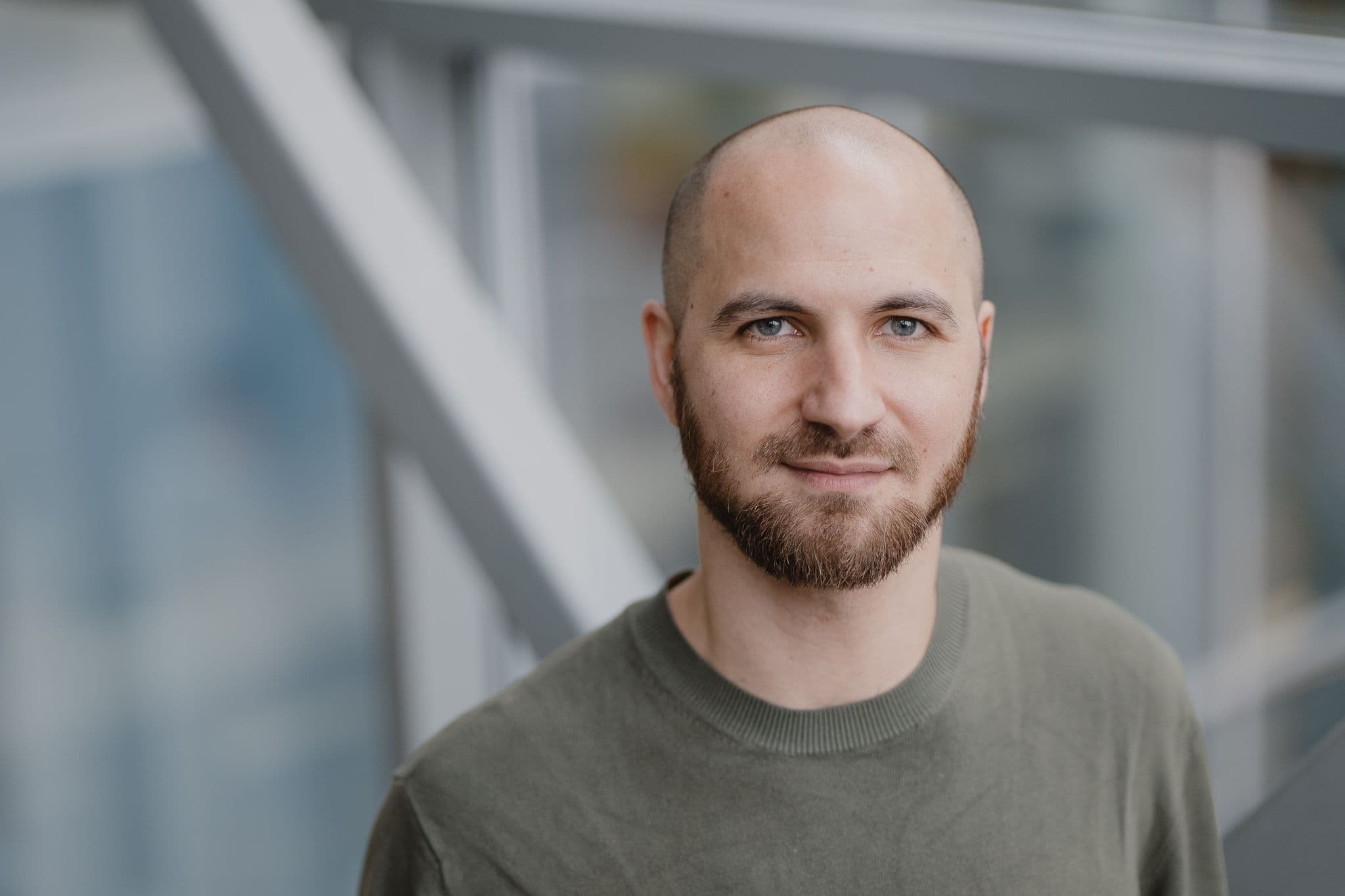
“If we truly understood how genome editing works, we would have already cured all genetic diseases and solved world hunger, because we would be able to safely edit the genome of any organism,” says Dr Constantinos Patinios, a scientist at the EMBL Partnership Institute operating at the Life Sciences Center of Vilnius University (VU LSC).
Dr Patinios’ laboratory develops next-generation genome editing tools, aiming to move beyond the principle of DNA cutting and achieve maximum precision and safety. His academic path includes studies in plant biotechnology at Wageningen University in the Netherlands, work with microorganisms and CRISPR-Cas technologies in Germany, and, since the beginning of 2025, he has been working in Lithuania.
At the end of January, it was announced that the scientist had been awarded a prestigious European Molecular Biology Organisation (EMBO) Installation Grant.
Your laboratory focuses on next-generation genome editing tools. What exactly does that mean?
First of all, it is important to clarify what genome editing is, to avoid misunderstandings. Genome editing is our ability to access the genetic material of an organism – its DNA – whether it is a bacterium, a plant, or a human, and to modify it. When we say “modify,” we mean different types of changes: we can introduce additional DNA into an existing genome, remove a specific DNA fragment, or substitute one DNA sequence with another.
So far, scientists have mainly relied on rather harsh methods that are essentially based on cutting the genome. The genome is cut, and then it is “stitched” back together along with the intended modification – whether that is a substitution, deletion, or insertion. However, cutting the genome is not an ideal solution. If the genome is not repaired, it can lead to toxicity, which is a major drawback. If it is repaired, the process is often imprecise and somewhat chaotic. And when we edit the genome, we want absolute precision.
Since the emergence of modern genome editing tools such as CRISPR-Cas, scientists have been looking for alternatives to cutting the genome. It is important to emphasise that the original CRISPR-Cas systems also operate by cutting the genome. Although significant advances have been made (for example, the base editing and prime editing technologies, the CRISPR-associated transposition systems, and the emergence of retrons and recombinases used for genome editing), we still do not have a universal solution that works for all cases.
That is exactly the goal of my laboratory: to develop such a universal method – one that allows genome editing without generating a cut on the genome, while maintaining very high specificity and precision, and the possibility to do all kinds of edits: insertions, deletions and substitutions. This is what I call the next generation of genome editing.
When did you become interested in genome editing? Was it your first scientific interest?
I became aware of genome editing during my bachelor’s studies. At that time, I became interested in modifying plant genomes in order to improve their traits – for example, making them resistant to pathogens, high temperatures, drought, or soil salinity. Such changes can improve crop yield and food production, helping to provide more food to people who need it.
This was my first encounter with genome editing, and I was fascinated by the idea that by changing just a few genes, you could fundamentally improve an organism’s characteristics. Based on this interest, I pursued a Master’s degree in Plant Biotechnology at Wageningen University in the Netherlands – one of the strongest institutions in the world in this field. There, I focused on plant interactions with pathogens and the environment and learned about the latest molecular techniques for plant improvement. While traditional breeding – crossing different varieties – is widely used, I was more interested in genome editing as a faster and, in my opinion, more efficient approach.
Later, I also began working with microorganisms, editing their genomes to produce biofuels or other compounds used in biotechnology and therapeutics.
How did EMBL enter your career path?
At the time, I was a postdoctoral researcher at the Helmholtz Institute for RNA-based Infection Research in Germany, working in the laboratory of Prof. Chase Beisel, a leader in the CRISPR-Cas field. I was at a stage in my career where I was looking for the next step. I had always wanted to become a group leader.
This opportunity was simply too good to let go. It provided a starting grant to build my laboratory at the pace and ambition I envisioned. I had access to the necessary infrastructure, a strong scientific environment, and the possibility to pursue the research lines I wanted. In addition, I find Vilnius a very beautiful city. Everything aligned, and moving here felt like a natural decision.
You mentioned funding. How much of modern science is driven by curiosity, and how much by funding logic?
Perhaps I am still too young in the system to judge definitively, but in my opinion, around 20–30 per cent is driven by curiosity, and 70–80 per cent by funding logic.
We live in a world that is constantly looking for the next big breakthrough – something that “sells.” Whether it is improving health or saving a species, if many people care about it, it will be funded. If only a few people care, it will not be funded.
Curiosity alone is not enough. One must demonstrate the societal impact of their research, or whether it can lead to a product used by our society, and how it can be applied in practice. A researcher must be able to convince others that the work is important.
That said, this is how I believe funding works at the moment. However, again in my opinion, it should be 50-50, allowing enough funding to go to curiosity-based exploration and enough to application-based research. If there is no funding for curiosity-based exploration, CRISPR-Cas and other genome editing technologies would never have made it to the market!
In the field of genome editing, what do we think we understand but actually do not?
We believe we understand how to perform genome editing. If we truly understood all the details, we would have already cured all genetic diseases, edited the genomes of all organisms, and solved the problem of world hunger.
There is still a lack of fundamental understanding of many aspects of the process. For example, how to selectively target one specific genomic location without affecting others – that is a question of specificity. How to introduce the exact intended modification at that precise location every time – that is a question of precision. How to ensure that editing is reproducible and consistent across all cells – that is a question of consistency. Until we address these questions, we still have a significant way to go.
Do you often doubt your own hypotheses? Can you share a concrete example?
We doubt our hypotheses constantly, every day. We get excited when data support a hypothesis, but often, as more data is collected, it turns out that the hypothesis is no longer valid. Then we must revise it, refine it, and return to the lab to gather new data until we develop a clearer understanding of the system.
Recently, we had a hypothesis that a genome editing tool we were developing would be highly accurate and precise, because theoretically it should have been. However, when we tested it in the microorganism E. coli, we observed numerous off-target effects – the tool was so toxic that it killed almost all the cells. This forced us to rethink our initial hypothesis, refine it, and work toward a safer solution.
How do you help your team cope with disappointment when experiments fail?
I tell my students and colleagues that this field is harsh because we fail 99 per cent of the time. Science requires patience. It is not a process where we fully understand a system and can simply engineer it exactly as we want. It is a continuous process of trial and error.
When an experiment fails, it may feel like a step backwards. But in reality, it is a step forward, because we now know what does not work. Knowing what does not work is essential to finding the answer. I try to motivate my team and explain that this is the nature of science. When a hypothesis is confirmed and an experiment works, the feeling is very strong and compensates for all the failures.
Do you still feel the joy of discovery as strongly as at the beginning of your career?
I sincerely hope I never get used to that feeling, because it is what motivates me to come to work every day. I would say that my excitement is even greater now than before, because I am involved in many projects through my students and collaborators. Previously, I worked on one or a few projects myself, but now I am engaged in multiple directions and collaborate with many partners.
The discovery of new systems, new biology, and new technologies never stops. In my opinion, this is the best job in the world.
What kind of scientist would you not want to become?
I would not want to become a scientist who has no time for himself, his friends, and his family. Nor would I want to become a scientist who is trapped by governmental or journal politics.
What surprised you most about Lithuania?
The biggest surprise was the cold, down to minus 28 degrees Celsius. Neither I nor my car were prepared for that.
At the same time, I was positively surprised by how smart and thoughtful people are, and how carefully designed their experiments are. I also appreciate that Lithuanians are patriotic in a good way – they truly love their country.
If we speak about challenges, I would say there is a lack of structure at the administrative level at the university – clearer procedures and documentation would be beneficial. I believe there needs to be a balance between excessive regulation and the complete absence of it.
There is also the issue of salaries. It is very difficult to attract international talent when we cannot offer competitive compensation. In such cases, people choose laboratories with similar opportunities but better pay.