- 28 April 2026
- Liudmila Januškevičienė, Vilnius University
Mobbing in Lithuanian Healthcare Institutions: Research Reveals Which Groups Face the Highest Risk

Mobbing in healthcare institutions is not merely a series of isolated conflicts or an issue confined to individual workplaces – it is a systemic phenomenon that has a significant impact on the well-being of different groups of medical professionals, leading to burnout and decisions to leave their jobs. The strikes by resident doctors in recent years and public group resignations from healthcare institutions have underscored the need for more in-depth analysis of this issue.
A team of researchers from Vilnius University – human resources management expert Assoc. Prof. Asta Stankevičienė; employment relations researcher Dr Darius Ruželė; child and adolescent psychiatrist and psychotherapist Prof. Sigita Lesinskienė; psychologist Prof. Jurgita Lazauskaitė-Zabielskė; and doctoral student at the Faculty of Medicine Kamilė Pociūtė – conducted a comprehensive study to assess the true scale of mobbing in Lithuanian healthcare institutions, identify its forms of manifestation, and explore effective ways to address the problem.
Distinguishing mobbing from conflict
According to Prof. Sigita Lesinskienė, the foundations of the current concept of mobbing in the context of employment relations were established in the 1980s by Professor Heinz Leymann, a Swedish psychologist. He defined mobbing as psychological terror – hostile, unethical, and systematic behaviour in the work environment. However, it was only approximately 25 years ago that the problems of bullying and group oppression in workplace settings began to receive broader public attention and systematic scientific investigation.
The term ‘mobbing’ quickly gained popularity in Lithuania; however, there is still an ongoing debate over the need for a clearer Lithuanian equivalent, such as ‘grupinis engimas’ (group oppression), which would help society better understand the essence of the phenomenon. Assoc. Prof. Asta Stankevičienė stresses that the search for a Lithuanian term is important not only linguistically but also legally – a clear definition of the phenomenon is a necessary condition for ensuring effective legal regulation of mobbing.
Since the term is relatively new in Lithuania, it is often confused with isolated conflicts or other unpleasant situations in the workplace. The human resources management specialist explained how to distinguish and define mobbing: ‘A one-off instance of criticism of an employee, when the employee is told that they have done something wrong or that they have violated the requirements of the workplace rules or procedures that apply equally to everyone, is not mobbing. The intensity of the unpleasant actions, their duration, and impact on a specific person or group of people are the key differences between a single instance of criticism and systematic psychological pressure on an employee.’
In their study, the researchers chose to employ a definition of mobbing that differs slightly from that provided in the Labour Code. The legal definition, according to Assoc. Prof. Stankevičienė, emphasises long-term negative behaviour towards employees.
‘Academic research defines this phenomenon more precisely: mobbing is considered to be systematic, long-term psychological pressure directed at an employee, lasting for six months or longer, occurring at least once a week, and goes beyond isolated incidents.’
The most common purpose of such behaviour is to humiliate a colleague, undermine their value, distance or even exclude them from the team.
There are various forms of mobbing; however, employment relations expert Dr Darius Ruželė noted that the following specific forms were analysed in the research: withholding necessary work-related information, spreading rumours or gossip, ignoring or isolating a colleague, making offensive or insulting remarks, as well as shouting at a person. Hostile reactions from others are also considered mobbing – for example, when an employee’s work and efforts are constantly criticised, when they are mocked, ignored, or encounter hostility, or when the employee is constantly reminded of their mistakes or misconduct.
Risks in the healthcare sector
According to Prof. Lesinskienė, mobbing can occur both in hierarchical (vertical) and non-hierarchical (horizontal) workplace relationships. ‘Non-hierarchical, horizontal mobbing occurs between colleagues who have similar duties, job functions, and responsibilities, when some become scapegoats, or when a victim is subjected to abuse by a group of colleagues. Hierarchical, vertical mobbing occurs between managers and subordinates, when a manager oppresses an employee or when a group of employees targets the manager.’ However, the researcher highlights that the position of bystanders in the workplace team is critical in all forms of mobbing, since their silence may allow the mobbing to continue, which intensifies the oppression of the employee subjected to mobbing, often with the aim of driving them out of the workplace, diminishing their dignity, and causing emotional harm.
When asked why mobbing may occur more frequently in medical institutions than in other work environments, researchers cite several reasons. Dr Ruželė points out that ‘difficult working conditions, as well as the physically and emotionally demanding work, create an environment in which mobbing may occur much more frequently than in other sectors. In addition, the nature of the work and the hierarchical structure in the medical sector further increase the risk.’ Prof. Lesinskienė agrees that the specific context of the healthcare sector also influences the prevalence of mobbing among medical workers: ‘Medical training and studies are very long and demanding; some students become exhausted and suffer burnout while still studying. Moreover, residents often change workplaces, leading to instability and the constant need to adapt to new teams. There is also additional pressure when performing work tasks that are sometimes unclear and unfairly assigned. Certain groups of doctors who work with severely and chronically ill patients, or with patients in critical condition, are also at greater risk of burnout.’ Difficult working conditions, on-call duties, and heavy workloads – all contribute to exhaustion, and exhausted individuals are more prone to protracted conflicts.
Prof. Lesinskienė also highlights that, in addition to the enormous workload, other significant risk factors include night shifts, low pay, extensive formal paperwork, and the heavy responsibility that medical professionals bear for their patients’ lives and health. Nonetheless, Lithuania has not developed or implemented a system to ensure professional support and burnout-prevention measures for doctors performing highly demanding, responsible work.
All healthcare staff groups were included in the survey
As the Vilnius University researchers note, most studies on mobbing in the healthcare sector to date have focused on nursing staff, who are most often identified in the literature as the most affected occupational group. At the same time, other groups of healthcare workers, such as doctors and residents, have been examined much less frequently, and, notably, laboratory technologists, auxiliary staff, occupational therapists, physiotherapists, midwives, psychologists, social workers, and rehabilitation specialists have hardly been examined at all.
‘Some studies on mobbing do include doctors and residents in addition to nurses, but only very rarely are other groups of medical staff involved. In this study, it was decided that other healthcare workers should also be included,’ stated Dr Ruželė, explaining the uniqueness of the study.
According to the researcher, it is essential to note that the impact of mobbing may vary among different groups of healthcare workers. Even if the level of psychological pressure among them is similar, the organisational consequences, such as the desire to leave the job due to mobbing, may manifest differently. Therefore, the inclusion of broader groups of employees that have so far been less visible in studies is particularly important, as they may experience the intense effects of mobbing yet remain unnoticed for a long time.
It is not only the nursing staff who are affected
During the research, doctors, residents, nurses, and other healthcare workers were surveyed electronically in a completely anonymous manner to ensure participant safety and data reliability. The researchers state that the anonymous responses did not allow for the identification of either specific employees or their workplaces. This enabled the collection of responses from a broad pool of survey participants, with a total sample of 851 respondents.
The questionnaire data were analysed using advanced statistical methods to determine mobbing levels across groups. Structural Equation Modelling allowed the researchers to assess how the quality of provisions to manage mobbing affects the manifestations of mobbing, as well as how mobbing, in turn, affects employee burnout and their desire to leave their jobs.
The highest level of mobbing was found among nurses and ‘other’ employees (auxiliary staff, technologists, laboratory workers, psychologists, etc.), lower among residents, and lowest among doctors (Figure 1).
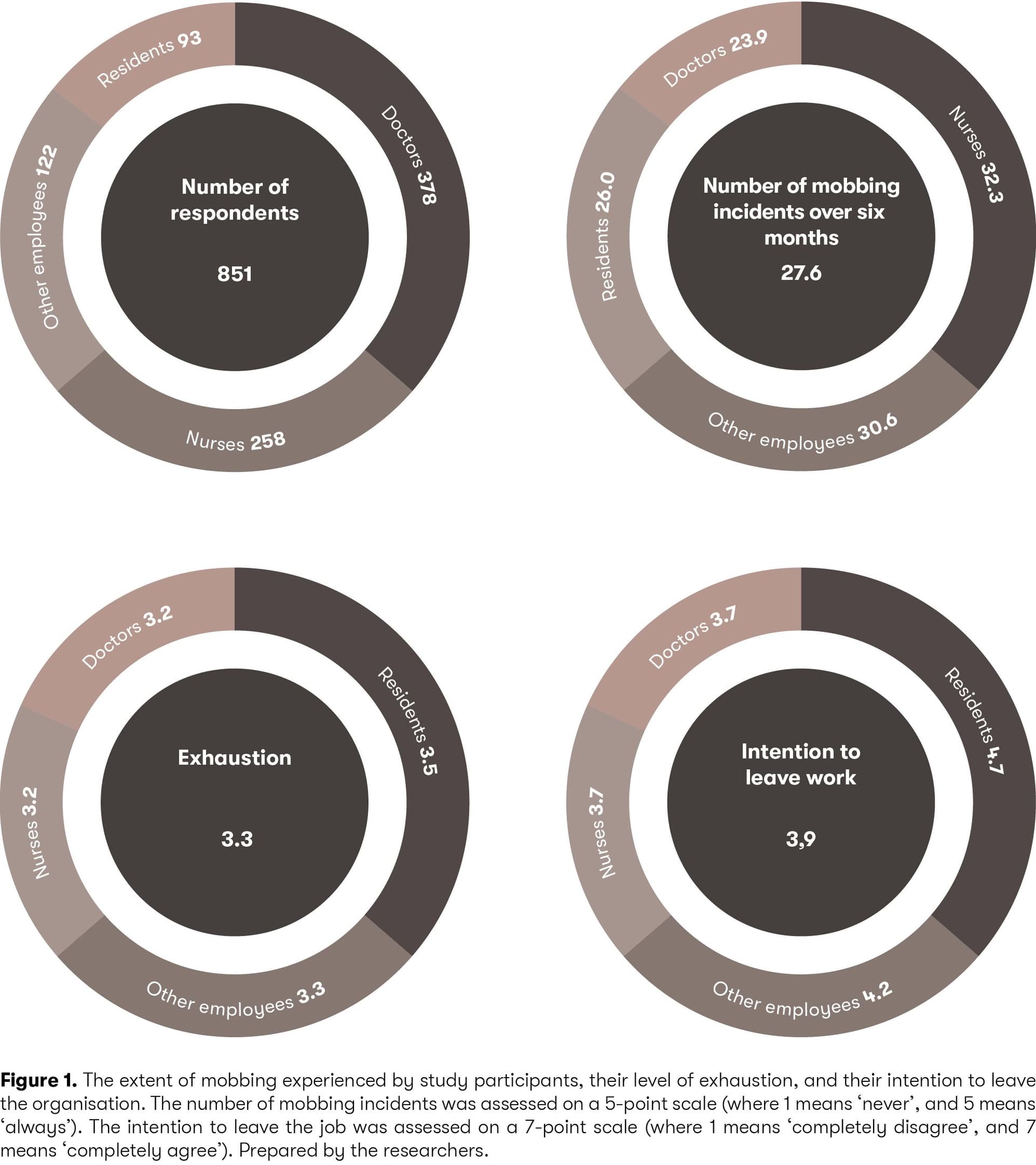
Researchers agree that one of the main reasons why mobbing is more common among nurses and other employee groups is hierarchical relationships. The power distance creates room for abuse, pressure, and belittlement. Another important reason, emphasised by psychotherapist Prof. Lesinskienė, is relationships based on the ‘us’ and ‘them’ principle. Hostile groups form in organisations: if an employee is not ‘with me’ or ‘with us’, then they become ‘against me’ or ‘against us’. According to Lesinskienė, this way of thinking is deeply rooted in human nature and is particularly strong in tense working environments.
The results of the study show that intentions to leave the organisation are most common among resident doctors (mean = 4.65) and the professional group of ‘other’ employees (mean = 4.24). As indicated by Assoc. Prof. Stankevičienė, the desire of ‘other’ employees to leave their institution is closely related to burnout and mobbing, while that of residents is related to exhaustion, burnout, and the search for better professional opportunities – for example, the intention to go abroad for work or to find another workplace. Although the overall level of exhaustion was high across all respondent groups, resident doctors reported the highest level of exhaustion (mean = 3.53).
Regarding the specific forms of mobbing that prevail across different groups of medical workers, the study found that gossip and shouting predominate among nurses and other employees. Among residents, criticism was the most widespread form, whereas withholding necessary work information was most prevalent among ‘other’ employees and doctors (Figure 2).

According to the human resources management expert, Assoc. Prof. Stankevičienė, although most of the research hypotheses were confirmed, there were also some surprising results, such as the fact that both men and women experienced similar levels of bullying – in other research studies, these results tend to differ. Two survey participants who identified their gender as ‘other’ reported extremely high levels of mobbing, and their intention to leave their job was the highest among all participants (mean = 5.60). Of course, the researchers emphasise that no general conclusions can be drawn due to the minimal number of such respondents; still, it seems they may feel excluded in the workplace.
What causes mobbing at work?
According to Assoc. Prof. Stankevičienė, the causes of mobbing can be very diverse and most often consist of several interrelated factors. Four main groups can be distinguished in theoretical terms: individual, social, organisational, and economic reasons.
‘Organisational reasons may arise when an institution does not clearly explain its targets, when human resource management processes are not operating properly, or when the workload is too heavy. Social reasons include hostile relationships within the team, rivalry, envy, and resentment among employees. Individual reasons include personal characteristics, emotional state, and a lack of self-expression at work. Economic reasons may be related to an employee being ‘pushed out’ of their job if they become unproductive or undesirable in the eyes of the company,’ explained the employment relations expert.
The factors often interact in complex ways because one may reinforce the other, which is why mobbing issues usually emerge from the combined effects of several causes.
Prof. Lesinskienė emphasises that a vital factor in the prevention of workplace mobbing is the opportunity for self-expression and professional realisation of one’s abilities and initiatives in the working environment: ‘When employees feel like small cogs in a big machine, and when work is strictly regulated, their overall well-being suffers. For instance, nurses have significantly greater expertise than what they are allowed to use – they could do a lot independently; however, they are burdened by red tape and cannot fully realise their competencies. The same often happens to doctors as well, leading to stress, job dissatisfaction, burnout, and an increased risk of mobbing,’ she added.
Prevention will not work if it exists on paper alone
The study reveals that the existing measures for managing mobbing in healthcare institutions are ineffective. According to Dr Ruželė, although the Labour Code provides for clear procedures, the level of mobbing management remains low. ‘This is likely due to managers lacking the competence to address mobbing effectively, unwillingness or ignorance of how to act, and the lack of external preventive mechanisms. For example, state institutions such as the Labour Inspectorate usually intervene only after incidents have occurred, rather than preventively.’ Assoc. Prof. Stankevičienė stresses that formal policies exist, but in reality, they are inadequate because managers have not decided internally whether this is important to them; moreover, employees remain afraid to speak up, no specialised services exist, and there is a lack of research dedicated to investigating individual cases.
The fear or reluctance to seek help is also reflected in the fact that only about 13% of cases are won by employees who seek legal assistance.
The researchers agree that formal rules alone do not solve the problem – active managerial involvement, effective support mechanisms, and open internal communication are essential. Effective prevention must be multifaceted. Employment relations expert Dr Ruželė suggests continuously monitoring the situation and ensuring incidents are properly escalated through formal channels – if mobbing occurs, information about it should be communicated within the organisation. The researcher asserts that organisations themselves should monitor and address manifestations of mobbing, but this is not enough: external oversight by independent institutions is also necessary to prevent mobbing, ensure ongoing monitoring, and mitigate its consequences for employees. Assoc. Prof. Stankevičienė emphasises that it is essential to ensure that assistance to victims is provided, especially psychological support, and to purposefully foster a culture of openness and a respectful workplace. As Prof. Lesinskienė notes: ‘a happy, healthy person who feels satisfied with their work has no need to bully others.’
The key message conveyed by the results of this study is that mobbing is a persistent and serious problem that can only be reduced by creating a mature and open organisational culture – and that it should begin with personal responsibility and everyday interactions. Psychotherapist Prof. Lesinskienė urges us to start with ourselves, for ‘every employee and manager can contribute to an environment where respect, open communication, cooperation, and creativity prevail.’