- 29 April 2026
- Greta Zulonaitė
Nethra from India on Life in Vilnius: ‘I See Great Potential in Lithuania’
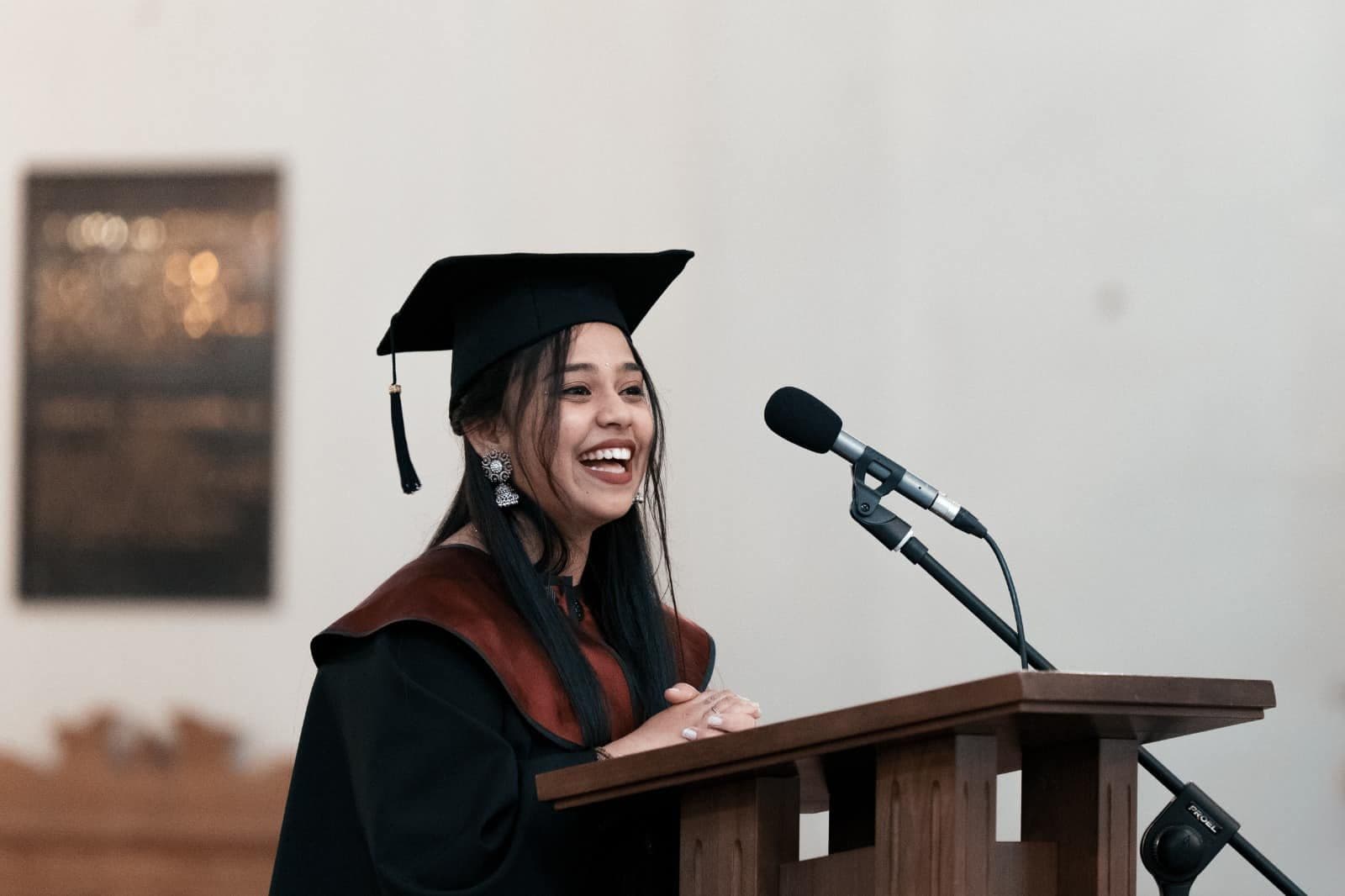
When Nethra Dev Milind Dev came to Lithuania during the COVID-19 pandemic to pursue a Master’s degree at Vilnius University (VU), she never anticipated that she would eventually build her life here. Yet over time, everything changed. She has been living in Lithuania for nearly six years now and considers the country her second home.
‘I see great potential in Lithuania. It has beautiful landscapes and a very clean environment. I can see my future here,’ said the VU alumna. She adds that it took her some time to understand the Lithuanian character, jokingly comparing them to cepelinai, the large stuffed potato dumplings that are the country’s most iconic and traditional Lithuanian dish: ‘Lithuanians are like cepelinai – you need to break through the outer layer to get to the good part.’
Studying during the pandemic
After completing her Bachelor’s degree in France, Nethra was considering where to pursue her Master’s. The decision was not easy, as she had received offers from six universities across Europe. In the end, she chose the Kaunas Faculty of VU, where she was granted a scholarship to study International Business Management.
‘This scholarship is granted to only five non-EU students out of thousands applying to Vilnius University, so the competition was enormous,’ Nethra noted.‘Only later did I realise that Kaunas is not the capital of Lithuania. I felt confused because I wanted to live in the capital,’ she recalled.
However, VU offered Nethra the opportunity to study in Vilnius; in September 2020, she began her Master’s studies in Global Business and Economics at the Faculty of Economics and Business Administration.
That same year, however, the COVID-19 pandemic brought everyday life in Lithuania to a halt. ‘I couldn’t go anywhere, and I missed having a social life. I enjoy going to parks, museums and taking part in different activities, but at that time none of that was possible,’ said the alumna.

Nethra Dev Milind Dev. Photo from personal archive.
Although she initially planned to go to Canada to study under a bilateral exchange programme, her plans changed when Lithuania introduced regulations allowing Master’s students to work full-time. Eventually, Nethra began working as an accountant in Vilnius.
Building connections with lecturers
According to Nethra, the Global Business and Economics programme at VU was very engaging. She says she has never liked theory and expected practical assignments and projects from her studies – exactly what the programme offered.
‘We had professors and lecturers from all over the world – Italy, the US, Lithuania, and other European countries. Their teaching styles were very different, and the students also came from diverse backgrounds. All of this made the experience really interesting.’
‘One thing I really liked about my programme was its structure: we didn’t have several course units at the same time. For example, we would focus on one subject for three weeks, complete it, and only then move on to the next one. There was no need to juggle multiple things at once, so this model suited me very well,’ she noted.
Although Nethra graduated almost four years ago, she still keeps in touch with some of her former faculty members. ‘Jim, our marketing professor from the US, comes to Lithuania every year and invites students to dinner – it has already become a tradition.’

Nethra Dev Milind Dev. Photo from personal archive.
Soaking up the rich history of VU
Nethra calls VU the number one university. ‘It is highly ranked, and it is also very old – more than 447 years since it was founded, so it exudes history and a certain energy.’
‘I think Vilnius University is the place where many strong professionals come from – you can find VU graduates in almost every company on LinkedIn,’ she added.
Nethra explains that competition among school pupils and university students in India is extremely intense, whereas VU offered her a calm, balanced, and stable academic environment. Nethra adds that during her studies at VU she was elected as the student representative and was one of the study program committee members. Her experience shows that VU gives students opportunities to contribute to improving study programmes.
‘During my studies, we wanted to choose one specific course unit. As the representative of my study group, I contacted the Dean, and just one week later, she organised a meeting with the Study Committee. In the end, the programme was adjusted to better meet our needs,’ she commented.
Differences between Lithuania and India
Nethra decided to stay in Lithuania because she feels safe here. Over time, she built friendships and found work, so she no longer feels far from home. ‘Lithuania is my second home. I can travel anywhere, but when I return to Vilnius, I feel like I’m back where I belong,’ said the alumna.
She currently works as a Business Support Specialist at ‘eFront’ within ‘Alter Domus’, a company operating in the field of alternative investments, and she will soon be promoted to Senior Specialist. Nethra also collaborates with the Embassy of India in Lithuania, contributing to the organisation of events. Additionally, she represents the Indian community through cooperation with ‘International House Vilnius’, a relocation and integration centre for foreigners, and ‘Go Vilnius’, the city’s business and tourism development agency.
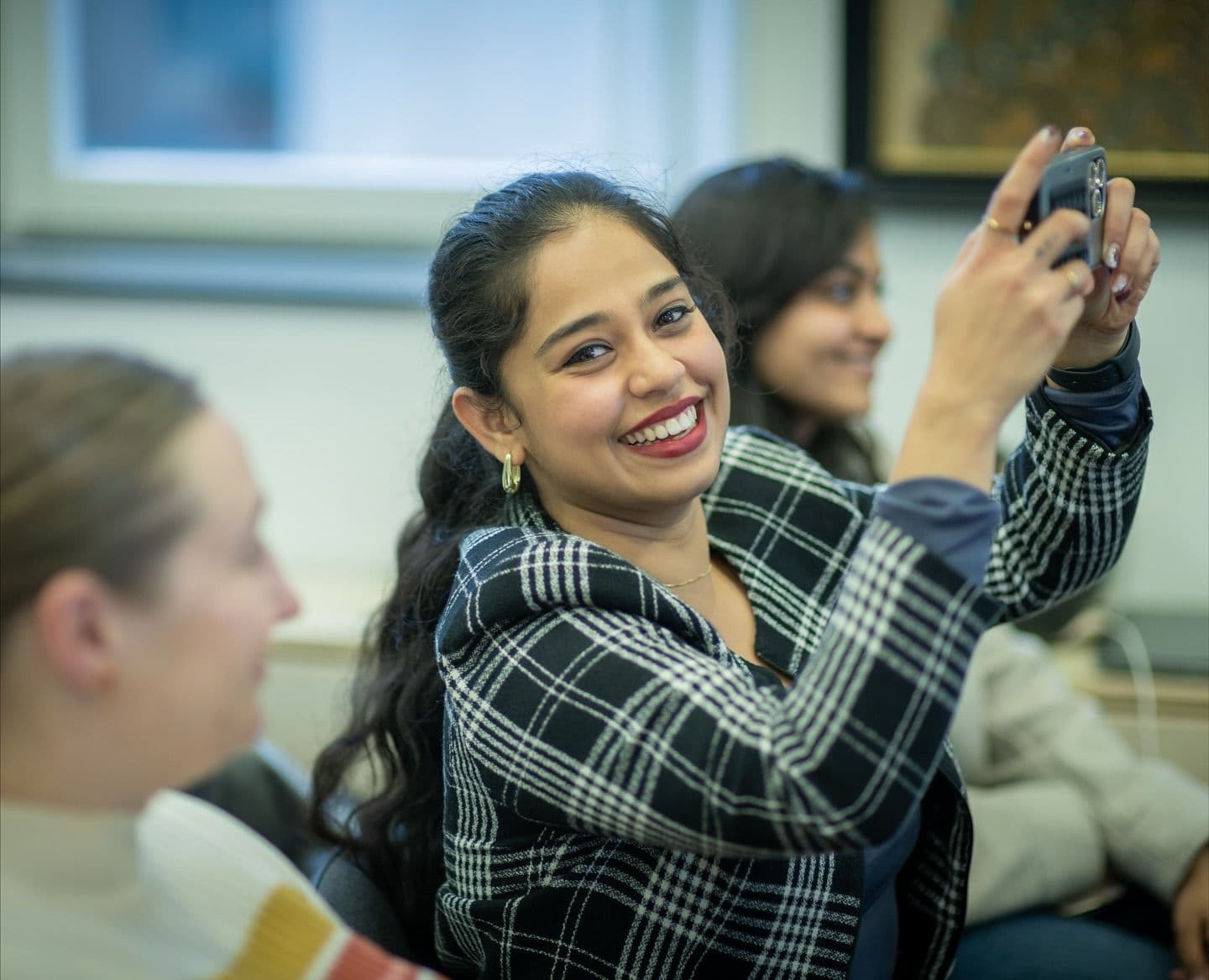
Nethra Dev Milind Dev. Photo from personal archive.
The VU alumna says she is happy with her work and notes that Lithuania offers a very good work-life balance. ‘In India, work culture is far more exhausting – your manager might call you during the weekend and ask you to work. That is quite normal because competition in India is extremely high. If you do not do the job, you can easily be replaced – there are thousands of people willing to take your place,’ she explained.
Asked whether anything still surprises her after six years in Lithuania, Nethra says she is still amazed that Lithuanians often prefer to do certain tasks themselves.
‘For instance, mowing the lawn – in India, we hire people to do that, but it’s different in Lithuania: people here often do these things themselves. Once I was talking to my Lithuanian boyfriend’s family, who live in a house. They said they had a few things to fix, so I asked: “Why don’t you hire someone?” “We are the someone,” they replied.’