- 17 April 2026
- Greta Zulonaitė
Researchers’ Mouse Study May Enable Earlier Detection of Neurological Disorders

During development, the human brain continuously ‘prunes’ its neural connections, eliminating those that are unnecessary while preserving and strengthening the most important ones. However, this process, known as ‘synaptic pruning’, can sometimes become disrupted. When this happens, too many redundant neural connections remain in the brain, which may contribute to the emergence of neurological disorders. Igoris Nagula, a PhD student at the Life Sciences Center of Vilnius University (VU), and Bachelor’s student Gabija Valentaitė are investigating what happens in the brain when this process is impaired and how this knowledge could contribute to earlier detection of neurological conditions such as autism or schizophrenia.
‘Our research is carried out at the cellular level. Such studies first provide a more precise understanding of what exactly goes wrong in the brain. Our results are important because we focus on fundamental mechanisms – how electrical signals and information are processed and transmitted. In the future, this type of cellular-level research may contribute to earlier detection of neurological disorders by helping identify what should be targeted when developing diagnostic tools,’ said the PhD student.
The researchers presented their study at the VU science communication competition ‘Science Sprint’, held in late March, where they won first place.
A comprehensive profile of healthy mice
Igoris Nagula and Gabija Valentaitė use mouse models that allow them to study the electrical activity of neurons. How does this work in practice? Using an extremely fine glass micropipette, the researchers connect to individual neurons and directly record their electrical signals in brain slices. This method enables real-time observation of neuronal ‘communication’, while detailed signal analysis helps understand how neuronal activity changes during early developmental stages.
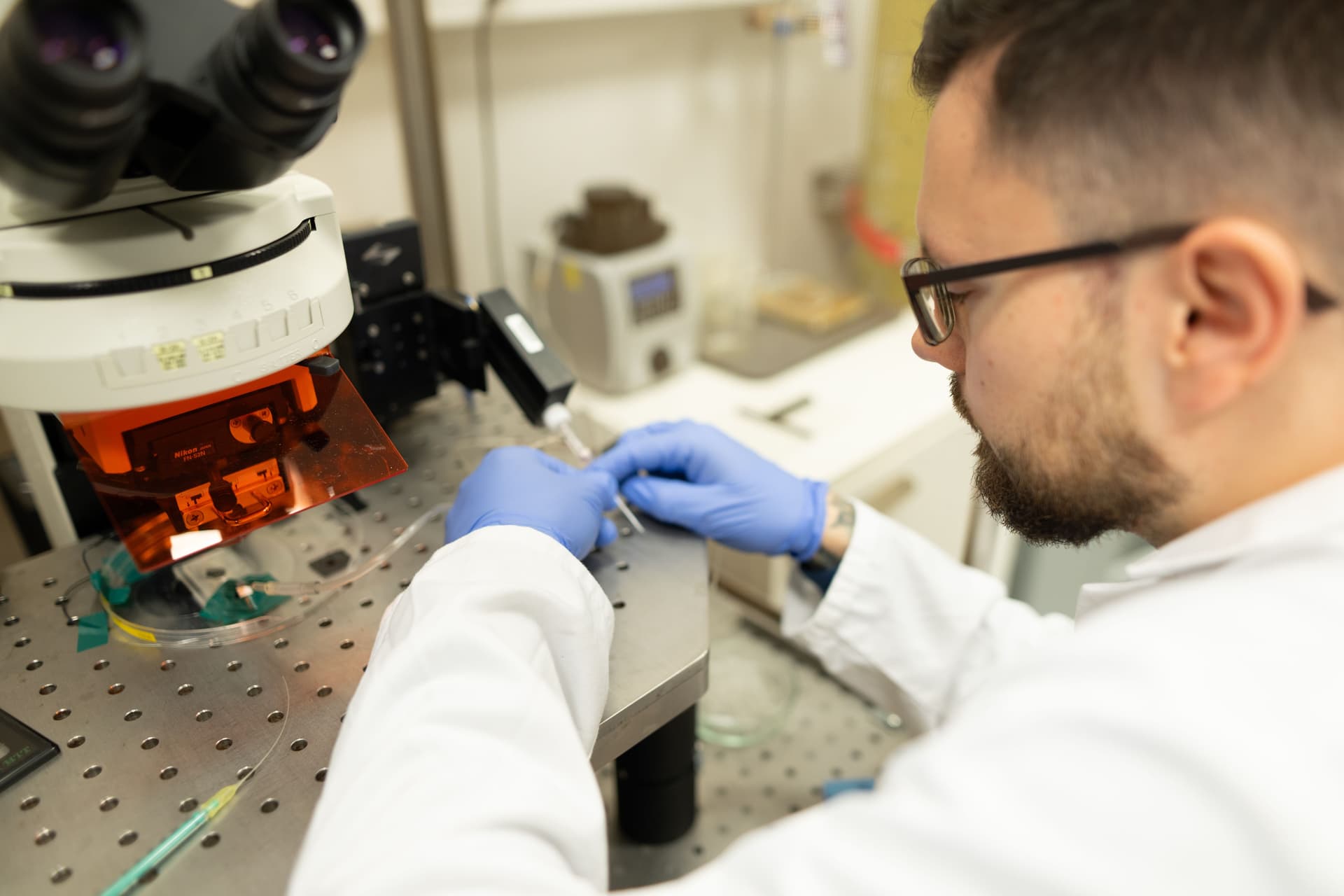
Igoris Nagula. Photo by Martynas Zaremba.
To understand what happens when synaptic pruning is disrupted, the researchers plan to compare healthy mice with genetically modified mice (exhibiting impaired synaptic pruning). They have already created a comprehensive electrophysiological profile of healthy mice, revealing how their brains develop during the first weeks after birth.
‘One might wonder whether this has been studied before. Of course it has – but no one has developed such a detailed overall profile. In one study, only a subset of specific parameters was analysed. As far as we know, for example, sex differences had not been analysed – we examined them and found that certain differences do exist. We also carefully selected developmental stages: one, two, and three weeks after birth,’ Igoris Nagula explained.
The PhD student expects that the study will reveal differences between the two groups – healthy and genetically modified mice.
‘In genetically modified mice, synaptic pruning is disrupted, meaning that neurons are exposed to a greater amount of information. It remains unclear exactly how much this increases neural connections and information load – that is what we aim to determine,’ Gabija Valentaitė added.
A method that facilitates analysis
The researchers are currently analysing data from genetically modified mice. However, this process is far from simple, as electrophysiological recordings are complex and often ‘noisy’, requiring careful processing, cleaning, and repeated review. As they approached the analysis of synaptic activity recordings (signals between neurons), which is one of the most challenging parts of the study, the researchers decided to use a machine learning-based model to process and refine the data more efficiently. ‘If everything had to be processed and analysed manually, it would probably take months, or even a year,’ noted the PhD student.
While searching for a tool to support the research, Gabija Valentaitė found a machine learning model developed by Swiss scientists, miniML. After testing and optimisation, the model’s accuracy improved significantly – from detecting fewer than half of synaptic events to nearly 95% in a control recording.

Gabija Valentaitė. Photo by Vilnius University.
Igoris Nagula notes that at this stage of the research, he is most interested in exploring the tool they are using to optimise the analysis. ‘When I think back to how much time was spent analysing the first dataset – constantly sitting at the computer and reworking everything over and over – it was a very exhausting process. The automated method we discovered, although still requiring final optimisation, looks very promising. If we manage to adapt it and obtain reliable results, it will significantly simplify the entire workflow,’ he said.
Meanwhile, Gabija Valentaitė is fascinated by the opportunity to observe neurons under a microscope – seeing what underlies movement, thought, and behaviour. ‘My deeper interest in electrophysiology was sparked by lecturer Indrė Lapeikaitė. She taught the electrophysiology lab course, where we learnt to assess and analyse various properties. That really captivated me, and that’s why I chose to pursue this topic,’ the student commented.