- 23 April 2026
- Dr Martynas Jakulis, Faculty of History
The Sisters of Charity in 18th–19th-Century Vilnius: ‘Dark Women’ or Devoted Nurses?
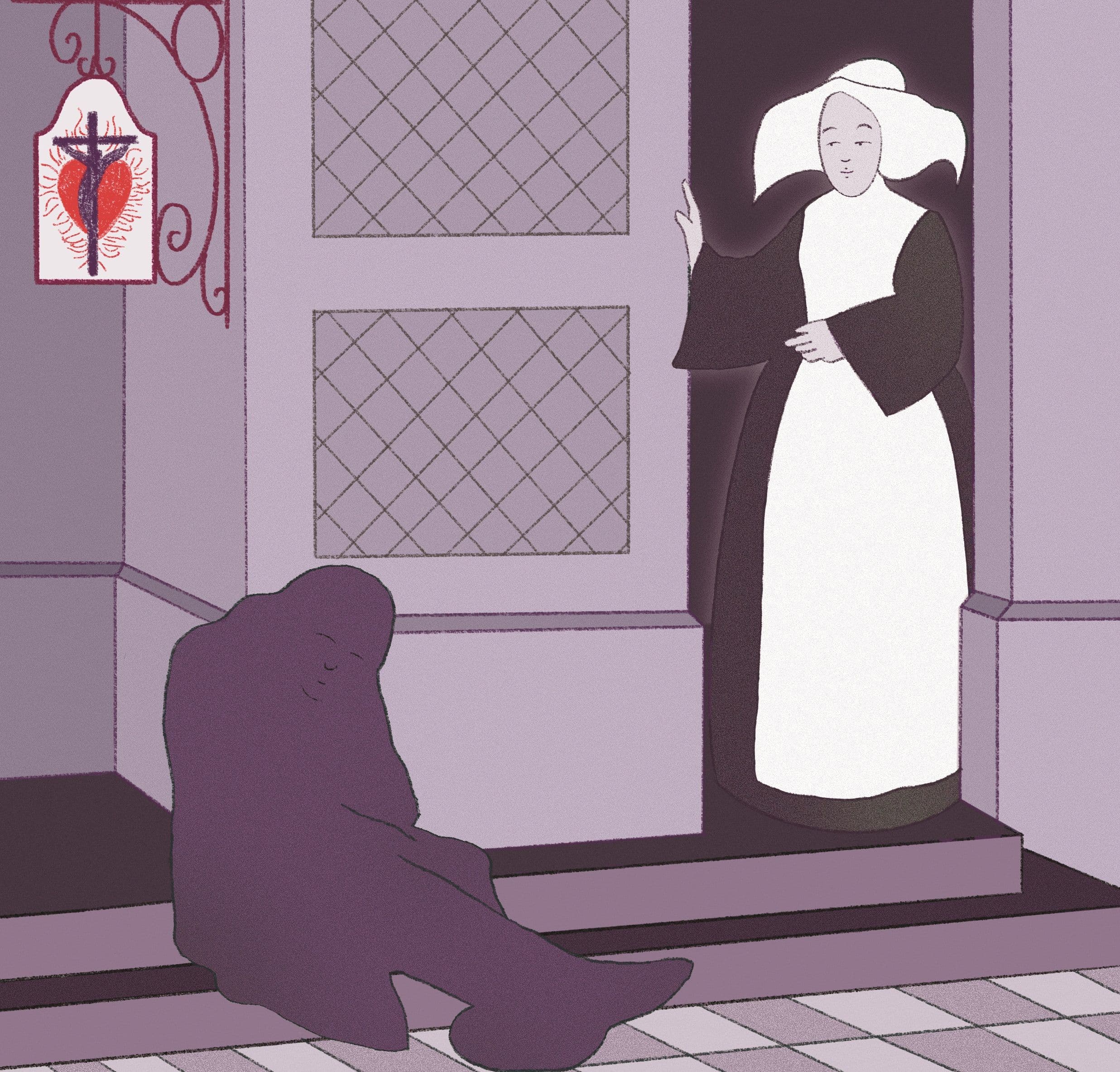
Behind the walls of the restored palace once owned by the Słuszko and later the Gosiewski families (situated at Bokšto g. 6 in Vilnius), a luxurious spa, an elegant restaurant, and office spaces now lie. Yet nearly two and a half centuries ago, a very different kind of life unfolded here, with at least several medical institutions operating on this site. One of them – a hospital and shelter (Lith. špitolė, a historical term for such institutions) run by the Sisters of Charity (1745–1867) – was for a long time the largest in the city. Its development at the turn of the 18th and 19th centuries bears witness to the growing role of professional medical practitioners in old-style hospitals, which were gradually being transformed into modern medical facilities. This shift not only encouraged cooperation that benefited patients and created better conditions for the training of future medical professionals but also generated tensions and led to mixed, and sometimes conflicting, views of the sisters’ work.
The origins of the Sisters of Charity in Europe
The Congregation of the Daughters of Charity of Saint Vincent de Paul, commonly known as the Sisters of Charity (from the French charité, meaning charity or compassion), was founded in 1633 by the priest Saint Vincent de Paul and Saint Louise de Marillac, a widow. The Congregation emerged in response to the challenges faced by French society at the time and, from its earliest years, engaged in active service to the poor, the sick, and abandoned children. In order to avoid the strict enclosure (cloister) required of women’s religious orders, which would have limited their ability to engage in active service, the community did not become a ‘proper’ monastic order and to this day functions as a society of apostolic life. For this reason, the institutions where the sisters lived were called houses rather than convents. These were typically accompanied by špitolės (the forerunners of modern hospitals and care homes), where patients received medical treatment, and those who could no longer care for themselves were offered help.
By the mid-17th century, dozens of Sisters of Charity houses and hospitals were operating in cities across France and other parts of Europe. Among them was Warsaw, where in 1652 the sisters began their work through the initiative of Queen of Poland and Grand Duchess of Lithuania Marie Louise Gonzaga. Soon afterwards, the Congregation expanded its presence to other Polish cities.
Conditions for the Sisters of Charity to settle in Vilnius emerged much later. On 18 June 1744, Bishop of Smolensk Bogusław Gosiewski founded a hospital ‘for poor sick persons, especially those lying in the streets and by the city walls, provided they are not suffering from contagious diseases’. He endowed the future institution with 100,000 gold coins and donated spacious palace buildings on what was then Sawicz (Savičiaus) Street, where a hospital, living quarters for the sisters, and a chapel of Saint Elizabeth – the patroness of hospitals and nurses – were later established. Although the bishop did not explicitly state that the property was being left specifically for a future hospital to be run by the Sisters of Charity, he appointed as executors of his will the missionary monks from the Congregation of the Mission who had been living in Vilnius since the late 17th century at the Church of the Ascension. This community was also founded by Saint Vincent de Paul, which meant that these missionaries and the Sisters of Charity were closely linked organisationally and structurally. It was therefore no coincidence that, through their efforts, the first sisters arrived in the capital from houses operating in Poland to begin the establishment of the new institution. The first patients were admitted to the hospital in 1748.
Vilnius špitolės: who was admitted?
The špitolė located on Savičiaus Street quickly became an integral part of the network of hospitals that had been forming since the early 16th century. Until the Third Partition of the Polish–Lithuanian Commonwealth, such hospitals were established in Vilnius in an unsystematic manner through private initiatives and were not supervised by any central government authority; over time, however, specific functional profiles emerged for those hospitals whose primary purpose was medical treatment. Before the hospital on Savičiaus Street was founded, two other hospitals run by Catholic religious orders were already operating in Vilnius. Since 1635, the Brothers Hospitallers of St John of God (known as the Fatebenefratelli or the Bonifratres) had treated primarily men suffering from various internal diseases. They cared for patients with mental disorders in a small hospital near the Church of the Holy Cross (at Simono Daukanto a. 1), which had up to 20 beds. In the considerably larger Hospital of St Roch (which has not survived), located at the junction of Šventaragio and Barboros Radvilaitės Streets, where the Brothers of Charity of St Roch (the Rochites) worked, assistance was likewise provided to Vilnius residents suffering from various internal diseases, but this institution’s particular specialisation was the treatment of patients with sexually transmitted infections.
The Sisters of Charity, who were prohibited from admitting people suffering from sexually transmitted diseases (referred to in the foundation act as ‘contagious diseases’), were therefore more similar in the nature of their work to the Fatebenefratelli. As the scarce references preserved in the sources suggest, assistance was provided to male and female patients suffering from internal, mental, and other illnesses. In addition, care was given to dozens of abandoned children, elderly people, and persons with disabilities. In the first years of operation, the annual number of patients amounted to only several dozen. However, by the late 1780s, more than 1,600 patients were being admitted each year, and the hospital was therefore frequently operating at full capacity and beyond. On the one hand, this trend reflects the constantly growing demand for more accessible medical care, as such hospitals were primarily sought out by those who could not afford the services of a physician. The sisters admitted craftsmen, day labourers, servants, soldiers, impoverished members of the nobility, and other vulnerable individuals, whose numbers were growing as the city expanded. On the other hand, this also indicates that the residents of Vilnius trusted the sisters and found their methods of treatment acceptable.
Disagreements between the Sisters of Charity and medical practitioners
At the Sisters of Charity hospital, key decisions regarding the institution’s management and finances, the distribution of duties, and other matters were made by the community superior. The other sisters – up to 15 of whom could reside in the house at any given time – were responsible for running the hospital, working in the kitchen, and nursing patients in the infirmaries (which in the 19th century already numbered six spacious wards). The nuns themselves did not treat patients and therefore employed physicians, for whom such hospitals were not their primary place of work. The sisters also relied on the services of city pharmacists. As hospital expenditure records show, a similar relationship between the religious community and physicians existed in the hospitals run by the Fatebenefratelli and the Brothers of Charity of St Roch. Thus, although these hospitals were medical institutions, professional doctors were not an integral part of their organisational structure, and decision-making authority rested with the superiors of the religious communities. It is therefore not surprising that such relationships were characterised by both constructive cooperation and recurring tensions between the religious communities and medical professionals, reflecting differing views on how patients should best be treated.
Even more grounds for disagreement emerged in the late 18th century, when such hospitals gradually became not only places of treatment but also sites of medical education. The large numbers of patients suffering from a wide variety of illnesses and treated in a single location, together with the opportunity to test out treatment methods in practice – these factors made the setting extremely important for the training of future medics.
Although the rule of the Sisters of Charity required the sisters to follow the advice of the physicians working in their hospitals, the nuns did not always respond positively to their active involvement, which they sometimes regarded as interference in their affairs and as a disruption of established routines. This attitude is clearly illustrated by a letter written on 24 November 1799 by the superior of the house, Marija Egiptietė Šubskytė, to Bishop Jan Nepomucen Kossakowski of Vilnius. In the letter, she stated that ‘none of us spares herself; we willingly sacrifice our health and our lives in serving poor patients, and we know how to care for them’. At the same time, while seeking the bishop’s protection, the superior complained about changing practices in the hospital: ‘under no circumstances may it be permitted that young sisters who have taken vows should be in the company of young physicians, pharmacists, and gentlemen doctors’.
The Sisters of Charity’s conflict with Joseph Frank
Perhaps the clearest illustration of the mutual distrust between the Sisters of Charity and physicians is the conflict that arose in 1805 with Joseph Frank, who served as Professor of Clinical Medicine at Vilnius University from 1804 to 1823 and described his years there in his Memoirs of Vilnius. From the very beginning of his work in the city, the Sisters of Charity hospital was of great importance to Frank, as he delivered well-attended lectures there and demonstrated pathological cases. Nevertheless, the professor critically assessed the sisters’ competencies and their position within the hospital. According to him, the hospital ‘[…] appeared deplorable. Two patients were assigned to a single bed; some were even placed on the floor strewn with sand, which served to conceal the filth. The beds were not numbered and lacked plaques indicating the patient’s name and diagnosis. The air was stifling, as there were no ventilators; the windows were kept closed because of the cold. No special diet was prescribed for patients – they ate whatever the nuns served’. In an effort to remedy these shortcomings and improve conditions, the professor organised a charity concert, the proceeds of which were used to support the hospital.
The day after the successful event, he went to the institution and tried to explain to the superior what improvements he wished to introduce. However, according to Frank, the superior ‘boastfully’ declared: ‘Sir, we do not want the changes you intend to make here. If you wish to replace our regular physician during his temporary absence – by all means. But do not attempt to command us. […] For any failure to fulfil our duties, we are accountable to the missionary monks’.
The dispute ultimately resulted in Frank, angered and having uttered what were described as ‘impertinences’, withdrawing from his teaching duties at the Sisters of Charity hospital. This decision greatly disturbed his father, Johann Peter Frank. According to him, ‘it would have been wiser to wait a little and first investigate their relations with the missionary monks and to approach them (the most enlightened missionaries of our time) rather than confront the dark women’.
This clash between the medical professor and the nuns – bearing in mind that it is presented only from Frank’s perspective and thus reflects a particular bias – reveals at least two important points. On the one hand, the negative assessment of the Sisters of Charity and their work by both Franks reflected, as Colin Jones’s research has shown, a broader negative attitude toward Sisters of Charity among physicians in Western Europe, especially in France. They were regarded as incompetent and superstitious and were associated with folk healers or charlatans. On the other hand, this conflict clearly demonstrates that for the sisters, any physician working at their hospital, regardless of his academic standing or fame, was merely a paid employee, responsible only for a limited aspect of hospital operations. It is evident that the nuns, drawing on many years of experience, considered themselves sufficiently competent to care properly for patients and to administer the hospital.
Local physicians’ views of the Sisters of Charity
Frank’s unfavourable and tendentious assessment had a significant impact on later historians of medicine, for whom it was taken as sufficient evidence that conditions at the Sisters of Charity hospital were extremely poor. However, it is essential to note that this was by no means the prevailing view among physicians in Vilnius at the time. In the late 18th century, another Vilnius University Professor, Andrew Sniadecki, who had spoken critically of the hospitals of the Fatebenefratelli and the Rochites as ‘more like graves for the living than a refuge and assistance for those who suffer’, commented positively about the institution administered by the Sisters of Charity: ‘through extraordinary work and effort, through the devoted service of the sisters, the best possible order and cleanliness are maintained, insofar as circumstances permit’. Although the hospital was always overcrowded, which is detrimental to patients, its management and buildings, as well as its sufficiently large inner courtyard and gardens, according to Sniadecki, constituted everything necessary for a well-run facility.
Similarly, August Ludwik Bécu, who served as a physician at the hospital, also expressed positive views of the sisters and their work in his lecture On the Perfection of Charitable Hospitals (1807) – for understandable reasons, as this was one of his workplaces: ‘Not only through their service to the sick but also through the proper administration of hospitals do they come close to the ideal of a good špitolė’. As Professor of General Pathology, it was particularly important to him that he was able to teach and learn both at the patient’s bedside, as well as by observing how the sisters cared for patients: ‘I admit that I learnt from them to pay attention to people’s needs. They understand them best and therefore are best able to help’.
The Lithuanian Hospitals Commission, which was responsible for the administration of care and treatment institutions, also expressed favourable views of the sisters. At a meeting on 13 December 1801, after it was established that the General Hospital, opened in June 1799 near the Church of Saints Philip and James in the Lukiškės suburb, was not being properly administered, it was proposed that it be entrusted to the sisters, who were noted for their ‘dedication to charitable service rooted in their vocation’.
Overall, attitudes toward the Sisters of Charity in Vilnius in the 18th and 19th centuries were ambivalent: they were regarded both as ‘dark women’, incapable of adequately caring for patients, and as excellent administrators and devoted nurses from whom even physicians could learn. Despite Joseph Frank’s influence, it appears that his negative assessment, although widely circulated, did not have lasting or decisive significance. The trust placed in the sisters is evidenced by the fact that, in addition to the charitable hospital on Savičiaus Street and the Infant Jesus Children’s Shelter (which began operating in 1790), the Vilnius General Hospital was also transferred to the Sisters of Charity, and they were invited to work within the Vilnius Charity Society. Only after the uprising of 1863, mainly for political reasons, were the sisters forced to cease their activities.
This article was prepared in 2025 within the framework of the Vilnius City Municipality budget-funded programme for grants to researchers of Vilnius city history (project ‘Hospitals in Vilnius at the Turn of the 18th–19th Centuries’, Contract No. IST-2025-IST-2025-00010)