- 17 April 2026
- Lect. Dovilė Butkienė, Dr Lauryna Rakickienė, Prof. Saulė Raižienė, Vilnius University Faculty of Philosophy
The Unsolved Equation of Mathematics Education in Lithuania: What Is the Missing Variable?

Every spring, as the examination period approaches, parents and teachers begin to worry about their children’s results. Mathematics examinations in particular attract considerable public attention.
The results of the Basic Education Achievement Test (PUPP) were consistently low until 2024, with only slight year-to-year fluctuations. Approximately half of secondary school students receive a grade of five or lower in mathematics. The results of the State Matura Examinations (VBE) and the number of school leavers who fail them cause concern every year. This means that a large proportion of students fail to achieve the objectives of mathematics teaching and learning, which raises the question: why is this the case?
Learning motivation receives the least attention
At least three explanations are possible for why students’ mathematics examination results in our country are so poor. First, the teaching objectives may not be realistic. Second, the methods used to achieve them may be ineffective. Third, students may lack the willingness to pursue these objectives: they may find mathematics uninteresting, not see the point of learning it, or find other activities more meaningful. In Lithuania, most discussions focus on the first two explanations, with attention shifting from curricula to examination difficulty and textbooks. Meanwhile, the third reason related to students’ motivation is left aside.
Researchers from the Institute of Psychology at the Faculty of Philosophy of Vilnius University, seeking to understand students’ motivation to learn mathematics, their experiences, and how these change upon entering upper secondary school, conducted a longitudinal study, during which they surveyed more than 1,500 upper secondary school students four times from 24 schools in cities, towns, and rural areas across Lithuania. This article presents data from the fourth stage, collected as students were completing their second year of upper secondary school.
There is no value without cost
The study was grounded in Expectancy–Value Theory, one of the most widely applied theoretical approaches to learning motivation. This theory is based on a cognitive perspective, emphasising that our motivation for engaging in an activity is shaped by our thoughts and beliefs. Two types of motivational beliefs influence students’ engagement, effort, and achievement in learning mathematics: expectancies, i.e. beliefs about how well they will be able to perform mathematical tasks, and the value they attribute to learning mathematics.
Value comprises several components. Intrinsic value refers to whether students find mathematics interesting and enjoy the learning process. Utility value reflects the perceived usefulness of mathematics for current or future goals. Attainment value describes how important it is for students personally to be good at mathematics.
One of the strengths of the theory is that, alongside these positive values, it also identifies negative values reflecting the perceived cost of learning mathematics. Effort cost refers to students’ perception that learning mathematics requires excessive effort that does not pay off. Opportunity cost reflects what students feel they must sacrifice to study mathematics, such as time spent on favourite activities or with friends. Emotional cost refers to negative emotions associated with learning mathematics, such as fear, tension, or irritation. Finally, ego cost concerns the threat that potential failure in learning mathematics poses to students’ self-worth and identity.
The perceived cost of learning mathematics has attracted increased research attention only in the past decade. The analysis of these four cost components presented in this study is novel not only in our national context but also internationally.
Not all students write themselves off
Upper secondary school students’ motivational beliefs about mathematics and studying it were assessed using a questionnaire developed specifically for this study. Each type of belief was measured using five to nine statements rated on a five-point scale. As there is no established benchmark against which upper secondary school students’ responses could be compared to classify motivational beliefs as ‘high’ or ‘low’, we present the evaluations of selected questionnaire statements that best illustrate each type of belief. This overview allows the students’ own voices to be heard – voices that are still relatively rarely included in discussions about mathematics teaching and learning in Lithuania.
First, it is important to note that a substantial proportion of upper secondary school students believe they can learn mathematics successfully. Approximately one third of students (30%) agree with the statement ‘I am good at mathematics’, while a slightly larger share (38.4%) disagrees (Figure 1). Public narratives may give the impression that almost all students have little confidence in their ability to learn mathematics. However, it may be that adults doubt students’ mathematical abilities even more than students doubt themselves.
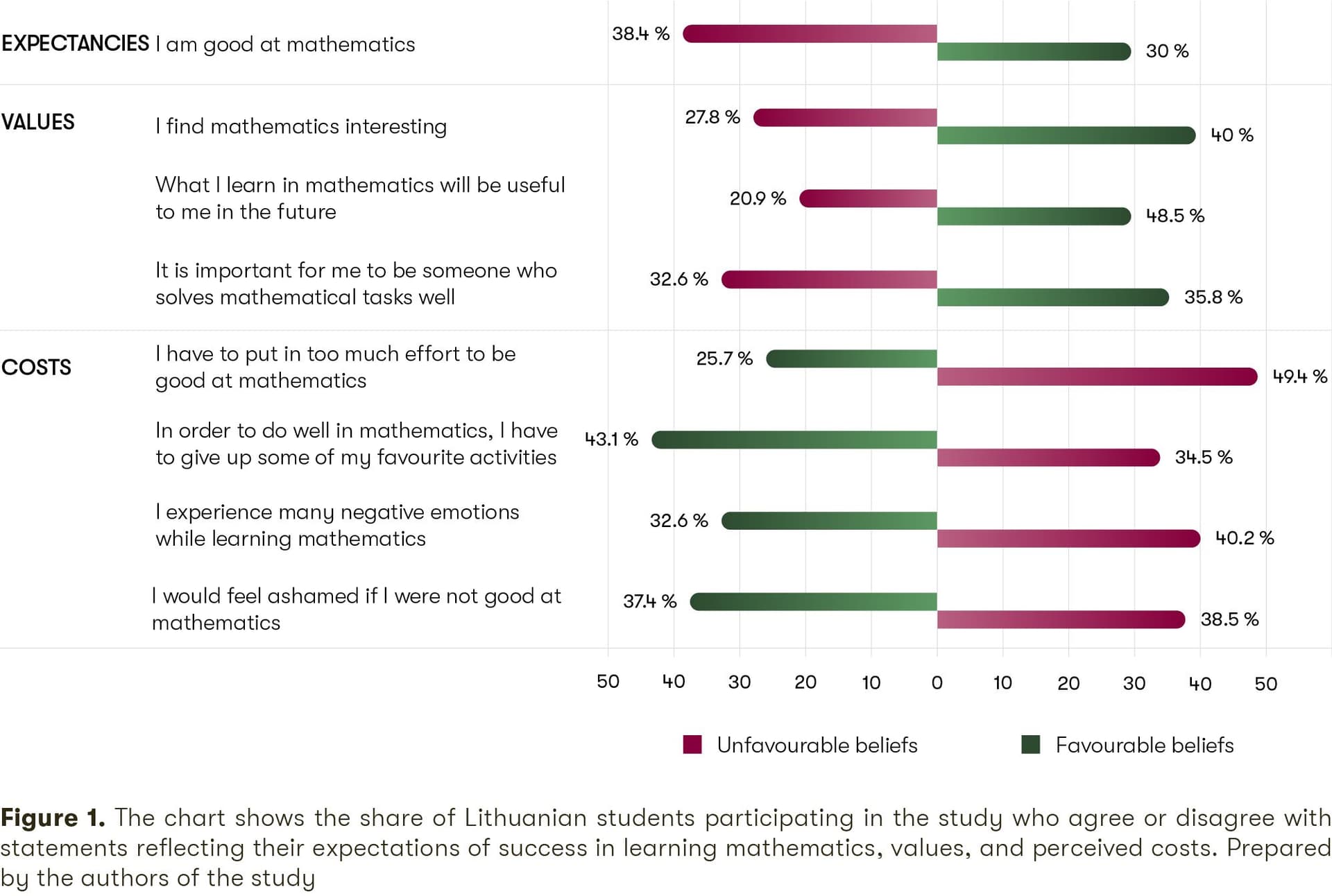
Figure 1.The chart shows the share of Lithuanian students participating in the study who agree or disagree with statements reflecting their expectations of success in learning mathematics, values, and perceived costs. Prepared by the authors of the study.
Over a third of students find mathematics interesting
When analysing the intrinsic value of mathematics, we can note that mathematics is not widely disliked among upper secondary school students. The statement ‘I find mathematics interesting’ received more agreement (40%) than disagreement (27.8%). This challenges the common societal belief that students dislike mathematics and learn it only because they have to. Theoretically, perceiving an activity as interesting is closely related to intrinsic motivation – engaging in an activity for its own enjoyment rather than for external reasons (such as usefulness, personal importance, or obligation). Research shows that such motivation tends to be more sustainable, promotes deeper learning, and is associated with greater student well-being.
The proportions of students who link mathematics with their identity and those who do not are similar. For example, 35.8% agreed with the attainment-value statement ‘It is important to me to be someone who solves mathematical tasks well’, while 32.6% disagreed. Although attainment value does not stem from the enjoyment of the activity itself (as intrinsic value does), it still reflects internally grounded motivation, arising from the importance of the activity for one’s sense of self. Thus, the findings of this study do not support the claim that most upper secondary school students learn mathematics only because parents or teachers pressure them.
Nearly half of the students recognise the usefulness of mathematics
Upper secondary school students most strongly endorse the utility value of learning mathematics. Nearly half of students (48.5%) agreed with the statement ‘What I learn in mathematics will be useful to me in the future’, while only about one-fifth (20.9%) disagreed. This result is not surprising for several reasons. In recent years, greater emphasis on applying learning materials in everyday life has become a common teaching practice. Moreover, students frequently hear that strong achievement in mathematics is a prerequisite for access to higher education.
Learning mathematics is hard
The analysis of the perceived costs of learning mathematics among upper secondary school students shows, first of all, that many students associate learning mathematics with considerable effort. Almost half of the students (49.4%) agreed with the statement, illustrating the effort cost ‘I have to put in too much effort to be good at mathematics’, while only about a quarter (25.7%) disagreed. This aligns with the widespread societal belief that learning mathematics is difficult.
However, although learning mathematics requires considerable effort, students’ lives do not revolve around it, and not all are forced to sacrifice their free time to study it. A larger proportion of students (43.1%) disagreed with the statement reflecting opportunity cost, ‘To be good at mathematics, I have to give up some of my favourite activities’, while 34.5% agreed with it.
Negative emotions often accompany the learning of mathematics. A slightly larger proportion of upper secondary school students (40.2%) agreed with the statement ‘I experience many negative emotions while learning mathematics’, while 32.6% disagreed with the statement. On the one hand, it reflects a widely held belief, supported by other research, that students experience considerable distress when learning mathematics. On the other hand, a third of students disagree with this statement, which suggests that this belief may be overgeneralised.
Finally, students’ attitudes toward the possibility of failing in learning mathematics are distributed rather evenly. For some, it poses a significant threat to their self-worth, while others do not feel such a threat. A similar number of students agreed (38.5%) with the statement illustrating ego cost, ‘I would feel ashamed if I were not good at mathematics’, and disagreed (37.4%). This pattern mirrors the responses to the statement measuring the attainment value, ‘I need to be good at solving mathematical tasks’. The similarity is expected as those who link their sense of self-worth to mathematical competence and achievements are more hurt by failure.
Formula for success: confidence, usefulness, and interest
The study showed that, even after controlling for prior mathematics achievement, upper secondary school students’ belief in their ability to succeed in mathematics predicts their later mathematics achievement. In other words, the more confident students are in their ability to learn mathematics successfully, the higher their subsequent mathematics achievement (both semester grades and PUPP results). It was also found that some value of learning mathematics predicts better PUPP results – the more upper secondary school students report enjoying mathematics and learning it, and the more they recognise the benefit of learning mathematics for their daily life and future (studies and career), the more successful they are with PUPP tasks.
What is the practical relevance of these findings? First, upper secondary school students must believe that they are capable of being good at mathematics. This invites us to imagine a teaching and learning process where students, even when experiencing difficulties and making mistakes, do not focus on the experience of failure, avoid attributing failure to a lack of ability, but would rather be instructed by adults on what they could do differently or what additional effort might help them succeed. Second, focusing on the benefits of studying mathematics (‘Study mathematics so that you can enter university’) is not enough. Showing the beauty of mathematics and helping students experience the joy of learning it are equally important. Teachers should find ways to spark at least situational interest among upper secondary school students in a specific topic in mathematics or in a learning activity that takes place during a lesson.
Threat to self-worth motivates but comes at a cost
The analysis of predictive relationships showed that most aspects of the perceived cost of learning mathematics (excessive effort and negative emotions, as well as the sacrifice of free time) do not predict upper secondary school students’ mathematics achievement. However, students’ perception that failure in learning mathematics threatens their self-worth positively predicts their mathematics achievement: the higher the ego cost upper secondary school students report, the higher their mathematics achievement. This result is unexpected because, by definition, perceived cost should motivate individuals to avoid an activity, reduce their persistence, and ultimately worsen performance.
One possible explanation is that the internal pressure created by the threat of failure motivates students to devote more time and effort to studying, which in turn leads to higher achievement in mathematics. Does this mean that threatening students with the possibility of failure is an effective way to motivate them? In terms of achievement, it appears so. However, the study also showed that higher ego cost predicts greater negative emotions during mathematics lessons, including anxiety, tension, irritation, and disappointment.
Importance of motivational beliefs for the future
In the study, we also asked students whether they intend to choose a profession related to mathematics. The results showed that, after controlling for previous mathematics achievement, students’ belief in their ability to succeed in learning mathematics, their understanding of its usefulness, and their interest in the subject predict their intention to pursue mathematics-related studies or careers. Meanwhile, the perception that learning mathematics requires excessive effort reduces students’ willingness to choose mathematics-related professions in the future.
What do these results tell us? To encourage students to pursue mathematics-related studies in the future, it is important not only to demonstrate the practical applications of mathematical knowledge in everyday life but also to empower them and spark their interest in mathematics. Equally important is organising teaching so that it does not discourage students from planning a future in mathematics because of the belief that learning it requires excessive effort that may not pay off.
Interestingly, although higher ego cost predicts higher mathematics achievement, it is also associated with a weaker intention among upper secondary school students to link their future with mathematics. It seems that, in the short term, the internal pressure to learn mathematics created by fear of failure may increase achievement, but it is not optimal for fostering long-term commitment to mathematics.
Motivation is an important part of the equation
In summary, motivational beliefs are not the main factor determining success in learning mathematics, but they are nevertheless important – they are one of the variables in the equation of mathematics learning in Lithuania that, as research shows, can be influenced through targeted action. Therefore, when searching for solutions to improve the teaching and learning of mathematics, it is worth asking not only what we teach and how we teach it, but also how this teaching affects students’ motivation: whether it strengthens their belief in their abilities or creates such a high perceived cost that, over time, it discourages even those who are capable of learning.
The longitudinal study ‘The Search for Effective Teaching and Learning: An Analysis of the Psychological Mechanisms of Obstacles in Learning Mathematics’ (2023–2025) (‘Veiksmingo mokymo(si) paieška: matematikos mokymosi kliūčių psichologinio mechanizmo analizė’) was funded by the Research Council of Lithuania (agreement No. S-MIP-23-12).