- 30 April 2026
- Gretė Gerulaitytė
Workplace humour reflects organisational culture

Have you ever noticed how a good, timely, and well-placed joke helped you connect better with a colleague? Or maybe you have experienced the opposite – an inappropriate comment that was meant to be funny, in fact, alienated, offended, or hurt someone? How did you respond in these situations? Research shows that humour at work can be a catalyst for productivity, creativity, and better mutual understanding. However, jokes must be appropriate, and the circumstances carefully considered. Dr Vytautas Ašeris, Partnership Professor at the Faculty of Mathematics and Informatics of Vilnius University (VU) and Senior Director of Engineering at ‘Vinted’, explores these aspects.
Workplaces differ
According to Dr Ašeris, the kind of joking culture that is tolerated depends largely on the workplace itself – different rules apply in a courtroom, a rectory, or a basketball club. The Partnership Professor, who greatly values humour, is grateful to have worked in organisational environments where joking was welcomed.
‘I must admit, people at work don’t always see humour the same way. I once spoke with several people at the London office of ‘Google’ who said that workplace jokes were mostly limited to the weather, and occasionally, sports – usually during lunch breaks – but that was about it. Humour never comes without a cost – it is hard to find a joke that does not offend someone or poke fun at someone,’ Ašeris recalled.
From a managerial perspective, the Senior Director of Engineering at ‘Vinted’ says that joking at work can serve as a way to address diversity and inclusion, and is sometimes the only tool to engage certain employees. ‘This contributes to creating an inclusive environment. I try to reach those who are far from understanding diversity. By joking and then discussing and analysing the jokes, it is easier to establish a connection.’
‘Of course, it is important not to overdo it – people sometimes say that laughing at oneself cannot offend anyone, but my experience shows otherwise. I am originally from Panevėžys, I could make a joke about myself, saying I can be a marozas [a derogatory term denoting a chav-like character or hooligan], but another person from Panevėžys might view that as inappropriate stereotyping.’
Understanding cultural differences
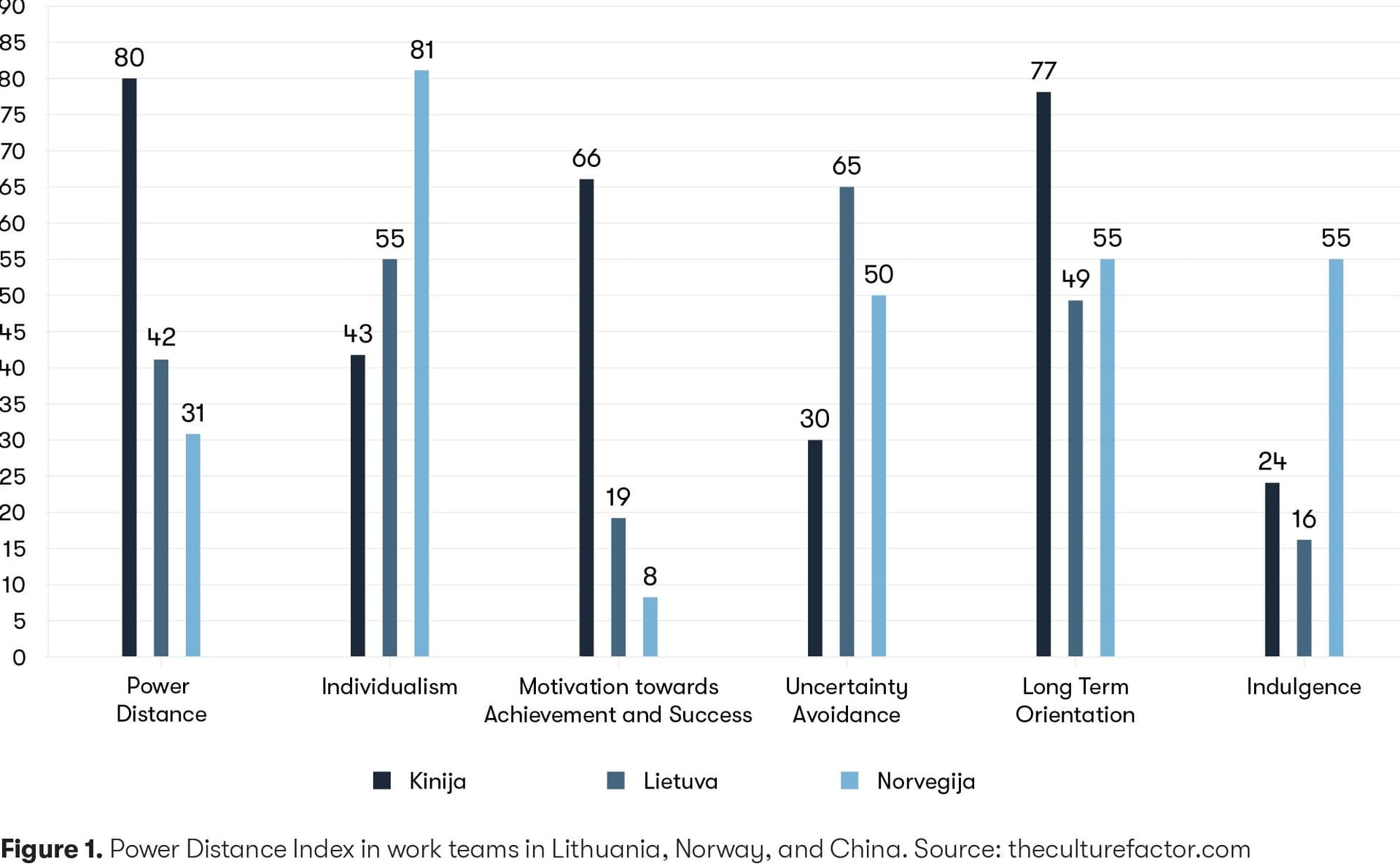
Geert Hofstede, who studied culture and organisations in the 20th century, along with other scholars in the field, developed a convenient tool for comparing countries and regions across six dimensions. When discussing humour at work, the key dimension in this scale is ‘Power Distance’. This dimension helps assess whether humour – and what kind – is acceptable in a typical workplace in a particular country.
‘It is crucial to understand the environment in which you operate. For example, in Scandinavia, the distance between employees and managers is relatively small – you can have friendly banter or joke about your manager, but you should not expect a positive outcome if you do the same in China or Japan. Due to the prevailing culture of restraint, no one may openly reprimand you, but you might receive silent disapproval. However, this does not mean that managers in Scandinavian countries are not respected. I have worked extensively with these countries, and I can say that humour there is thoughtful and good-natured, based on the idea that if we are working together, we are in this together, so we might as well enjoy it. By contrast, in England – particularly in London – the focus is on professionalism and career; if you want to joke, perhaps do it elsewhere,’ said Ašeris.
According to Hofstede’s Power Distance Index, Lithuania scores 42 on this scale, while China stands at 80 (Figure 1). This suggests that Lithuanians tend to prefer horizontal, open, and equality-based workplace relationships, with lower levels of control and supervision and a more independent decision-making process. China, on the other hand, is characterised by stronger subordination; managers are granted significant authority, regarded as figures of power, and communication tends to be formal. ‘Therefore, managers in such contexts must be very aware that the higher the position of power they occupy, the less acceptable joking becomes. This is also reflected in more formal modes of address – using surnames, titles, or other status-indicating forms, rather than first names.’
Of course, the situation is changing not only through comparisons of communication cultures across different countries, but also through work in multicultural teams. ‘I have a personal story – when I was working at a bank, we cooperated with different markets – Denmark, Sweden, Norway, Finland, and India. When I was on a business trip in India, my colleagues immediately warned me and gave me advice on what to avoid, noting that in this country, the manager is seen as an authority and that there is no horizontal communication like in Scandinavian countries. Although I knew this, I still slipped up.
After a working day, we went to a bar in the evening – it looked very European, and I did not feel that I was abroad. We started talking about our free-time activities. I started telling them that I like to grill meat, and I pulled out my phone to show how I cut meat and prepare everything. I noticed strange glances, and one colleague asked what kind of meat it was. When I said it was beef, I realised I had made a faux pas and apologised. Thus, even if you try your hardest, you can still make a mistake. It is imperative to be interested, aware of the context, and prepared, but being able to find the right way out in case of failure is equally important. Are you trying to remedy the situation? Or do you respond by saying that it doesn’t matter to you and that you don’t follow their beliefs?’, Ašeris shared.
Humour reveals the level of organisational culture
According to Ašeris, a country’s humour culture can also be linked to its economic situation. In his view, there is a clear correlation between these factors: the lower a country’s education levels, GDP, and other economic indicators, the more unrestrained humour tends to be. In contrast, in more developed and ‘sophisticated’ countries, humour is typically more thoughtful and refined. How humour manifests itself depends on the specific cultural context: in some countries, humour is almost absent; elsewhere, joking is more cautious, and a respectful, safe feedback culture is nurtured.
In the opinion of the VU Partnership Professor, humour works best in professional settings where a strong feedback culture is cultivated. ‘Humour works when we ask, listen, and truly hear one another. For example, I constantly have various jokes running through my mind, but only one in five deserves to see the light of day. If an inappropriate joke slips out and, after a meeting, a colleague approaches me to say that a boundary was crossed, humour still has a good chance to serve its purpose – because next time I will be more mindful of that particular type of humour. It is essential to read the room: if you joke with your closest colleague in ways that may even stretch organisational norms, you need to think much more carefully before joking in front of a larger audience.’
Ašeris asserts that organisational culture and feedback culture can be assessed by how humour is used at work. ‘There are many layers to this, for instance, if you make an inappropriate joke, does anyone tell you? Is it addressed directly or through a manager? Personally or anonymously? Or is it discussed behind your back? There is a fine line between a culture of bullying and the ability to engage in good-natured banter – to ‘pull one another’s leg’ – in an environment of high psychological safety’.
Ašeris emphasises that for those in managerial positions, the ability to use humour appropriately is an essential skill closely linked to emotional intelligence: ‘There is good chemistry when people laugh together. Various psychological studies show that there are very few recurring factors among high-performing teams. The most common one is psychological safety. This is a factor closely connected to humour, as the two go hand in hand. Although I am speaking specifically about the IT sector, since that is where I work, I believe the situation is similar in other fields as well.’
What can we joke about – and how?
Ašeris underlines that it is not only the content of jokes that matters but also the intention behind them. ‘If we joke to strengthen psychological safety and build trust between colleagues, that intention will be visible. In the earlier example of my interest in grilling, no one was upset by the photos I shared because they understood that my intention was not to offend. However, if I came with the aim of preaching, mocking those who do not eat a certain type of meat, or imposing my own truth by asking: ‘How can you not eat it when it is so delicious?’, the reaction would be different. With humour, we rarely stop to think about the position we are speaking from, and our intentions sometimes reveal themselves unintentionally. That is why we need to work on ourselves, exercise contextual awareness, think consciously, and remain open to feedback. And if we ourselves feel confused or uncomfortable after hearing a joke, it is better to clarify what the person meant by that or to ask what the person was trying to say.’
Although there is no fixed list of topics that can or cannot be joked about, Ašeris suggests approaching humour in a similar way to offering guidance: ‘I never give advice on raising children. It is a very sensitive topic, and it is rare for anyone to have perfect relationships with both their parents and their children. You never know when you might step into sensitive territory. Whether it is humour or not, I would advise against joking about children.’

‘Another topic, influenced by my professional field – mathematics and informatics – makes me think about jokes concerning gender. These fields are still male-dominated; therefore, one must consider the relationship and context. I once heard a comment intended as a compliment: when asked what proportion of students taking a course were women, the answer was only about 10%. The follow-up remark was that, although few, they still ‘decorate’ the course. Such a comment sounds disrespectful and in poor taste, creating an unnecessary association between gender and a professional field. We are working to ensure greater gender balance in areas where, in grades five and six, the numbers of girls and boys in informatics clubs are roughly equal, but by the first year of university, the proportions differ drastically. Therefore, jokes about so-called ‘women’s jobs’ and professions ‘for men’ should only be made with a very clear understanding of why we are making them and what effect they may have.’
By participating in various events, conferences for managers, and lectures for students, Ašeris also tests the boundaries of humour in his presentations, noting that joking about religion – often considered a taboo topic – is no longer perceived as sharply as it once was: ‘When it comes to religion and politics, one must be cautious, but, in my view, religion is gradually becoming less of a sensitive issue. From my experience, people are most offended by jokes about health and least offended by jokes about religion.’

In a small experiment conducted during his presentations to different audiences, Ašeris repeatedly joked about the same topics: health, the LGBTQ+ community, religion, race, and gender. After the presentations, he surveyed participants and found that the audience was most sensitive to jokes about health (Figure 2).