- 19 March 2026
- Vytas Navickas
VILNISH: A New Service for Recognising Yiddish and Hebrew Historical Texts

The Center for the Study of East European Jewish History at the Faculty of History of Vilnius University has launched VILNISH, a new service dedicated to the recognition of handwritten and historical printed texts in Yiddish and Hebrew. The service builds on the Vilne-Yiddish language model developed at Vilnius University by Dr Sergii Gurbych, a researcher at the Center, whose work focuses on archival sources and digital text analysis.
The service relies on machine learning methods specifically adapted to complex historical sources. It is designed to help transform manuscripts and old printed materials into searchable digital text. By converting such materials into machine-readable form, VILNISH opens new possibilities for working with Jewish historical sources and makes them significantly easier to explore and study. It will be especially relevant for those who do not know Yiddish well enough, as the service also includes adaptation and interpretation (translation) of sources into English or Lithuanian in addition to text recognition.
Who Can Benefit from the Service
- Archives and memory institutions
Archives often hold large collections of diaries, personal and business correspondence, synagogue records, and historical manuscripts that have only brief annotations or no detailed descriptions. Text recognition allows institutions to identify document content more precisely and to integrate materials into electronic databases with full-text search, making collections easier to manage, explore, and reuse.
- Researchers and research projects
For scholars working with Jewish history, converting handwritten documents into digital text can significantly reduce the time required to prepare and analyse sources. It also enables new forms of Digital Humanities research based on large corpora of historical texts.
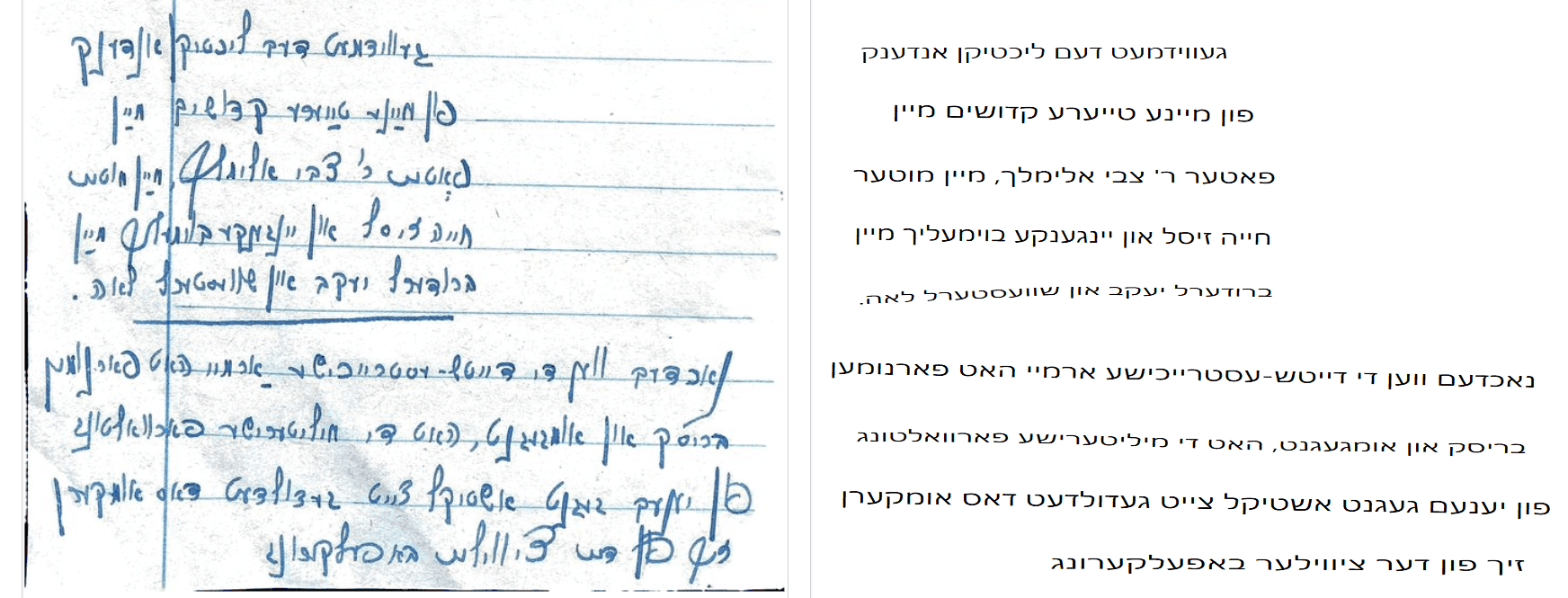
The process and quality of Yiddish text recognition. A fragment of a document from the collection of Judaica Research Centre at Martynas Mažvydas National Library of Lithuania.
- Libraries and special collections
University libraries and specialised collections can use text recognition to create searchable versions of historical materials, facilitating cataloguing, scholarly description, and teaching.
- Private individuals researching family history
For private individuals interested in family history, the service makes it possible to access letters, diaries, and documents written several generations ago in Yiddish or Hebrew. Text recognition, combined with the subsequent adaptation and interpretation (translation) in English and Lithuanian, makes it possible to trace and reconstruct unknown family histories and gain a deeper understanding of personal and cultural heritage.
- Legal and governmental institutions
VILNISH may also help in the work with archival documents when preparing materials to confirm eligibility for repatriation or citizenship, where synagogue records, internal documentation of Jewish communities, correspondence, and other historical documents serve as supporting evidence.
How the Service Works
VILNISH offers recognition of both handwritten and printed historical texts while preserving the original spelling and orthographic features of the sources. When needed, the recognised texts can also be translated into English or Lithuanian.
The service is provided by specialists at the Center for the Study of East European Jewish History at Vilnius University, who work directly with the materials and adapt the processing to the specific characteristics of each collection.
More detailed descriptions of the services are available here:
- Recognition of handwritten and printed text in Yiddish
- Interpretation and adaptation of texts in Yiddish into English or Lithuanian
The VILNISH project reflects the Center’s broader mission to combine humanities research with advanced digital technologies and to strengthen engagement with society. By developing and sharing digital tools for historical research, the Center aims to contribute to international academic collaboration and to support education by making complex sources more accessible to researchers, students, and cultural institutions.
The tools used by the Center are continuously being improved in terms of accuracy, adaptability to different handwriting styles, and processing efficiency. The Center plans to further develop its technological capabilities and expand the range of supported materials and languages.
For information about the VILNISH service and collaboration opportunities, please contact Dr Sergii Gurbych by email.
The project is implemented under the Development Programme for 2022–2030 of the Ministry of Education, Science and Sport of the Republic of Lithuania (Measure No. 12-001-01-02-01 “Strengthening Innovation Ecosystems in Science Centres”) and funded by the Recovery and Resilience Plan New Generation Lithuania (Agreement No. 10-036-T-0005).