- 12 May 2026
- Dr Deividas Zibalas, Faculty of Philology Vilnius University
Vilnius on Screen: How Do Films Create the City’s Image?

The opening scene of the 2018 US action comedy The Spy Who Dumped Me is set in Vilnius. A US secret agent wanders around a market when he suddenly becomes a target for hired assassins. Fleeing his pursuers, he runs into a block of flats and later into one of the apartments. Here, two young people are watching the iconic 1990s US series ALF dubbed into Russian, while a bottle of vodka stands on the table.
The film clearly relies upon the stereotypically negative image of Eastern Europe, using it to create the atmosphere of a sinister, paranoid city, typical of spy films. Such a depiction inevitably raises questions about the image of Vilnius in the West. Is this film an isolated case, or does it reflect a more general tendency of how Vilnius is portrayed in foreign films and series? How does such a portrait of the city shape the imagination of those who have not yet visited the city?
Vilnius – a vast film set
Over the past decade, Vilnius has become an increasingly important hub for international filmmakers. The city has served as a backdrop, at least in part, for a number of big-budget, globally recognised films and TV series – the sign ‘Filming in Progress’ has become almost an everyday sight in the streets of the capital.
The filming of two projects in Vilnius garnered particularly intense media attention: the fourth season of the Netflix series Stranger Things (2022) and the HBO series Chernobyl (2019). In the first, Lukiškės Prison became Kamchatka on screen, while in the second, Fabijoniškės district embodied the city of Pripyat in northern Ukraine. In addition to these major productions, smaller-budget historical and documentary films, as well as a number of Scandinavian thrillers, were filmed in Vilnius.
According to data from the Lithuanian Film Centre website, 111 foreign and 106 joint Lithuanian-international projects were shot in Lithuania between 2014 and 2024. From the comprehensive list of foreign films and series since 2014, 36 films or series were identified as having been filmed in Vilnius – forming the basis of this small-scale study.
The popularity of Vilnius in the film industry is the result of the deliberate and strategic efforts of Lithuania to increase the city’s visibility in the international arena. The Vilnius Film Office, founded on 23 November 2011, played a key role in this process, contributing to shaping the city’s image as an attractive filming location.
The ‘Mayor’s Invitation’ published on the website of the Film Office, later updated by the current mayor, functions as a modern echo of the letters by Grand Duke Gediminas, inviting cinema ‘craftsmen’ to come and create in Vilnius. This invitation highlights the strengths of the city: its compactness and versatility, and especially its wide architectural diversity.
However, economic factors have undoubtedly had the biggest impact on the film industry. In 2014, a film tax incentive came into force in Lithuania. In 2014 and 2018, both Lithuanian and foreign filmmakers could benefit from tax relief of up to 20 per cent of the film’s total production costs, and since 2018, this tax relief has increased to 30 per cent. Given that this incentive was extended until 31 December 2028, it is likely that filming activity in Vilnius will not decrease in the coming years.
Vilnius in cinema: three ‘city scripts’
Films often contribute to the formation of the city’s image and spark tourist interest. Through a camera lens, everyday urban spaces are transformed into sites of storytelling and become attractive to visitors. Researchers Rebekka Rohleder and Martin Kindermann emphasise that films ‘emplot’ our experience of the city – through narrative, they shape our perception of it. As noted above, Vilnius was discovered by foreign filmmakers as a convenient and financially attractive production location. Yet the city itself does not seem to be important to the plots of their films and series. The reviewed list contains only three cases (8 per cent) where Vilnius appears as itself rather than serving to depict other cities. Vilnius plays a significant narrative role in the plot of the previously mentioned US film The Spy Who Dumped Me, as well as in the Norwegian crime series Wisting (2019–present), and the Finnish romantic drama 2 Nights Till Morning (2015).
These three cases can be considered ‘city scripts’, which contribute to the formation of both the imagined and real cityscape. According to the German scholar Andreas Mahler, various cultural representations of the city – whether novels, paintings, films, or TV series – generate narrative frameworks or scripts through which the city is experienced and perceived.
Vilnius, depicted in the cinema, encodes a particular (imagined) experience of the city, which later begins to shape real ways of perceiving and representing the city. As is evident from the very concept of a ‘city script’, established, predictable patterns of urban experience are created. As Prof. Mahler puts it, ‘a meaningful experience [of the city] presupposes a certain scenario-specific experience, […] which gives the city a certain semantic profile.’ City scripts, in this instance films and series set in Vilnius, contribute to the creation of associations about the city by forming its ‘semantic profiles’ – the meanings that come to mind when thinking about that city. Films and series whose action takes place in Vilnius create and consolidate particular meanings, linking specific urban locations with the depicted narratives. Once these scripts are established and take hold, it becomes difficult to change them.
Although the limited number of cases makes it impossible to draw broader conclusions about how Vilnius is imagined through cinema, the three ‘city scripts’ detailed above are worth discussing. In them, Vilnius is highlighted as a threatening location related to the criminal world, yet at the same time – unexpectedly – as a city of love. However, the bleakest portrayal of Vilnius is in the US film The Spy Who Dumped Me, which perpetuates the image of Vilnius as a post-Soviet city.
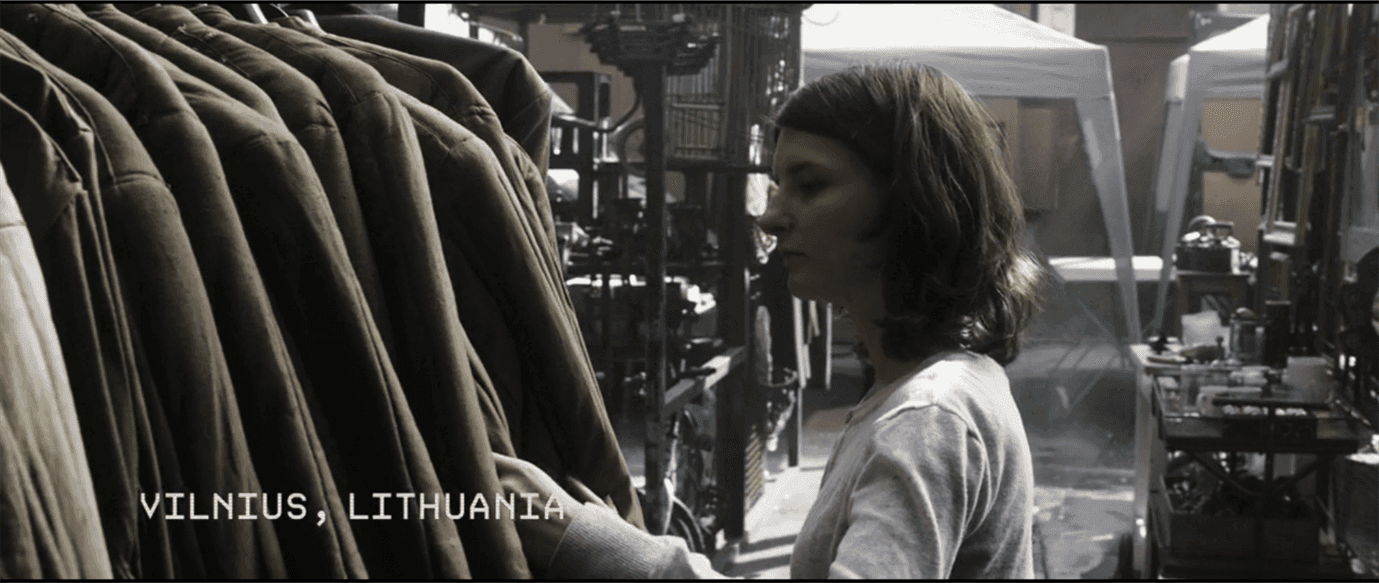
Gloomy market scene set in Vilnius (still from The Spy Who Dumped Me)
It is no coincidence that the opening Vilnius scenes are accompanied by the ballad ‘Wind of Change’ by the German rock band Scorpions – the song was inspired by the band’s 1989 visit to the Soviet Union. Often dubbed the anthem of the end of the Cold War, combined with archival images from the series ALF and images of a gloomy market, the song conveys the impression of a Vilnius and a Lithuania that are seemingly frozen in the 1990s.
A similar narrative is echoed in the Norwegian series Wisting. In Episode 3 of Season 5, the eponymous detective arrives in Vilnius in pursuit of a criminal lead. The city is depicted through the prism of the crime-centred narrative, with locations such as Hotel Narutis and Lukiškės Prison serving as meeting points with suspects, further reinforcing the image of Vilnius as a dangerous city.
Meanwhile, the Finnish film 2 Nights Till Morning presents a contrasting vision of Vilnius, which counterbalances the depressing portrayal of the city in the US film and Norwegian series. The film depicts the unexpected relationship between two foreigners, highlighting the image of Vilnius as a romantic city. A French architect and a Finnish DJ find themselves stranded in Vilnius when their flight is cancelled due to a volcanic eruption in Iceland. The film interweaves panoramic views of the city with romantic music, revealing the beauty of Vilnius and showing that the urban spaces can serve not only as a backdrop for crime narratives but also for love stories.
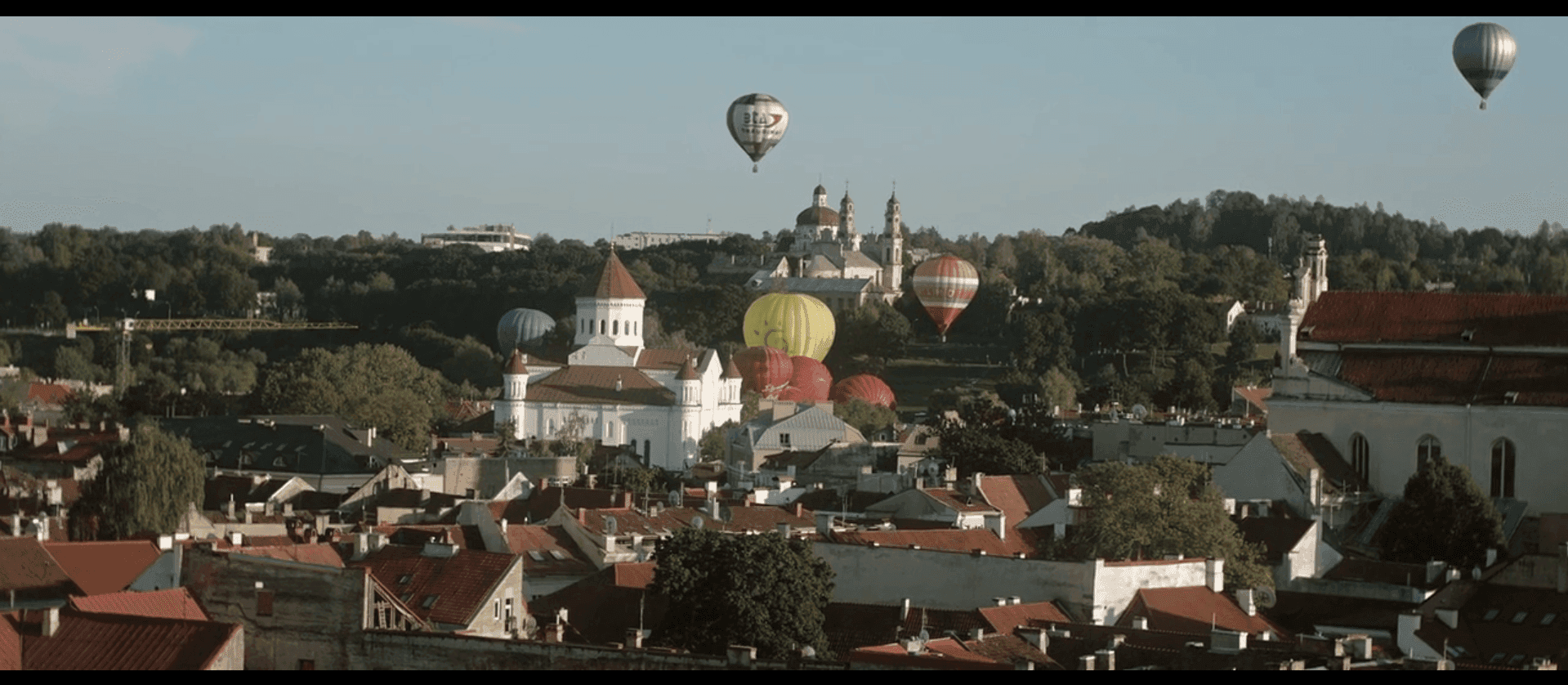
Romantic panorama of Vilnius (still from 2 Nights Till Morning)
In cinema, Vilnius most often becomes Stockholm
In the world of cinema, Vilnius operates as a cinematic chameleon. Owing to its architectural diversity, it can easily stand in for other cities or places. Except for the three cases already discussed, all other films or series filmed in Vilnius by international filmmakers transport viewers to cities in other countries.
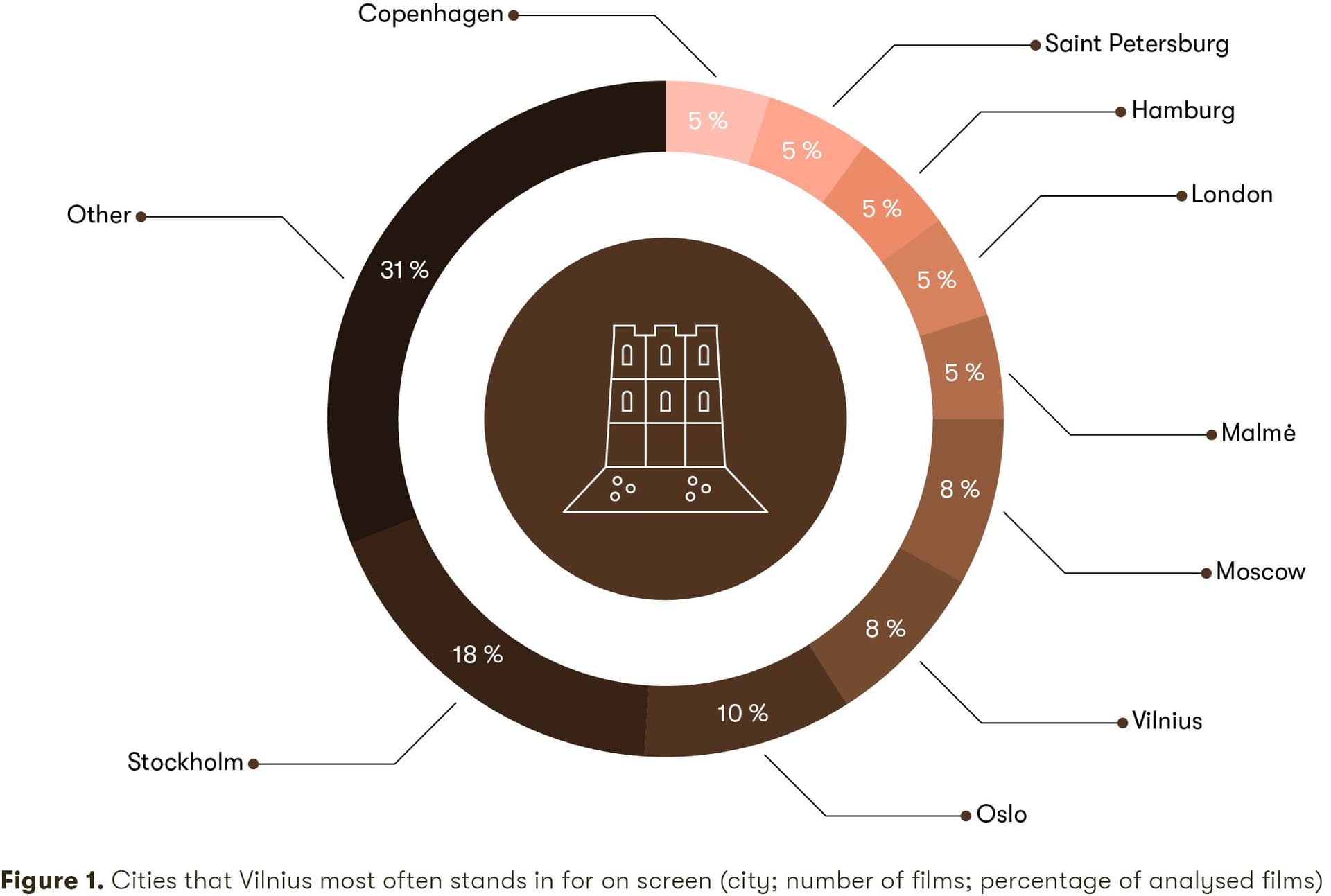
In the analysed material, twenty different cities (or locations) were identified as having been ‘played’ on screen by the Lithuanian capital. Most often, Swedish filmmakers used Vilnius to portray Stockholm (18 per cent), followed by Oslo, which it doubled for in 10 per cent of films or series. Among the more frequent transformations of Vilnius was Moscow, appearing in three productions, while five cities each featured twice: Copenhagen, Malmö, London, Hamburg, and Saint Petersburg. In addition, a further twelve cases involved Vilnius representing other cities, including Berlin, Tokyo, and New York. It is worth noting that in several series Vilnius stands in for more than one city simultaneously – for example, Stockholm and Saint Petersburg in the thriller Max Anger: With One Eye Open (2021).
Perhaps the most interesting metamorphosis of Vilnius occurs in the German science-fiction thriller Paradise (2023). The film transports the viewer to a dystopian Berlin of the near future, where a futuristic cityscape is presented. Recognisable Vilnius locations, such as the Fabijoniškės district, intertwine with both real and imagined buildings in the German capital, for example, the Berlin TV Tower, which is visible in the background.
However, the study reveals that Vilnius is most often transformed into Scandinavian cities. When such individual cases in which the streets of Vilnius appear on screen as Stavanger or as an unnamed town somewhere in Sweden are taken into account, 43 per cent of all foreign films and series filmed in Vilnius transport viewers to Scandinavia. If we add two more cases where the action takes place in Finland, we could say that about half of all films and series filmed in the capital of Lithuania are set in the Nordic countries. For example, in the episodes of the series Whiskey on Rocks (2024), wooden or Scandinavian-style buildings in Žvėrynas, such as the Composers’ House, turn into a residential district in 1990s Stockholm. In this series, Pasažo Skersgatvis turns into a street in Stockholm where a shooting takes place. Meanwhile, in the film We Come in Peace (2024), Konstitucijos Prospektas serves as a Stockholm street during an alien invasion.
International productions filmed in Vilnius showcase not only the city’s exterior spaces, but also the interiors of various buildings. In the already mentioned Whiskey on Rocks, the Lithuanian Cooperative Union building turns into the Swedish Government Chancellery, while in the series Hilma (2021), viewers can recognise the corridors of Vilnius Town Hall. The Lithuanian Library of Medicine, where the series Agent Hamilton (2020–2022) was filmed, also serves as a recurring location. At times, the illusion falters, and minor incongruities are visible: unmistakably Lithuanian signage occasionally appears in scenes set in Stockholm. For example, in one scene of the series Conspiracy of Silence (2018), filmed on Gedimino Prospektas, a stand promoting Kaunas’s Žalgiris basketball club is clearly visible in the background.
Films contribute to the creation of new city maps
As discussed earlier, only in very rare cases does Vilnius remain itself in films and series of filmmakers from abroad. The question arises: if our urban spaces are most often used to depict other cities, does this mean that, in such cases, there is no influence on how Vilnius is imagined? In other words, do such audiovisual stories in films and series create city scripts only for the cities represented on screen, or do they also shape the image of the places where the filming took place?
Such films and series in which Vilnius transforms into other cities act as ‘double’ city scripts. On the one hand, they encode certain (imaginary) urban experiences that can potentially affect the way people imagine the depicted city. It becomes entirely irrelevant that the urban spaces in reality exist not in Stockholm but in Vilnius, since the film or series’ plots and narrative render the depicted city believable, and thus contribute to the creation of the meanings associated with that city.
On the other hand, these films and series undoubtedly influence the way Vilnius is experienced. They contribute to the creation of new city maps. A good example of this is the Go Vilnius booklet ‘Vilnius on Screen’, dedicated to Vilnius as a city of cinema. It presents not only the main films and series filmed in Vilnius, but also city maps showing the filming locations. These places become a point of attraction not necessarily because they have monuments significant to the city, but because filming took place there. Guests and locals are invited to explore the city in a different way. They are given the opportunity to see Vilnius through the prism of a famous film or series, which creates a hybrid experience of the city and the film. According to researcher Richard Koeck, these maps form ‘cinema pockets’ that combine real urban spaces with imaginary ones seen on film screens. Thus, according to Mahler’s definition, these films and series also become city scripts for Vilnius, forming new urban experiences.
Official tours are also contributing to the development of new city maps. Media outlets often report that a particular well-known international film or series is being shot in Vilnius. So even when Vilnius is not immediately recognisable on screen – and is mistaken for Stockholm or Oslo, media coverage highlights the city’s role as a filming location. There are numerous articles inviting residents to try out new city routes; the Vilnius Film Office website invites city guests to explore Vilnius through cinema, offering 21 cinematically themed routes, such as ‘Vilnius in Winter’, ‘Splendid Vilnius’, as well as itineraries for specific series and films. All these tours can be considered city scripts, offering new ways of experiencing the city through specially designed routes. It is interesting that in some ways, a new layer of urban ‘infrastructure’ is also being formed. For example, the owners of one apartment in Fabijoniškės rent it out to visitors eager to fully immerse themselves in the atmosphere of the series Chernobyl.