- 13 May 2026
- Povilas Sabaliauskas
What Can Science Fiction Teach Us?

Science fiction is a genre that leaves few people indifferent. Some can’t take it seriously, while others can’t imagine their lives without it. Unsurprisingly, there are a lot of scientists among sci-fi fans. According to Dr Augustas Vaitkevičius, a researcher at Vilnius University’s (VU) Faculty of Physics, this is no coincidence. It’s almost bound to happen with a genre that encourages people to dream, to explore, and to test out even the strangest ideas. Above all, science fiction inspires us not to be afraid of imagining a different, better future.
A priceless community of fans
Like many others of his generation, Dr Vaitkevičius’s love for science fiction began thanks to the legendary Lithuanian sci-fi publishing house “Eridanas”, which released “The Golden Treasury of World Science Fiction”, a series of nearly 500 books.
“A few shelves at school were dedicated to these books. I saw them, got curious, and started reading. Somehow, I felt that since I was a bit of a nerd, these were the books I was meant to read. So I started devouring them. I’m not sure if I read every single one, but I definitely got through most of them. Later, books from other publishers came along, and books in foreign languages too,” he recalls.
Even more importantly, his love of science fiction drew him into the “Tolkien Lietuva” club – a group dedicated to the work of J. R. R. Tolkien, the famous author of “The Lord of the Rings.”
“This community has had a huge impact on me, both personally and as a scientist. There are many academics there, and they offer a kind of support I probably wouldn’t have found anywhere else. Being part of that group, you get to talk with historians, physicists, mathematicians, sociolinguists, and so on. Those discussions and problem-solving sessions were an enormous help to me throughout my life, especially during my doctoral studies,” he says.
The freedom to imagine
Sceptics tend to associate sci-fi with useless daydreaming. What’s the point of fantasising about utopian civilisations or technologies that don’t exist? The VU physicist has a simple answer: science fiction sparks creativity because these stories tend to wrestle with big unknowns and difficult questions.
“At the end of the day, science fiction is really about people. It doesn’t matter that the characters are duelling with lightsabers; what matters is what they’re fighting for. Those fantastical elements loosen the bolts in our brains, so to speak, and let us think about the problems humanity faces differently. Giving yourself permission to imagine is incredibly useful in science, too,” he says.
Science fiction has even pushed Dr Vaitkevičius into a few scientific adventures of his own. For instance, he currently co-teaches a course on Colonization of the solar system with his colleague, Assoc. Prof. Kastytis Zubovas, walking students through what it would actually take.
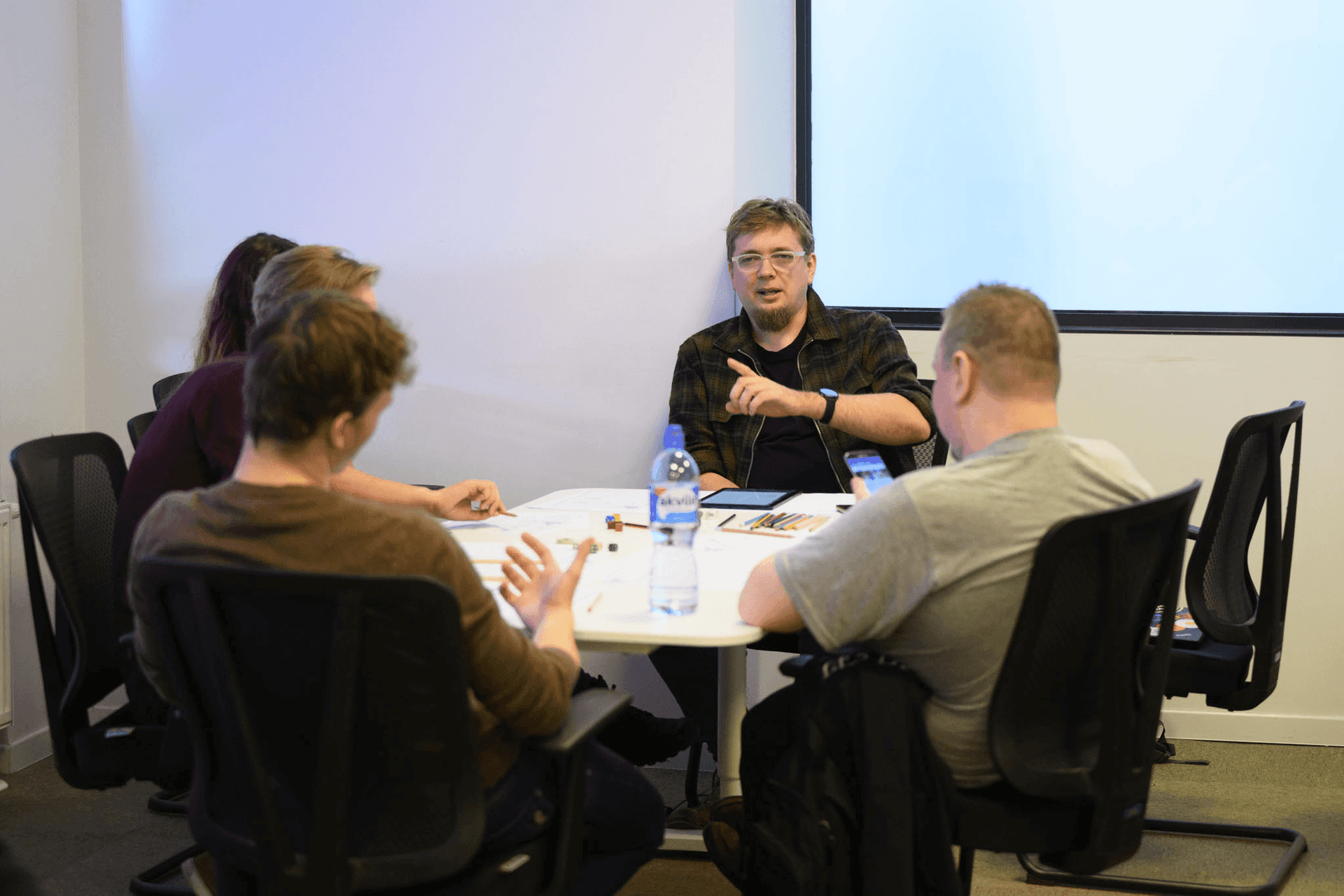
Dr Augustas Vaitkevičius. Photo by Nail Garejev.
“Together we’re learning to separate what politicians and businesspeople say from what’s really being done. It’s a very rewarding experience. While preparing for lectures, I learned that there’s such a thing as a Mars simulator, where people get used to the environmental conditions and to being in a small space with others. It turns out the closest one is in Gdańsk, Poland. Examples like that really show how close science fiction actually is to reality,” the scientist says.
A vision of a better future
The science fiction genre was popularised above all by the legendary series “Star Trek”. Both the original and its 1990s sequel, “Star Trek: The Next Generation,” stood out for their attention to detail and, just as much, for their optimistic vision of the future. There’s no unemployment, poverty, or racism here. People devote themselves to exploring the universe and working through ethical questions. Today’s science fiction looks a bit different. It leans much more dystopian.
“We’re living in pretty cynical times. Even scientists and their accomplishments are often seen as tools politicians use to boast. But that’s not the whole truth. CERN is a great example that really inspires me. It’s a place built for solving the impossible. The smartest people in the world go there to do things that shouldn’t be doable. Some of those problems never get solved, but along the way we end up with things like the internet, the touchscreen, and advanced algorithms,” he explains.
In his view, science fiction tracks social trends. After all, it’s written by people, and people mostly write about themselves. He notes that society’s mood has turned fairly pessimistic and gloomy. Yet science still leaves room to imagine how things could be better.
“There’s a whole spectrum of ‘punk’ genres about rebelling against the system. Now there’s a new one called ‘solarpunk.’ It’s about optimistic rebellion, ecology, and adapting to your environment. In other words, it’s a revolt against today’s pessimism. The future really can be good. The consequences of technology can be far more than just negative. We just have to let ourselves imagine that things could be different,” Dr Vaitkevičius says.