- 9 July 2026
Hidden for More Than Two Centuries: One of the Baltic Region's Largest Baroque Painting Programmes Re-emerges
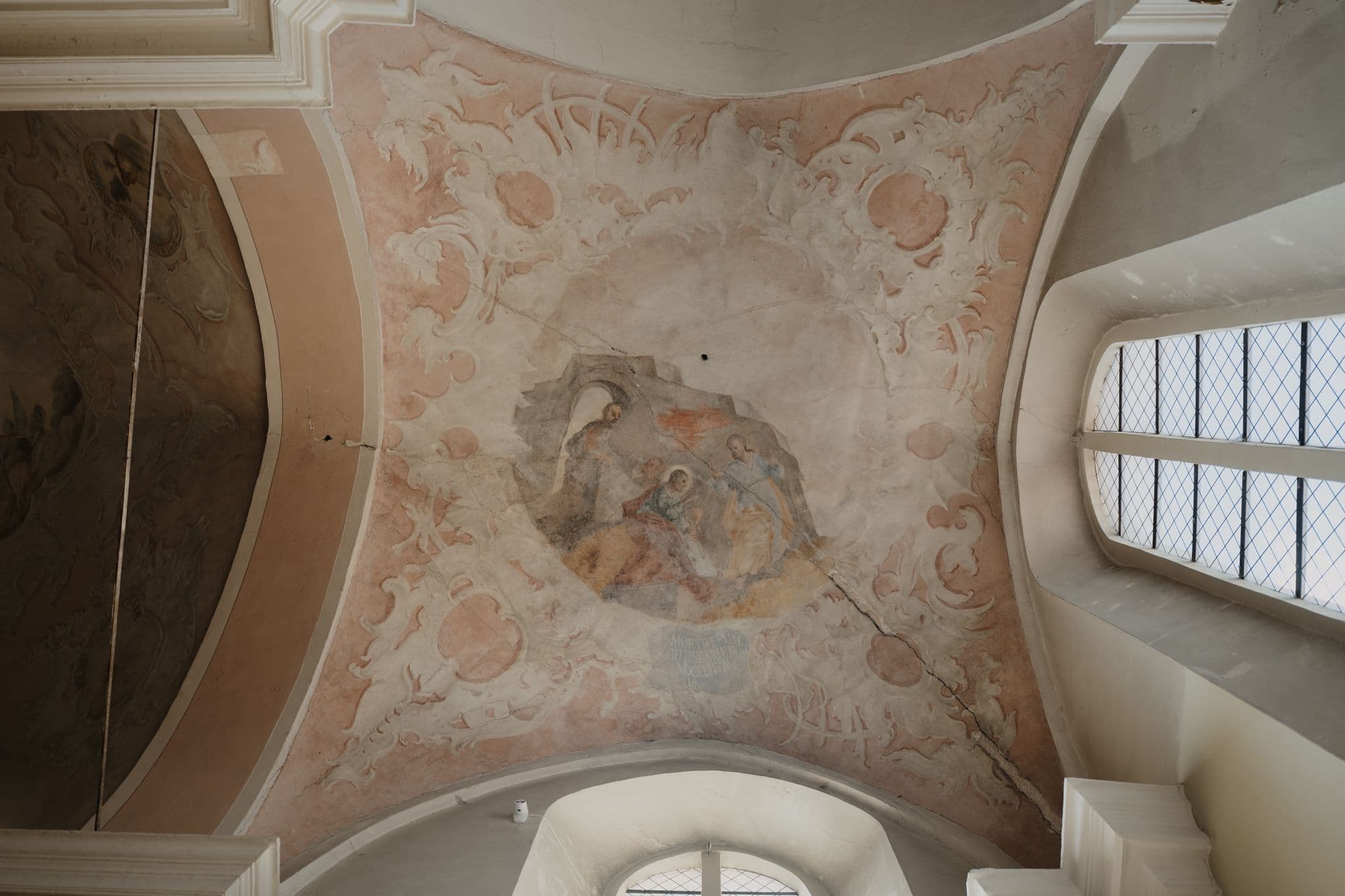
Hidden beneath layers of paint for more than two centuries, one of the largest surviving Baroque wall painting programmes in the Baltic region has re-emerged inside Vilnius University's St John's Church. A comprehensive investigation has revealed that more than 2,000 square metres of authentic eighteenth-century murals survive beneath nineteenth-century overpainting, offering rare new insight into the scale, artistic ambition and authenticity of Baroque painting in the Baltic region.
Unlike many Baroque church interiors across Europe, where repeated restoration campaigns have altered the original decoration, the paintings in St John's Church were largely covered rather than repainted. As a result, the investigation revealed an exceptional amount of original eighteenth-century material, allowing conservators to study the decoration largely as it was conceived almost three centuries ago.
"This discovery significantly advances our understanding of Baroque painting in Vilnius and sheds new light on the Baroque artistic heritage of the Baltic region. Much remains to be discovered within St John's Church, and these findings demonstrate how much there is still to learn about one of the region's most remarkable Baroque monuments. As Vilnius University approaches its 450th anniversary, the discovery also highlights the enduring importance of St John's Church to the University's history and identity," says Professor Rimvydas Petrauskas, Rector of Vilnius University.
What Survived Beneath the Paint?
Although specialists have known about the existence of the eighteenth-century vault paintings for decades, no one had ever established how much of the original decorative programme had survived. During the second half of the twentieth century, Lithuanian art historian Vladas Drėma documented and restored several scenes above the organ gallery and in the presbytery, but these isolated discoveries offered only a glimpse of what once covered the church's vast vaults.
"After almost fifty years, we finally had the opportunity to return to this monument and examine it systematically. Earlier studies focused on individual fragments, but no comprehensive investigation of all the vaults had ever been carried out. As a result, we simply did not know how much of the original painting had survived," says Indrė Valkiūnienė, who led the research.
The investigation, carried out in early 2026, set out to answer precisely that question. Over two months, the conservation team examined seventeen vaults and carried out 352 exploratory probes. For the first time, every nave of the church was assessed systematically. The research confirmed that authentic eighteenth-century painted layers survive in every vault examined. It also revealed how the compositions were organised, assessed their condition and generated the evidence needed to prepare a future conservation and restoration programme.
The need for such comprehensive research stems from the history of the church itself. Following the devastating fires of 1737 and 1749, St John's Church was transformed under the direction of Johann Christoph Glaubitz, one of the leading architects of Central and Eastern European Baroque. The new study refines previous assumptions, showing that the decorative programme originally consisted of twenty-one figurative compositions illustrating scenes from the lives of St John the Baptist and St John the Evangelist.
At the beginning of the nineteenth century, during the reconstruction led by architect Karol Podczaszyński, the paintings were covered over as part of a broader remodelling of the church's interior. Although their existence was never completely forgotten, and several fragments remained known to specialists, for more than two centuries the vast majority of the ensemble could only be inferred from scattered fragments. The new investigation is the first to examine the vault paintings as a coherent artistic programme rather than as a collection of isolated discoveries.
An Unexpected Level of Authenticity
For the conservators, the most remarkable finding was not that the paintings existed – specialists had long suspected they did – but the extraordinary degree to which they had survived. Despite being concealed beneath between three and twelve later paint layers, the eighteenth-century figurative compositions remained largely intact.
"The interiors of many historic churches have been repeatedly repaired, refurbished, repainted and adapted to changing tastes over the centuries. Conservators are therefore often faced with the difficult task of distinguishing the original work from later interventions," says Indrė Valkiūnienė.
In St John's Church, however, the researchers found virtually no evidence of significant repainting. Apart from traces of nineteenth- and twentieth-century repairs, the original paintings had survived remarkably intact beneath the later layers.
"In many historic churches we encounter paintings that have been repeatedly restored or altered over time. Here we found something quite different. The paintings had simply been covered over. They had not been professionally repainted or fundamentally changed. That means an exceptionally large amount of authentic eighteenth-century material has survived," Valkiūnienė explains.
For the conservators, that authenticity is the discovery's greatest value. Rather than reconstructing an idealised eighteenth-century interior, the research focused on identifying and understanding what has genuinely survived. The study also revealed that every vault was painted individually. Although artists used similar pigments throughout the church, each composition has its own colour palette and subtle tonal variations, making the preservation of the original material all the more important.
Wall painting conservator Aidonas Valkiūnas believes this exceptional state of preservation makes St John's Church exceptional among surviving Baroque church interiors in the Baltic region: "When we assess cultural heritage, we look not only at artistic quality but also at how much of the original material has survived. Here we are dealing with an exceptionally high degree of preservation. It means we can study eighteenth-century painting directly rather than through the layers left behind by later restorations."
Reconstructing a Baroque Masterpiece
"When people hear about this research, they often imagine one or two newly discovered paintings. In reality, we are talking about an entire system – a unified programme of vault paintings that extends throughout the church," says Valkiūnas.
Covering more than 2,000 square metres, the paintings formed one of the largest surviving Baroque decorative programmes in the Baltic region. For the first time, researchers have been able to understand them as a single artistic and iconographic vision rather than a series of isolated fragments. The investigation showed that each vault follows the same compositional principle: central figurative scenes were painted al fresco, while Rococo ornamental frames and decorative motifs were executed al secco. Although each vault forms an individual composition, together they create a coherent decorative programme.
The research also provides new clues to that programme's iconography. Changes in the direction of the compositions suggest that one side of the church depicted the life of St John the Baptist, while the other depicted St John the Evangelist. One important clue is the inscription IOANNES EST NOMEN EIUS ("His name is John"), which researchers associate with the birth of St John the Baptist.
Although much remains hidden beneath later paint layers, the study has fundamentally changed scholars' understanding of one of the Baltic region's largest surviving Baroque decorative programmes. Rather than a collection of isolated discoveries, St John's Church can now be recognised as a remarkably well-preserved artistic vision that has survived for more than two centuries beneath layers of paint.
The comprehensive investigation was led by wall painting conservator Indrė Valkiūnienė and carried out together with wall painting conservator Aidonas Valkiūnas, conservators Jana Grinevičiūtė-Pčalienė, Gabija Markevičiūtė, and Kateryna Nikolajenko. Over two months, the team carried out 352 exploratory probes across seventeen vaults, producing the first comprehensive assessment of the church's eighteenth-century polychromy.