- 31 March 2026
- Aušra Kudirkaitė
Inspired by Quantum Technologies, Researchers at Vilnius University Have Developed a Highly Sensitive Spectroscopic Device
Scientists from Vilnius University’s (VU) Faculty of Physics, drawing on tools used in quantum technologies, have collaborated with an international team to develop a promising new spectroscopic device – a superconducting microwave microresonator. The innovative study has been published in the prestigious journal “Small Methods”. This achievement expands the range of applications of microresonators and paves the way for studying trace amounts of a wide variety of materials.
VU doctoral student Gediminas Usevičius explains that this extremely small device, only about half a millimetre in size, will be useful in biochemistry and other fields that use electron paramagnetic resonance (EPR) spectroscopy and develop experimental EPR methods. “The microresonator we have developed can measure a sample a million times faster than conventional equipment. With this device, we can perform experiments in a few seconds that would otherwise take years, or that were not possible at all until now. We are pleased to contribute to a deeper understanding of material structure by helping to reveal what happens at the microscopic level,” he says.
Professor Mantas Šimėnas from the VU Faculty of Physics notes that, although this research is not directly focused on medicine, its results may still be useful in the medical field. “Proteins are the basis of all life and are often associated with various diseases. The resonators we have developed are unlikely to be used directly for disease diagnosis. Still, they can certainly contribute to the study of protein structures, the analysis of various substances and the investigation of chemical compounds,” he says.

The back cover features a conceptual depiction of EPR spectroscopy using a superconducting microwave microresonator.
According to scientists from the Institute of Applied Electrodynamics and Telecommunications at VU Faculty of Physics, superconducting microresonators are advanced devices that significantly enhance the interaction of microwaves with electron spins, which behave like quantum bits, or qubits. Microresonators made from superconductors are closely related to the broader concept of superconducting quantum circuits, which is strongly linked to this year’s Nobel Prize in Physics. Superconducting qubits and microresonators are also used in quantum computers being developed by major technology companies such as “Google”, “IBM”, “Amazon” and others.
“Such microresonators can ‘couple’ to particle spins – a quantum property of particles present in many materials. This ability of the microresonators increases the sensitivity and efficiency of the EPR experiments,” explains G. Usevičius, noting that EPR spectroscopy measures the behaviour of unpaired electron spins in various materials. The microresonators developed at VU Faculty of Physics are made from YBCO, a high-temperature superconductor. This allows experiments to be carried out at liquid-nitrogen temperatures (up to about 80 Kelvin, or 196 degrees Celsius), making these microresonators relatively inexpensive to use compared with standard superconducting microresonators, which typically operate at much lower liquid-helium temperatures.
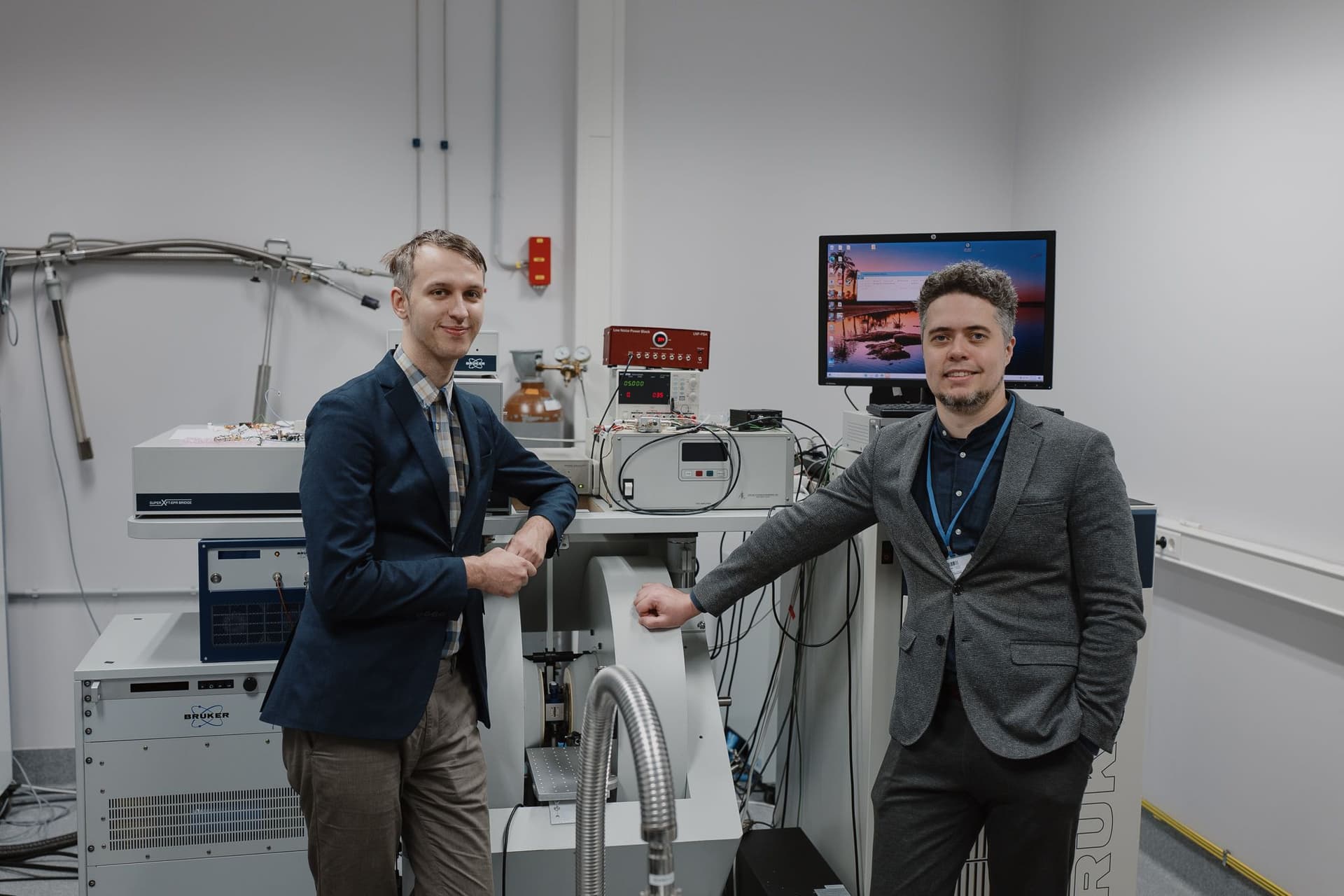
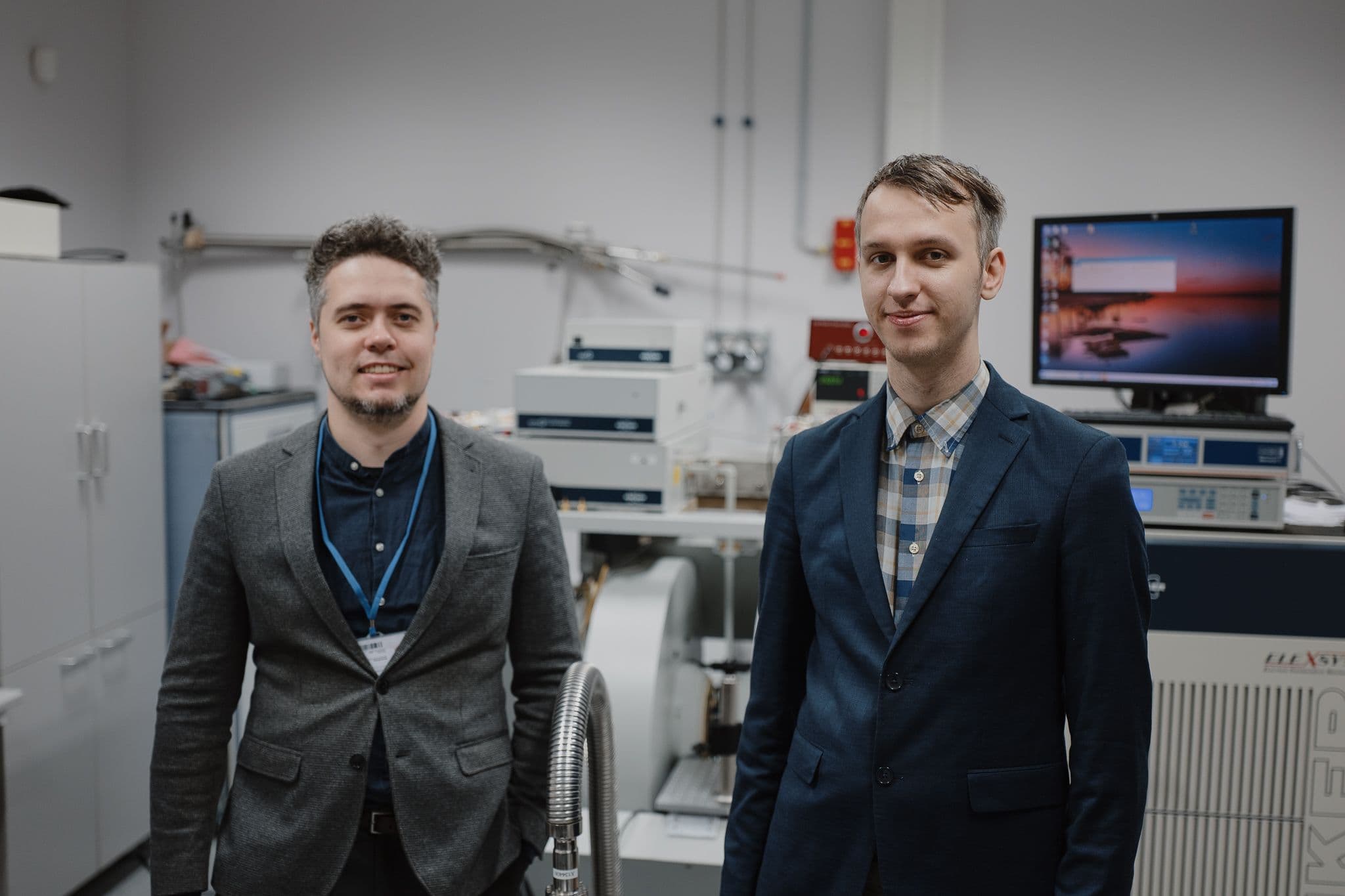
Prof. Mantas Šimėnas and doctoral student Gediminas Usevičius. Photo by Vilnius University.
In conventional spectroscopy, a material is illuminated with light, and researchers observe what fraction of the radiation is absorbed at different frequencies, which provides information about the material’s structure and composition. EPR spectroscopy differs from traditional spectroscopy in that it uses microwave radiation. “EPR spectroscopy operates in the microwave, or gigahertz, frequency range, which is also used by devices such as Wi-Fi routers and microwave ovens. The microresonators we have developed are specifically designed for microwave resonance, which is what makes EPR experiments possible,” explains Prof. Mantas Šimėnas.
The research was carried out jointly with scientists from the prestigious University College London and Imperial College London. Researchers from the Center for Physical Sciences and Technology also contributed to the fabrication of the microresonators.
The research was partially funded by the European Research Council through the project Strongly Enhanced Sensitivity EPR through Bimodal Resonators and Quantum Limited Amplifiers (ERC, Strong-ESPRESSO, 101162021).