- 19 May 2026
- PhD student Goda Norvaišytė, Faculty of Law Vilnius University
Parole from Prison: Not Clemency but an Important Integration Process

A well-functioning parole procedure (‘conditional release’ in European legal terminology) is not just a technical matter in the execution of sentences. It reveals how much the State trusts a person’s ability to change, how it understands the meaning of punishment, and what place the penitentiary system assigns to resocialisation. Parole allows sentenced persons to return to society prior to the completion of their custodial sentence, while ensuring their consistent integration through supervision and assistance. It is no coincidence that international recommendations have identified this measure as one of the most effective tools for reducing reoffending and strengthening public security.
However, in Lithuania, parole, despite its recognised significance, is still granted relatively infrequently. In the international context, this highlights a systemic problem that raises questions not only about the effectiveness of the execution of sentences, but also about the institutional confidence in the ability of sentenced persons to change their behaviour. What leads to such a situation – gaps in legislation, inconsistent practice, or the inertia of the system itself?
The role of parole in reducing repeat crimes
The Recommendation of the Committee of Ministers of the Council of Europe of 24 September 2003 on Conditional Release (Parole) (Rec (2003) 22) defines parole as the conditional release of sentenced prisoners under individualised post-release conditions. In other words, parole refers to the release of a sentenced person from prison before the end of the term of the imposed custodial sentence, subject to specified behavioural restrictions. Conditional release is a key mechanism for the structured social reintegration of sentenced persons, ensuring their smooth return to society. During this transition period, persons on parole are provided with timely supervision, support, and intervention measures to manage the risk factors that led to criminal behaviour.
The rationale for granting conditional release is grounded in the fundamental principle that imprisonment can be harmful; therefore, the State should provide clear, uniform conditions for the granting of conditional release to all prisoners. The Recommendation underlines that the criteria for conditional release should be clear, realistic, and explicit. All prisoners who are deemed ready to respect the law and integrate into society should be released on parole. Although the Recommendation does not contain details, its principles clearly convey the essence of conditional release – an approach that must be reflected in the practice of each state.
The problem of unclear parole criteria
One of the most significant changes to the parole framework in Lithuania occurred in 2012, when the Republic of Lithuania Law on Probation was adopted, and Parole Commissions were established. These changes were intended to update the procedure for conditional release, but they proved ineffective and did not result in the growth of the number of individuals placed on parole. The new mechanism for parole and the reformulation of the conditions for granting it should have led to greater consideration of the needs of sentenced persons and to an assessment of risk factors.
Even though the reform of the penitentiary system raised high expectations, the researchers who investigated conditional release in Lithuania at that time (Ilona Michailovič, Gintautas Sakalauskas, and Andželika Vosyliutė) noticed that after the entry into force of the Law on Probation and the amendments to the Code of the Enforcement of Punishments, parole was granted less often. The courts have granted conditional release to only about half of those sentenced persons whose applications for parole were approved by the established Parole Commissions. Subsequently, these indicators continued to decline (Figure 1).
Since 1 July 2020, Lithuania has operated a mixed model of conditional release, introducing the possibility of automatic parole for persons who have served at least three-quarters of their custodial sentence. Under this mixed parole system, most sentenced persons may be released on parole automatically, except those whose partially suspended sentence was revoked, whose previous parole has already been revoked, or whose assessed risk of reoffending is high and who have made no progress in reducing their criminal behaviour. Automatic conditional release is also not currently granted to persons convicted of very serious offences or those serving a sentence for certain serious crimes provided for in the Criminal Code. Persons granted automatic parole are subject to intensive supervision. The mixed parole model – where most individuals are released after an assessment of formal and substantive conditions, while others who meet specified criteria are released automatically – led to a significant increase in the number of persons granted parole in 2020–2024 (Figure 2).
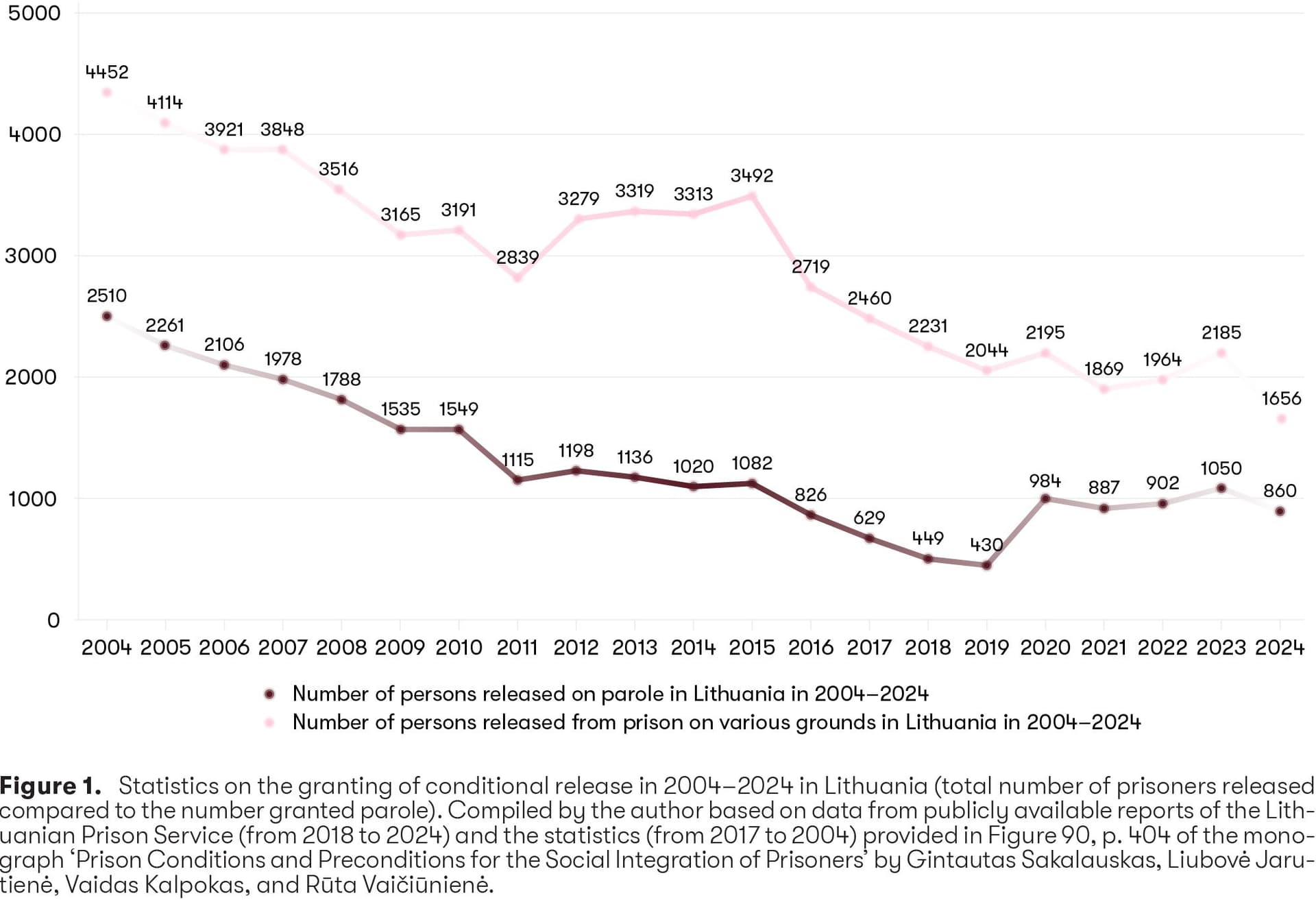
Figure 1. Statistics on the granting of conditional release in 2004–2024 in Lithuania (total number of prisoners released compared to the number granted parole). Compiled by the author based on data from publicly available reports of the Lithuanian Prison Service (from 2018 to 2024) and the statistics (from 2017 to 2004) provided in Figure 90, p. 404 of the monograph ‘Prison Conditions and Preconditions for the Social Integration of Prisoners’ by Gintautas Sakalauskas, Liubovė Jarutienė, Vaidas Kalpokas, and Rūta Vaičiūnienė.
Currently, the substantive conditions for parole, in accordance with Article 82(1) of the Code of the Enforcement of Punishments, concern the low assessed risk of reoffending by the sentenced person or demonstrable progress in reducing that risk; the formal conditions relate to the completion of a specified proportion of the imposed custodial sentence.
However, an identified low risk of reoffending cannot be considered as an independent ground for parole. Therefore, the progress of the sentenced person is constantly evaluated, although its content is not defined in Lithuanian legislation. In determining an individual's progress, the courts take into account disciplinary penalties received, participation in specific programmes, and compliance with established procedures. However, even these criteria are not assessed consistently – comparable factual circumstances can be treated differently across cases.
Lithuanian legislation on the execution of sentences lacks a clear definition of the content of substantive conditions. The inconsistency of the practice not only hinders the effective application of the conditional release framework but also reduces the motivation of the sentenced persons themselves – they do not know what conditions must be met, which often leads to overly cautious assessments and an overestimation of their risk of reoffending.
In one of his studies, Joel Caplan pointed out that one of the principal shortcomings of the modern parole system is the unclear criteria for defining success. As true success is undefined, almost unattainable perfection is sought. Frieder Dünkel likewise emphasised this issue, arguing that the legislation should define the criteria for progress in detail.
The role of the Commission and the courts in the parole process
Although the use of parole has increased in recent years, one of the main problems with granting it is the interaction between the work of the Parole Commission and the courts. The Commissions confirmed conditional release in 23–27 per cent of the cases examined between 2021 and 2024. However, the final number of persons released on parole remains significantly lower as a result of court rulings denying conditional release.
During the stage of judicial approval, when the sentenced person’s reoffending risk and the progress achieved in reducing it are assessed, individuals often become caught in a vortex of competing judicial interpretations. In other words, the analysis conducted indicates that the growth in the granting of parole since 2021 is primarily attributable to the introduction in 2020 of automatic parole for certain groups of sentenced persons.
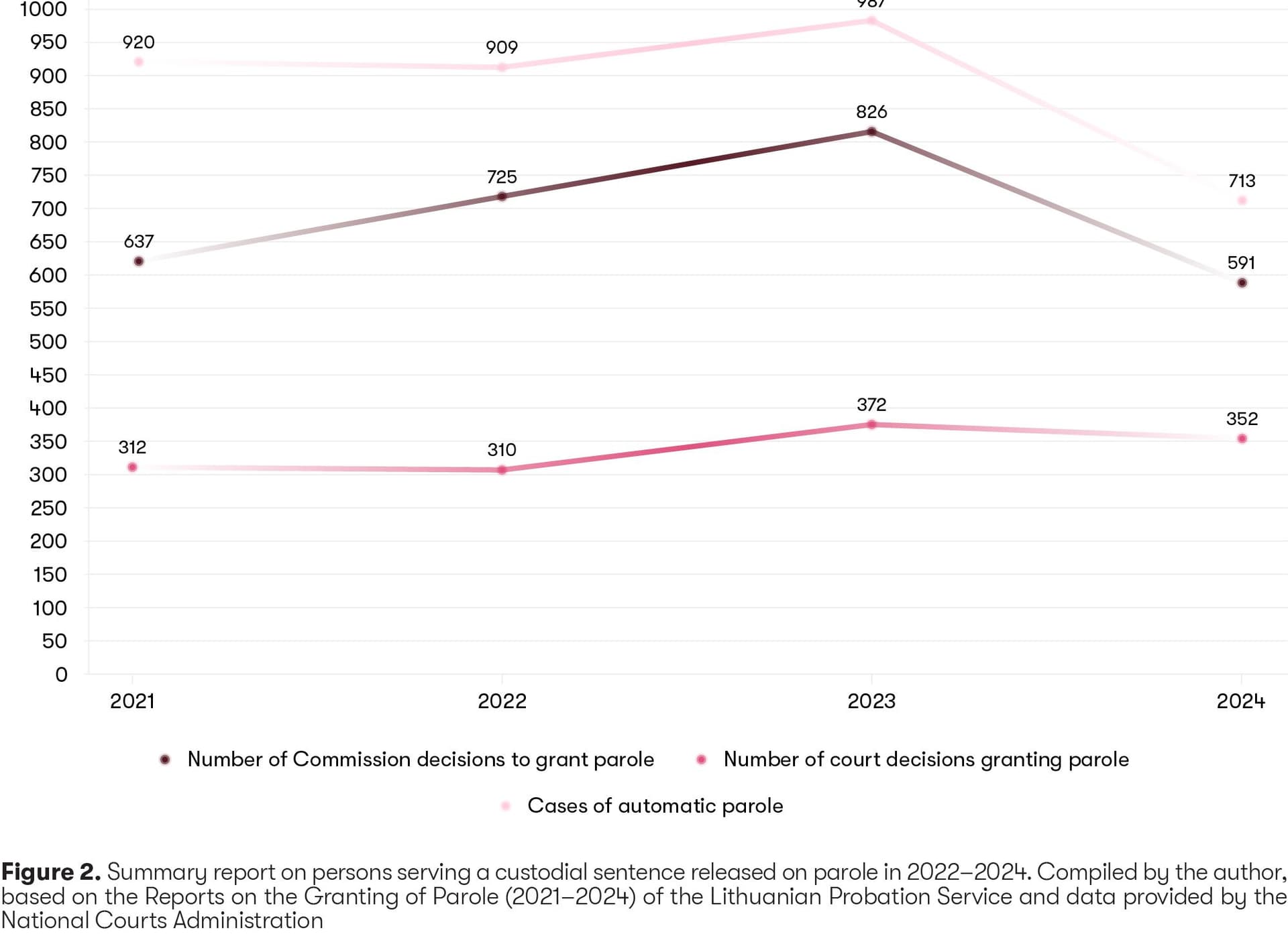
Figure 2. Summary report on persons serving a custodial sentence released on parole in 2022–2024. Compiled by the author, based on the Reports on the Granting of Parole (2021–2024) of the Lithuanian Probation Service and data provided by the National Courts Administration
Parole is based on mutual responsibility
The Law on Probation provides for an extensive supervision and assistance package for people who are released on parole. This support framework includes both formal control and comprehensive assistance aimed at addressing the sentenced person’s personal challenges and strengthening their ability to lead a law-abiding life. These measures include individual and group work, the development of social skills, the promotion of constructive means of employment, as well as therapeutic, psychological, and psychotherapeutic services.
Officers coordinating parole are not limited to supervision; they consult, mediate to secure accommodation, refer individuals to social service providers and addiction treatment facilities, assist with employment, initiate meetings with potential employers, encourage the sentenced person to acquire an education, and motivate them to participate in behavioural correction programmes. In this way, parole serves not only to mitigate the severity of punishment but also to facilitate active integration.
In addition, Article 19(8) of the Law on Probation establishes the elements of the progressive restorative justice principle in criminal justice, seeking to promote dialogue between the probationer and the victim and to provide reparation for harm caused by the criminal offence. At the same time, parolees make a clear commitment to assume clearly defined obligations: to be in a designated place at a specified time, to participate in behavioural correction programmes, to continue ongoing addiction treatment, to abstain from using psychoactive substances, to adhere to established prohibitions, and to avoid contact with specified individuals or groups. Parole is therefore grounded in both trust and mutual responsibility.
High rates of successful probation in Lithuania
Probation is deemed to have been successful when the sentenced person fulfils the measures and duties assigned to them, and conditional release is not revoked. In such a case, the person is considered to have served the sentence and is removed from the probation register.
Practice shows that cases of probation revocation, in which the sentenced person is returned to prison to serve the remainder of the custodial sentence, are primarily attributable to failure to comply with the conditions of probation rather than to reoffending. This indicates that the success of probation largely depends on effective engagement between the sentenced person and probation officers, as well as on the individual’s ability to comply with established rules and to cooperate with supervising authorities (Figure 3).
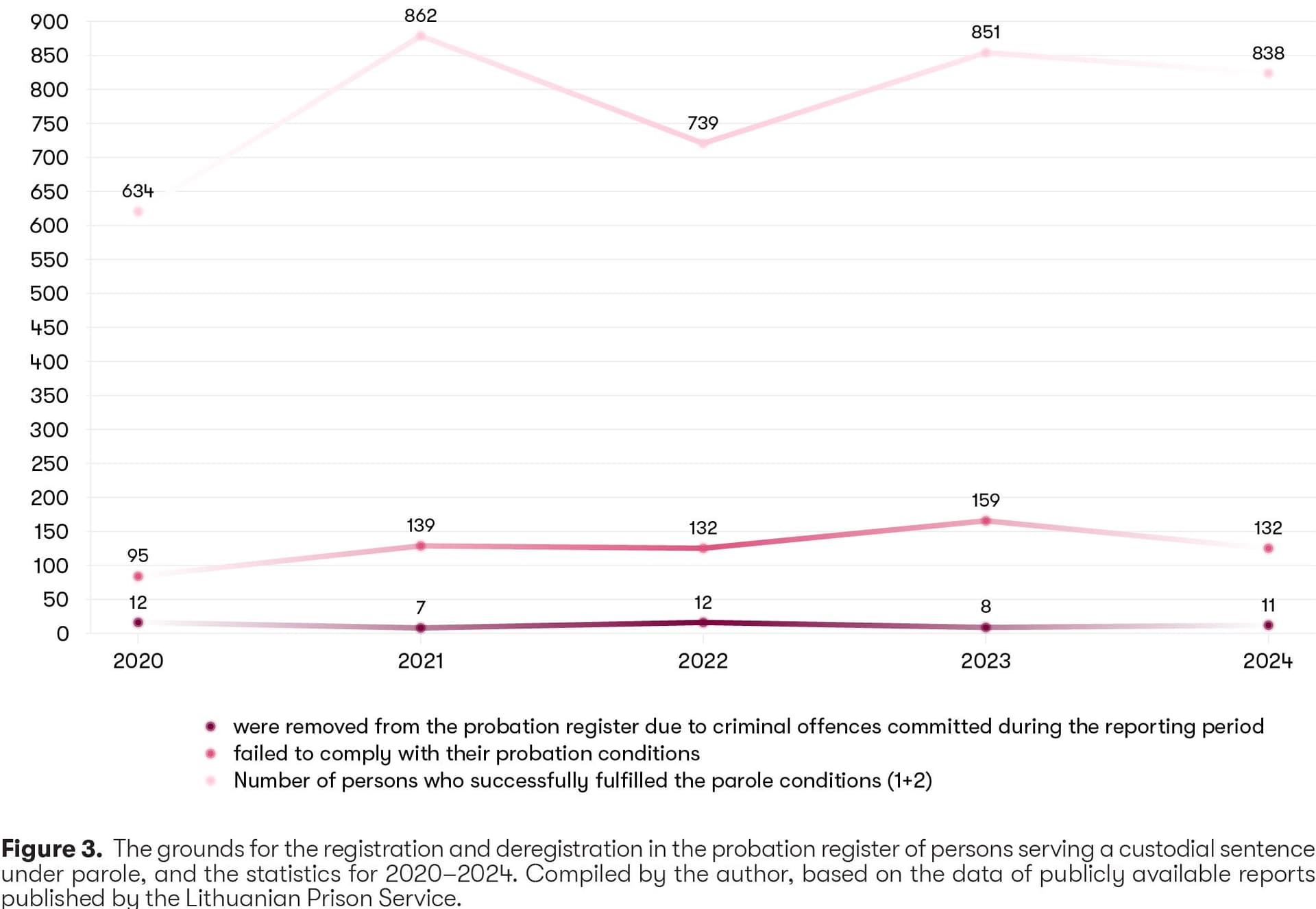
Figure 3. The grounds for the registration and deregistration in the probation register of persons serving a custodial sentence under parole, and the statistics for 2020–2024. Compiled by the author, based on the data of publicly available reports published by the Lithuanian Prison Service.
A more detailed analysis of the parole statistics reflecting the results of the social integration of sentenced persons supports a conclusion contrary to prevailing public perceptions. The vast majority of parolees successfully comply with the probation conditions imposed on them. During the reference period of 2020–2024, the proportion of these persons ranged from 68 to 81 per cent, indicating a clear positive trend.
Accordingly, this data reveals that relapsing into crime during parole is extremely rare. Throughout 2020, the number of persons who committed new criminal offences during parole was 12 (0.65 per cent), compared to 7 (0.36 per cent) in 2021, 12 (0.65 per cent) in 2022, 8 (0.39 per cent) in 2023, and 11 (0.59 per cent) in 2024. These figures negate the assumption that parole, in itself, increases the risk of recidivism.
The statistical analysis of the registration and deregistration of persons serving sentences under conditional release has revealed that the primary structural weakness in the operation of the parole framework lies not in repeated criminal behaviour but in non-compliance with probation conditions. It is precisely violations of probation conditions that result in the increase in the number of persons removed from the probation register, creating the impression that parolees frequently reoffend; the empirical evidence, however, does not support this perception.