- 7 April 2026
- Ingrida Tomaševskienė
The Prof. Virginijus Šikšnys Scholarship Awarded to a PhD Student Driving a Breakthrough in Molecular Biology
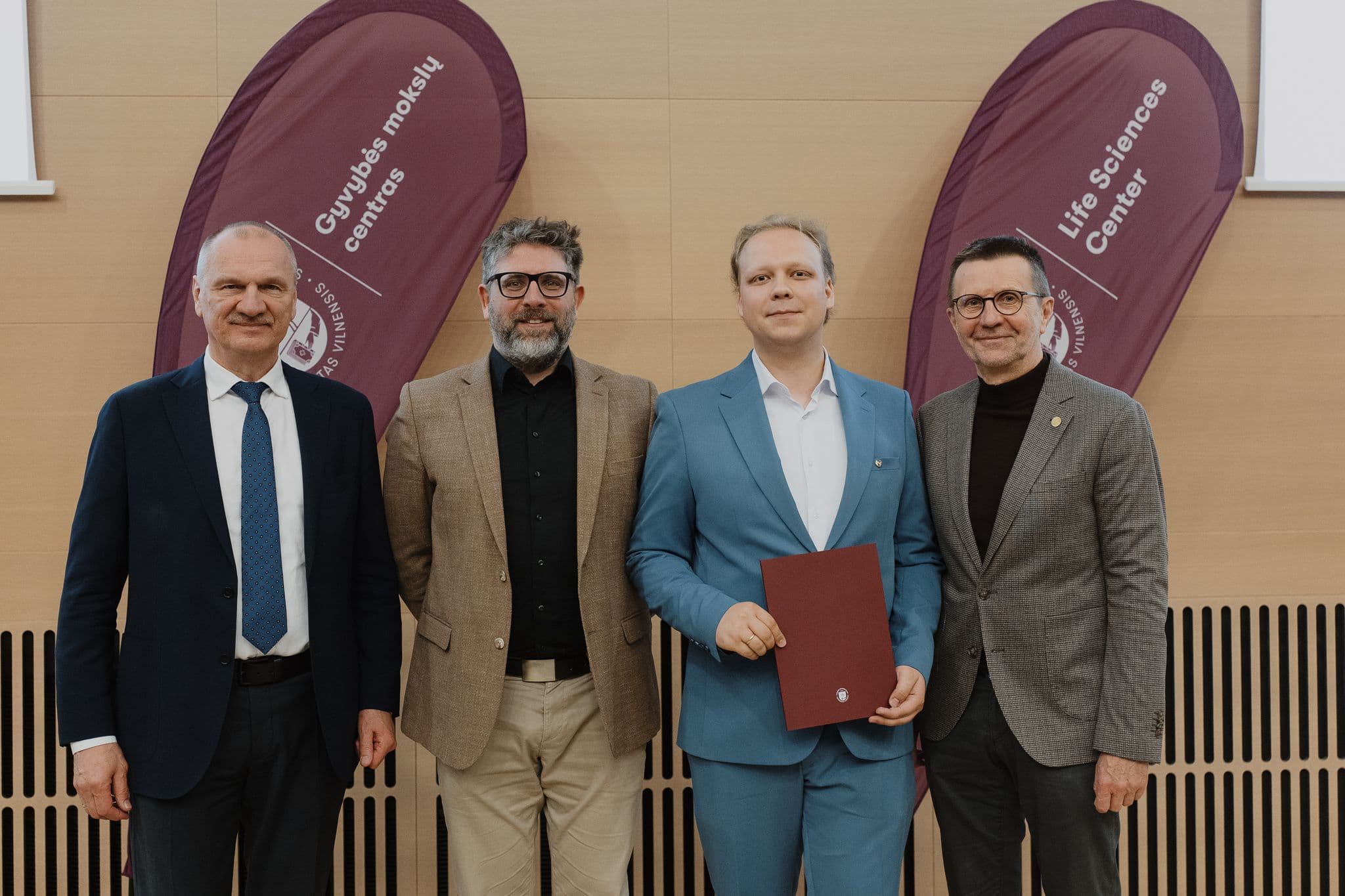
Džiugas Sabonis, a PhD student at the Vilnius University Life Sciences Center (VU LSC), has been awarded the Prof. Virginijus Šikšnys Scholarship in recognition of his internationally acknowledged scientific achievements in the life sciences.
The €10,000 scholarship was established by ‘Go Vilnius’, the Vilnius city business and tourism development agency, to encourage high value-added life sciences research and strengthen the capital’s competitiveness in the international innovation ecosystem.
The award was presented to the laureate by Mangirdas Šapranauskas, Head of the Business Department at ‘Go Vilnius’. He noted: ‘Today, world-class life sciences ideas are emerging in Vilnius. The Prof. Virginijus Šikšnys Scholarship helps nurture talent and is shaping one of Lithuania’s fastest-growing high-tech sectors, which is expanding by more than 20% each year’.
From music to molecular biology
The path that led Džiugas Sabonis to science was neither straightforward nor planned. While still at school, it might have seemed that he would become a musician – he attended a music school in Alytus and took part in various competitions. After finishing eighth grade, he moved to Vilnius to study at the National M. K. Čiurlionis School of Art.
However, a decision he made in his final year of school changed the course of his life. As the doctoral student explains, the decisive factor was not what he was good at, but the way he thought.
‘I was doing well in music, but I approached it constructively rather than creatively. That made me question whether I would be able to realise my true strength – rational thinking,’ Džiugas Sabonis recalled.
It was this doubt that prompted him to look for a field where he could apply his analytical mindset. After speaking with people from different professions and trying to understand their choices, he ultimately chose biochemistry at VU – a discipline that allows the systematic study of life processes and offers an environment of diligent, knowledge‑seeking peers.
Research revealing how bacterial ‘immune systems’ work
Džiugas Sabonis is currently investigating bacterial defence mechanisms against viruses – complex molecular systems that allow microorganisms to detect infection and stop it before the virus spreads.
One of his most significant studies focuses on a type of bacterial ‘immune system’ named after the ancient Egyptian goddess Taweret, known in Greek as Thoeris. In an article published in the prestigious scientific journal Nature, Sabonis and VU LSC researchers uncovered the operating principles of this system.
They found that a protein that, upon recognising viral infection, produces a signalling molecule, which in turn activates another protein – an effector. Once the effector forms a spiral structure, it begins to break down NAD+, a molecule essential for bacterial survival. This triggers the death of the infected cell and prevents the virus from spreading.
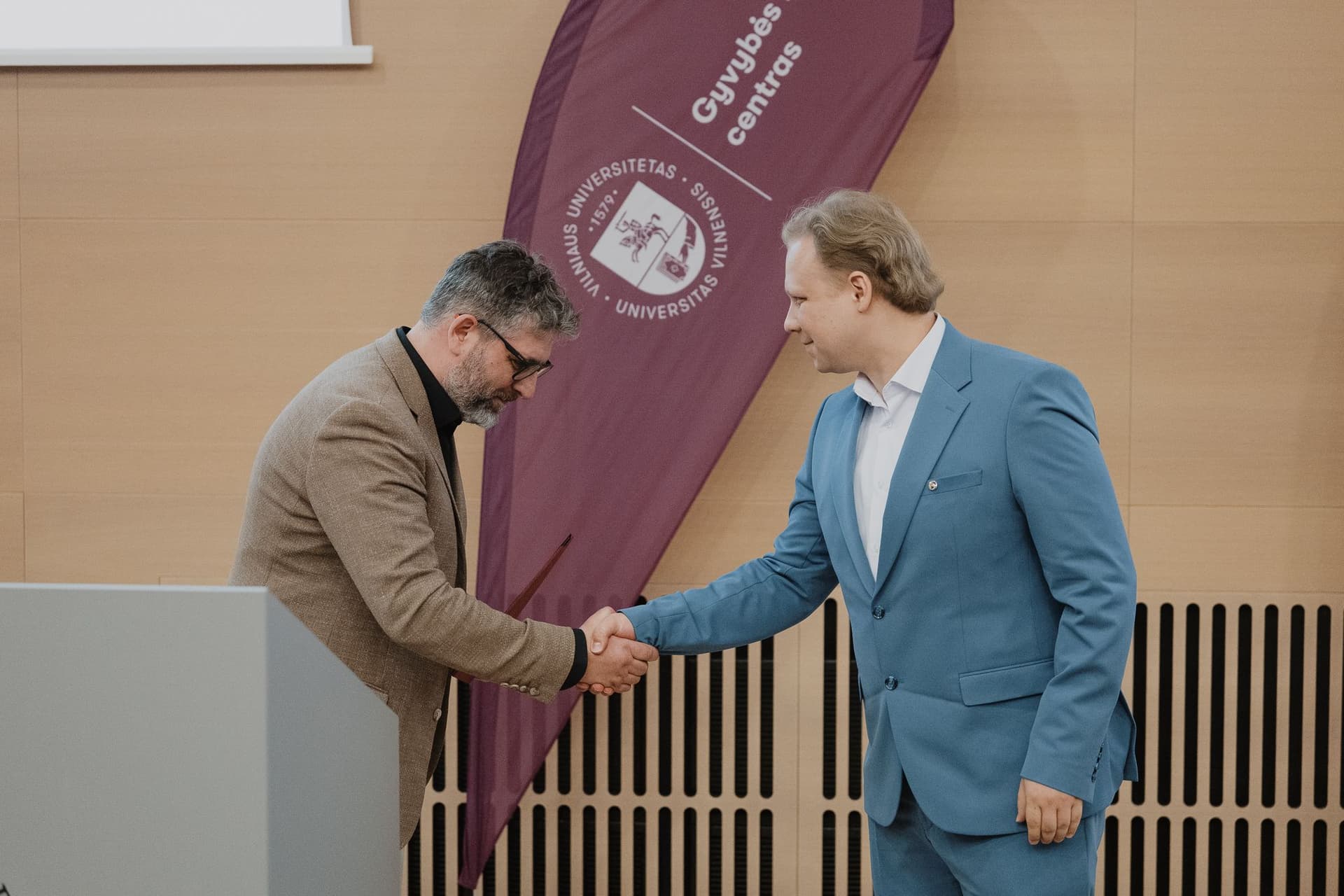
PhD student Džiugas Sabonis. Photo by Vilnius University.
Another study published in Nature presents research in which Sabonis and the VU LSC team discovered and described a new signalling molecule, His-ADPR. This molecule acts as a ‘message’, transmitting information about viral infection and activating the bacterial defence response.
Importantly, Sabonis was one of the key contributors to this discovery. He took part in the structural and biochemical studies that helped clarify how these signals are recognised and how the protective mechanism is triggered.
This research expands the fundamental understanding of bacterial antiviral systems – a field that has seen major breakthroughs in recent years and has already provided gene-editing tools now used worldwide to treat severe genetic diseases.
Recognition as motivation to move forward
Džiugas Sabonis notes that the received scholarship is important both as recognition of his achievements and as motivation to continue his research.
‘It shows that I am moving in the right direction. Science is a long process, often marked by uncertainty, so recognition like this provides an extra push to keep moving forward,’ he said.
The young researcher emphasises that his studies at VU have given him opportunities to grow in an international environment: collaborating with scientists abroad, working in modern laboratories, and contributing to high-level research.
An investment in the city’s future
The Prof. Virginijus Šikšnys Scholarship was established to honour his contribution to the discovery of CRISPR–Cas9 gene-editing technology and to strengthen Vilnius as a life sciences hub on the international stage.
Such initiatives recognise achievements already made and create opportunities for young scientists to further develop research in Vilnius with the potential to make a global impact.