- 22 April 2026
- Gintarė Bidlauskienė
The Universe Doesn’t Care What We Like: Nobel Laureate Prof. Brian Schmidt on an Expanding Universe
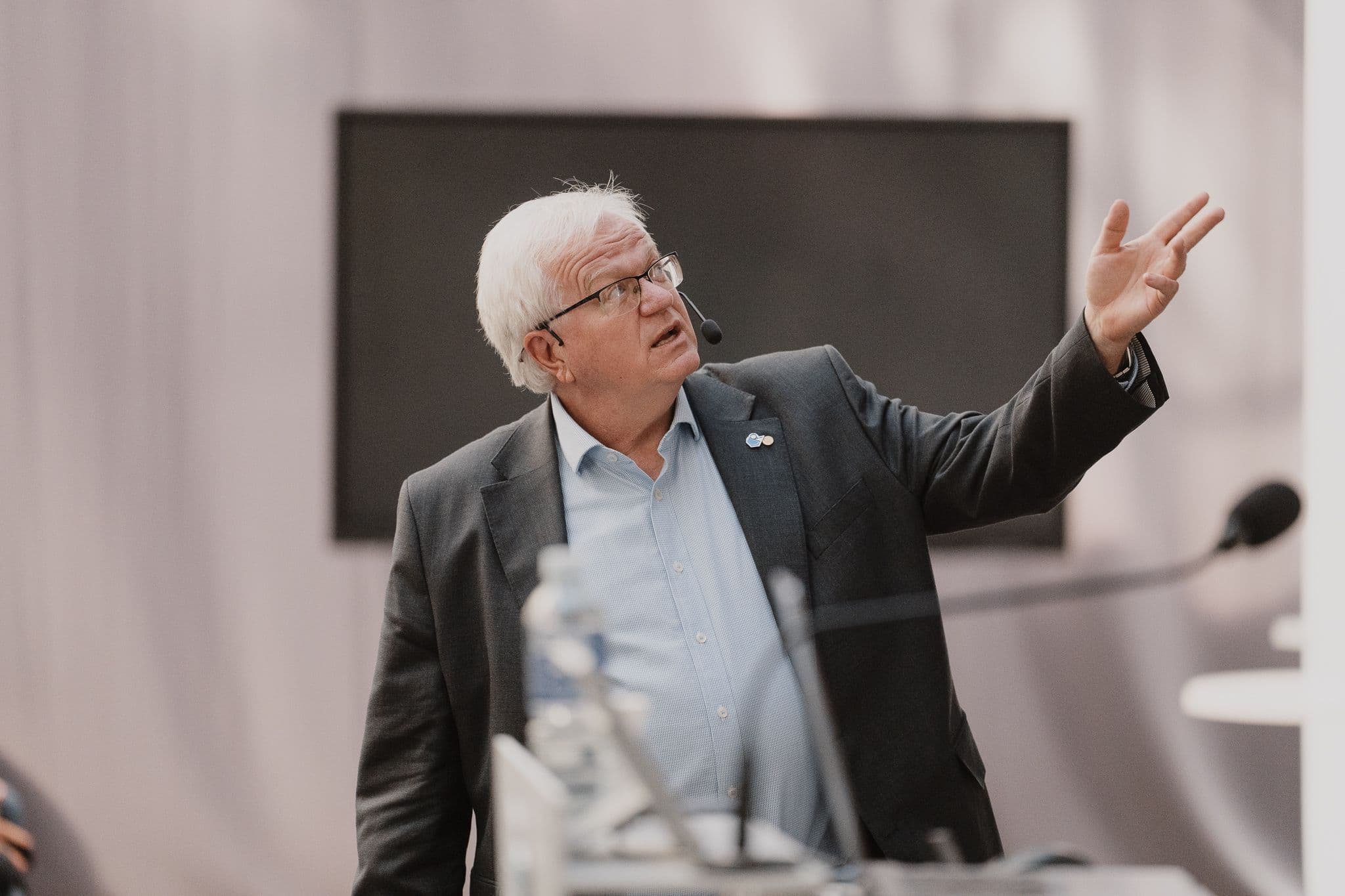
“The Universe doesn’t care what I like. It just does what it does,” said Prof. Brian P. Schmidt, a US-born Australian astrophysicist and 2011 Nobel Prize laureate in Physics. He was awarded the Nobel Prize for showing that the Universe is not only expanding, but that this expansion is accelerating. At Vilnius University, Prof. Schmidt outlined how we understand the evolution of the Universe today, from the discovery of its expansion to the unexpected realisation that this expansion is speeding up.
Measuring a Universe That Is Moving Away
Prof. Schmidt began with what he called “the very beginning of cosmology” – the problem of measurement. “You can measure distances to objects by looking at how they appear. The further away they are, the fainter they appear,” he explained. At the same time, he noted that light also carries information about motion. Observations in the early 20th century showed that light from galaxies is “stretched almost always redward,” a sign that those galaxies are moving away from us. If objects were coming towards us, he added, the shift would be towards blue.
Taken together, these measurements led to a central conclusion: the Universe is expanding. From this, its age can be estimated. “The universe is about 14 billion years old… and it turns out that’s more or less the correct answer,” Prof. Schmidt said, referring to the work he was involved in early in his career. He highlighted that this result did not emerge from a single discovery, but from decades of increasingly precise observations.
From Expansion to Acceleration
Once expansion was established, the next question was what happens next. Gravity, in principle, should slow everything down. Prof. Schmidt explained that, depending on how much matter exists in the Universe, there were three possibilities: the expansion could continue forever, gradually slowing; it could slow to a halt; or it could reverse and collapse. “That was the state of the universe in 1994,” he said, describing a moment when cosmology still allowed for a range of futures.
To test these scenarios, his team turned to Type Ia supernovae – rare stellar explosions that can be used as reliable distance markers. “They’re five billion times brighter than our Sun,” Prof. Schmidt noted, explaining why they can be observed across vast cosmic distances. By measuring these objects, researchers could compare how fast the Universe was expanding at different times.
The result did not behave as expected. Instead of showing a Universe gradually slowing under gravity, the observations suggested that distant objects were farther away than they should have been. The expansion of the Universe was not decelerating. It was accelerating.
“When we saw this, we didn’t go ‘woohoo’. We have done some horrible mistake,’” Prof. Schmidt recalled. He noted that the team spent months checking every part of the analysis, convinced that something must be wrong. Nothing changed. At the same time, another research group reached the same conclusion. The result held: the Universe was speeding up.
Prof. Schmidt admitted that this was not the outcome he had expected. “I kind of like the universe having a beginning and an end. It seems good,” he said. But the data pointed elsewhere. “The universe doesn’t care what I like. It just does what it does,” he added.
A Universe Dominated by the Unknown
To explain this behaviour, physicists returned to a concept introduced by Einstein – the cosmological constant, the idea that space itself has energy. Today, this is associated with dark energy, a component that appears to drive the accelerating expansion of the Universe. Prof. Schmidt explained that dark energy behaves differently from ordinary matter, as its density does not decrease as the Universe expands.
According to current understanding, about 70% of the Universe consists of dark energy, around 25–30% is dark matter, and only about 5% is ordinary matter. “95% of the universe are things that we’ve never been able to detect here on Earth,” he said. Dark matter, he explained, does not emit or absorb light and is observed only through its gravitational effects, while dark energy acts in the opposite direction, pushing the Universe to expand faster over time.
Despite this uncertainty, Prof. Schmidt emphasised that the overall model is consistent across different types of observations. Measurements of supernovae, large-scale cosmic structures, and the cosmic microwave background all point to the same picture. “It’s a messy universe, but it is the story we keep seeing,” he said.
What We Still Don’t Understand
At the same time, important questions remain unresolved. Prof. Schmidt pointed to the so-called Hubble tension: a discrepancy between different methods of measuring how fast the Universe is expanding. Measurements based on nearby observations do not fully match those derived from the early Universe.
“We don’t know how to reconcile. In physics even small inconsistencies matter, When you have a little problem… it means something is wrong“, suggested astrophysicist. According to him, such discrepancies may indicate that the current cosmological model, however successful, is not yet complete.
A Future That Fades
Looking ahead, Prof. Schmidt described a future in which dark energy continues to dominate. As the Universe expands, galaxies move further apart, and eventually the light they emit will no longer be able to reach us. “The light they emit today will never reach us,” he said, referring to distant galaxies.
Over time, he explained, the observable Universe will become increasingly empty, not because galaxies disappear, but because they move beyond the limits of what can be seen. The lecture did not end with certainty, but with perspective. Much of the Universe remains unknown, and even the best models leave open questions. For Prof. Schmidt, that uncertainty is not a flaw, but the point: it is what keeps cosmology moving forward.