- 24 March 2026
- Aurita Petrulytė
VU Faculty of Physics Student from Greece: “I Learned So Much in the Laboratories“
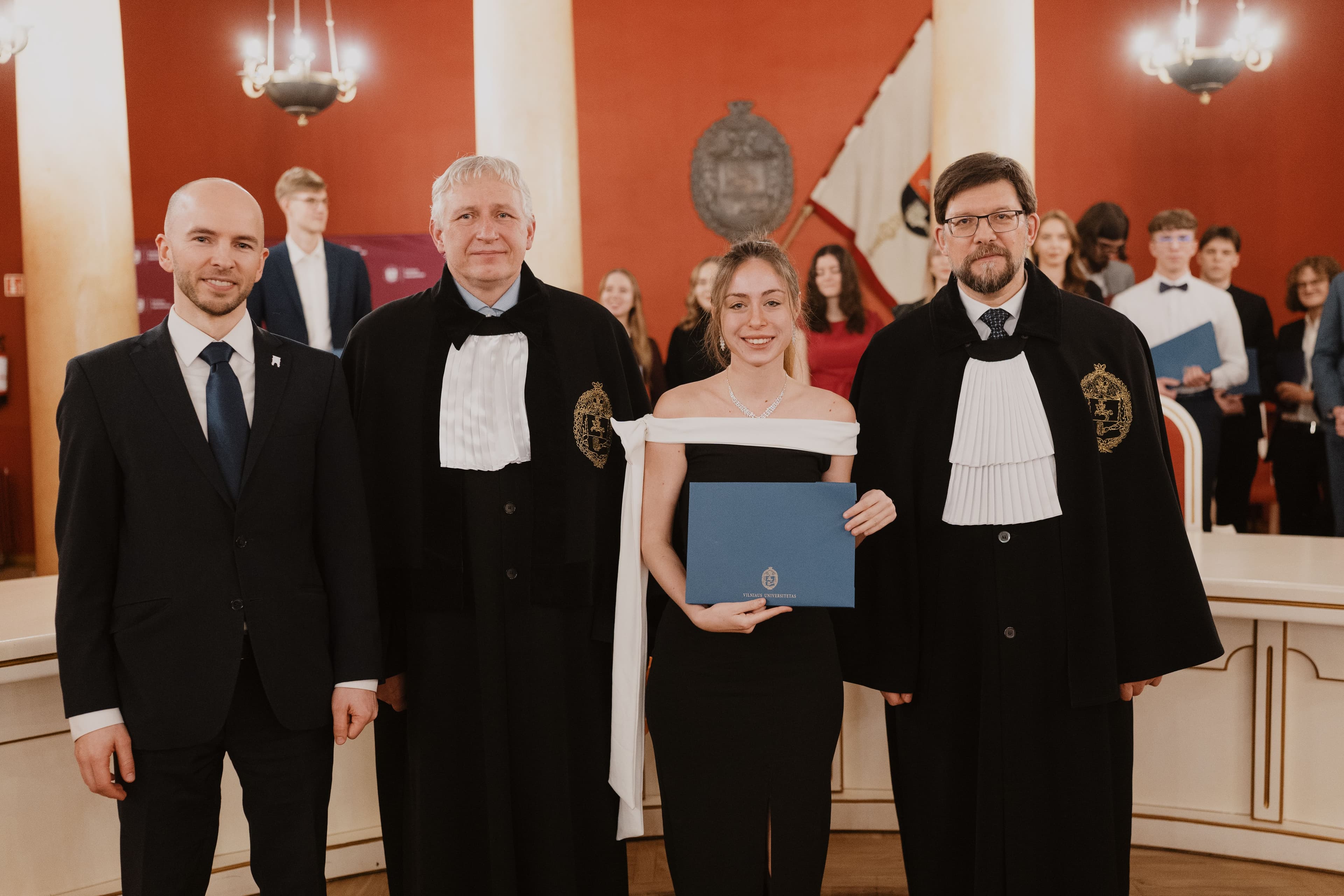
“It’s a really nice experience. Study-wise and career-wise”, smiles student from Greece Ioanna-Angeliki Petsi, speaking about her life at Vilnius University (VU) in Lithuania. She is pursuing a master’s degree in the Laser Physics and Optical Technologies program at the VU Faculty of Physics and is actively involved in several national and international research projects.
I.-A. Petsi decided to go on an Erasmus exchange while studying at the University of Patras in Greece and, in her own words, ended up at VU in Lithuania. “It was a completely different experience here. I cannot think of a single complaint,” says the student. Here, she shares her story of enrolling at VU, involvement in exciting research projects, and a stereotype-breaking experience in Lithuania.
Searching for her kind of physics
When reflecting on what first sparked her interest in physics, I.-A. Petsi recalls that even as a child, she had a strong curiosity about theoretical physics, astrophysics, particles, and related topics. This curiosity led her to study Physics.
“I’ve been fascinated by physics since I was five years old: astrophysics, quantum physics, particles, cosmology, and so on. I lived for it and, after graduating from high school, decided to study physics at the University of Patras in Greece.
That’s when I started doubting whether it was really my calling. I knew I liked physics, but I also saw all those theories that seem simple in principle yet become very tangled mathematically. I realised that nobody really understands them completely. Learning physics theories mainly through mathematics felt like seeing the tree but losing the forest. So I wanted to do something I could actually understand more directly and switched to electronics and microelectronics. I also volunteered for a short period with the Institute of Electrical and Electronics Engineers,” says the student.
Ioanna-Angeliki Petsi. Photo from personal archive.
Unexpected turn
In her fourth year, I.-A. Petsi joined the Erasmus exchange programme and came to VU in Lithuania. One semester was enough for her to fall in love with the country and discover the many research opportunities available to students.
“I loved the country, its people, and the university. I expected Northerners to be less welcoming, but it’s very friendly here, and almost everyone speaks excellent English. The study experience I had here was truly different and better suited to my needs. I learned so much in the laboratories. So, I chose to do an Erasmus+ internship and return to the Laser Research Center at the VU Faculty of Physics.
During that time, I met another Greek student who had graduated here and encouraged me to continue my studies. I was so amazed by how easy the whole procedure was. I transferred all my ECTS from Greece to here, continued working in the Laser Nanophotonics lab, and graduated. Now, in my master’s studies, I learn about physical phenomena, for example, the processes that can be induced by lasers, even more through extensive laboratory work. Lecturers are also oriented to the application of the theoretical material rather than stacking one mathematical problem upon another. Studies here go more in depth; you must do research to graduate. Also, living here isn’t that expensive. Comparing studying in Greece and here, it’s pretty much the same,” says I.-A. Petsi.
Printing tiny structures using lasers
Before coming to Lithuania, I.-A. Petsi didn’t know much about lasers and laser physics. However, she currently works in the Laser Nanophotonics group, led by Prof. Mangirdas Malinauskas.
“I use a technique known as multiphoton 3D lithography, which is an advanced form of 3D printing. This method enables solidification of a light-sensitive material at almost any point in space, enabling the creation of truly three-dimensional structures. Using a sharply focused ultrashort-pulse laser beam, the process achieves extremely high precision, enabling me to fabricate structures only a few hundred nanometres in size. For comparison, a human hair is roughly 500 times wider than the structures produced using this technique,” explains the young researcher.
International collaborations
In a few years spent at the VU Faculty of Physics, I.-A. Petsi already co-authored a scientific paper. Moreover, she is currently working on several research projects, collaborating with Lithuanian and international research groups.
“For example, we’re collaborating with a group at ENEA in Frascati, which researches inertial confinement fusion. Their goal is to create highly porous, extremely low-density foam-like structures that could improve energy transfer. Our group’s fabrication method proved a good fit for producing these materials. The pores can be filled with a gas, such as deuterium, and then hit with a high-power laser, causing an implosion that forms plasma. My role in the project focused on fabricating the structures, building on work from a previous paper I was also involved in.
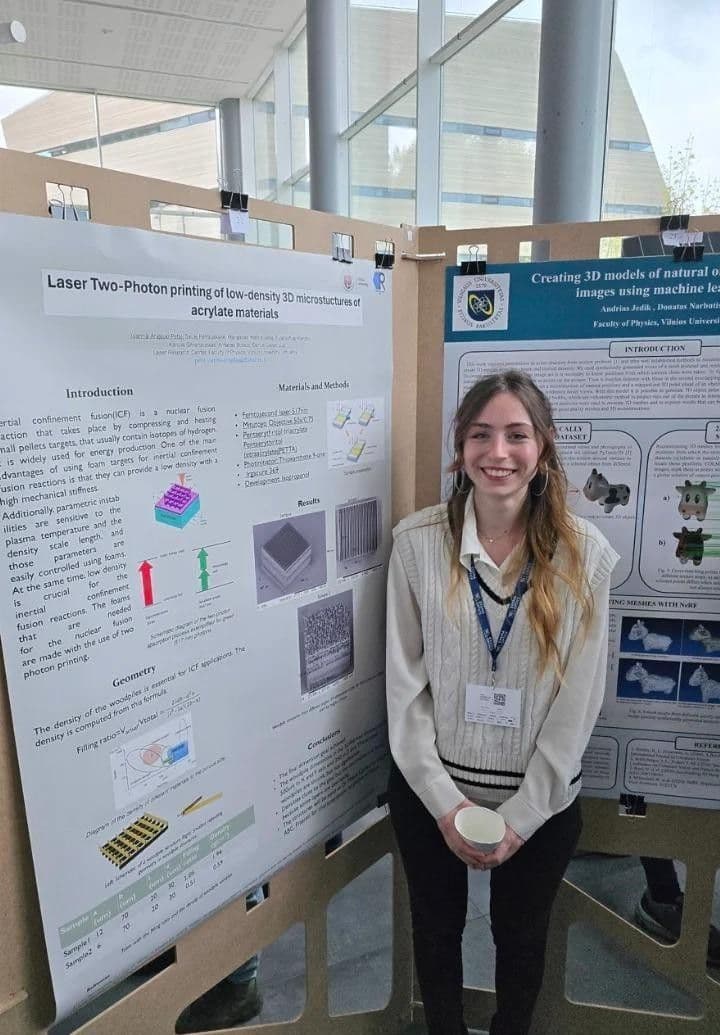
Ioanna-Angeliki Petsi. Photo from personal archive.
We also have other projects. There’s one where my work is to find the right laser exposure parameters for new bio-based polymers – long-chain molecules used to make plastics and many other materials. Another one is oriented to medical practice. There, I make calibrators for X-rays to improve resolution and therefore more precisely identify microcracks in teeth. This semester I also work on fabricating micro-lenses for drone cameras using grayscale lithography, a microfabrication technique,” says I.-A. Petsi.
Two graduation ceremonies and future study plans
While talking about plans, I.-A. Petsi notes that they have changed a lot in the last few years. Surprisingly, currently she is planning two graduations instead of one.
“I will be graduating from my studies in Greece and receiving a second bachelor’s degree in physics in April. When I started studying at VU full-time, I contacted both universities, and neither had a problem with me continuing my studies in Greece while studying at VU. I would return to Greece for short periods to take exams, and that’s how I finished those studies.
To tell the truth, I would prefer to start a PhD now rather than have two bachelor’s degrees, but it would have been a waste not to take that opportunity. I feel more secure knowing I have another diploma to help me in my future career. Afterwards, I’m planning to graduate from VU and probably pursue a PhD here as well,” says the young researcher.