Facts and Figures
Number of employees
Total number of employees (as of December, 2025): 5 971
Academic staff: 2 636
Research staff: 960
Non-academic staff: 2 375
Students at Vilnius University
Total number of students (as of October 1, 2025): 26,553
Bachelor's studies: 15,001
Integrated studies: 3,431
Master's studies: 4,648
Professional pedagogy studies: 294
Doctoral studies: 864
Residency studies: 789
Auditors: 473
Non-degree students: 1,053
Foreign students: 3,424 (full-time studies – 2,859)
Graduates: 4,513
Doctoral degree holders: 113
Students Admitted During Admissions to Vilnius University in 2024
Total number of students admitted (as of October 1, 2025): 7,657
Bachelor's studies: 4,265
Integrated studies: 748
Master's studies: 1,964
Professional pedagogical studies: 1,216
Doctoral studies: 187
Residency studies: 206
History
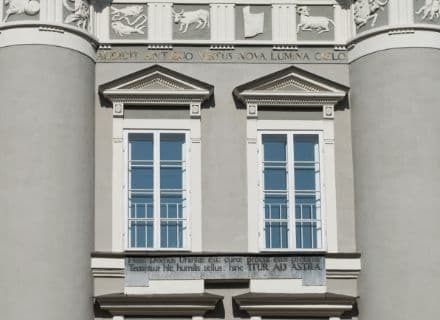
Hinc Itur Ad Astra
On the wall of Vilnius University's observatory, there is the inscription "Hinc itur ad astra", meaning "from here the way leads to the stars". The university was founded in the 16th century, amidst the spread of ideas from the Renaissance, Reformation and Catholic Reformation. Vilnius University is considered one of the oldest universities in Central and Eastern Europe. There are other aspects of historical significance at this ancient university. From the 14th century, and for two centuries thereafter, the University of Kraków held the distinction of being the easternmost university in Europe, but in the 16th century Vilnius assumed this role, transcending the borders of both ethnic Lithuania and the multinational and multi-confessional Grand Duchy of Lithuania by casting scientific light across the Central and Eastern European region. Certain achievements of the Jesuit university were so significant that they influenced the whole of Catholic Baroque and even non-Baroque Europe, including the poetry of Maciej Kazimierz Sarbiewski, as well as the logic, rhetoric and theology of Martinus Smiglecius.
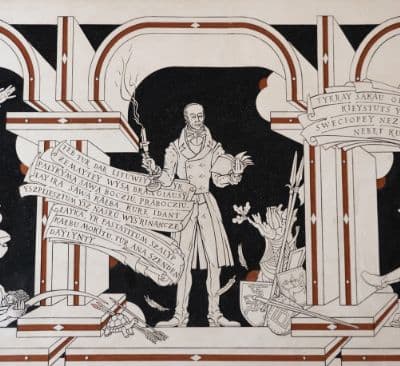
The Old Vilnius University Era
Vilnius University gradually transitioned from the Baroque to the Enlightenment. This process was not substantially hindered even by the annexation of Lithuania to Russia in 1795. According to many contemporaries, the university of the early 19th century ranked amongst the most advanced universities in Europe. Due to the calibre of its schools of science and studies, as well as its impact on society, the university educated Simonas Daukantas, the pioneer of the Lithuanian national revival, and renowned European poets who came from the Grand Duchy of Lithuania but became leading figures of modern Polish culture and prophets of the nation – Adam Mickiewicz and Juliusz Słowacki. All of them witnessed not only the apogee of the university's development but also its tragedy – in 1832, following the suppression of the Polish-Lithuanian uprising, Russia closed the university. Thus ended an epoch of history which can be called the era of the old Vilnius University.
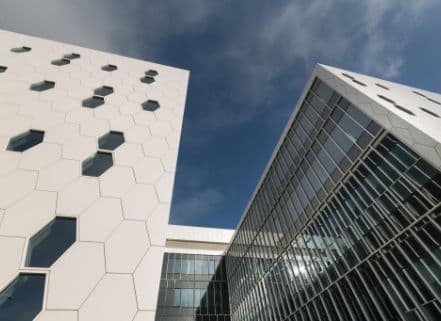
Modern University
A new era in the history of the university began in 1990, as Lithuania regained its independence and the university regained its autonomy. The inscription "Hinc itur ad astra" symbolised the academic dreams and aspirations of former times. In the era of regained independence, such a symbolic function is perhaps performed by the modern Centre for Physical Sciences and Technology in Saulėtekis, which conducts research into laser and light technologies, organic materials, chemistry and semiconductor nanotechnology. The facade walls of this building bear no inscription, but the goals and ambitions of a modern university are symbolised by the hexagonal windows, where an ordinary eye would most likely see only fragments of a honeycomb structure, whilst an expert eye can discern the true symbolism – the crystal lattice of graphene, one of the strongest materials, which was created at the beginning of the 21st century.
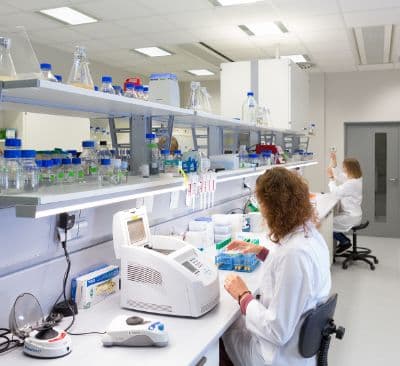
From the Stars to Bacteria
Physical and life sciences are currently a significant field of study at the University. The new slogan, somewhat ironically, could be "from here the way leads to bacteria". However, the achievements are far from ironic. Recent research into bacteria, viruses, molecules and DNA structures has gained worldwide recognition, whilst the University has announced the discovery of unique, hitherto unknown signalling molecules, and a protein that could be used to precisely edit DNA to alter the genome in specific ways. As a result, Professor Virginijus Šikšnys was amongst the candidates for the Nobel Prize. The Centre for Physical Sciences and Technology is situated next to the modern Joint Life Sciences Centre, which could certainly compete with its neighbour for the status of a modern university symbol: the complex is designed as cube-shaped structures with exteriors reminiscent of cellular structure.
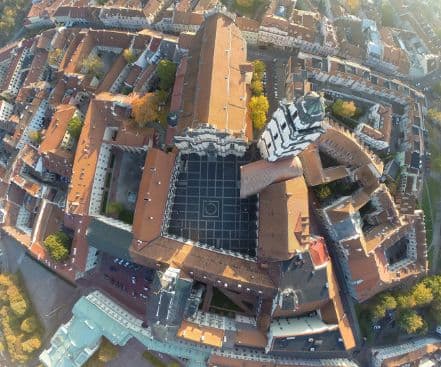
University DNR
Since the restoration of independence, the university has constantly had to navigate between the demands of global competition and satisfying the local needs of the state, whilst simultaneously making difficult choices between the roles of a university that serves the technocratic market and a classical educator of humanity. The strength of the modern Vilnius University and its aspiration to become the academic home of graphene is measured not only by its historical mission but also by various formal assessments. However, what symbolises today's Vilnius University most profoundly are the two most important threads of its identity, twisted like a DNA helix: its passionate efforts to adapt to the needs and trends of the rapidly changing world; and simultaneously, the traditions that have endured since its establishment. The first thread represents the technical and life sciences that have replaced (or evolved from) the logic of the 17th century. The second represents the poets of the 17th century – even if in (post)modern times they are often called humanities scholars. Thus, whilst the university enjoys the rewards of its DNA research, the university's own DNA has remained unchanged since its establishment.
The Most Important Dates
On the initiative of Vilnius Bishop Valerijonas Protasevičius, Jesuits came to Lithuania and founded the Vilnius Jesuit College in 1570.
On 1 April, the King of Poland and the Grand Duke of Lithuania, Stephen Báthory, issue a letter of privilege to open the Vilnius Academy. Then on 30 October, Pope Gregory XIII issued a decree approving the reorganisation of Vilnius College into a university. The official name of the University was Academia et Universitas Vilnensis Societatis Jesu (Jesuit Academy and University of Vilnius).
The Society of Jesus was dissolved, the state took over the university and established an educational institution - the Educational Commission.
Vilnius University was renamed the Principal School of the Grand Duchy of Lithuania – Schola Princeps Magni Ducatus Lithuaniae. The university, like the whole state, entered an era of reforms, which were interrupted by the last partition of the Polish-Lithuanian state.
The Grand Duchy of Lithuania was annexed to the Russian Empire, and Vilnius University was renamed the Vilnius Principal School – Schola Princeps Vilnensis (1797).
Russia implemented education and higher education reforms. Vilnius University received a statute to become a model for other universities in the Russian Empire, and was renamed the Imperial University of Vilnius (Vilenskij imperatorskij universitet – Imperatoria Universitas Vilnensis).
After suppressing the Polish-Lithuanian uprising, the Russian Empire closed the university.
After the First World War, when the Russian Empire collapsed, the governments of the emerging Polish and Lithuanian states put their efforts into restoring the university in Vilnius. On 5 December, the State Council of Lithuania adopted the statute of Vilnius University.
The Poles who had occupied Vilnius managed to restore the university. It was renamed after Stephen Báthory (Uniwersytet Stefana Batorego).
The University of Lithuania was restored in the temporary capital of Lithuania, Kaunas, and in 1930 it was renamed Vytautas Magnus University (Universitas Vitoldi Magni).
Lithuania reclaimed Vilnius and the Polish stage of the university’s development came to an end. The Lithuanian university was moved to Vilnius and was renamed Vilnius University.
After the first Soviet occupation, Vilnius University was Sovietised.
Vilnius University was re-Lithuanianised, but was already under Nazi occupation until it was closed again in 1943.
After the second Soviet occupation, Vilnius University was restored by the Soviet authorities and renamed Vilnius State University.
Vilnius University was named after Vincas Kapsukas, a man who had no merit for either the university or Lithuania. At the time of commemorating its 400th anniversary, the university had the longest name in its history – the Vilnius Order of the Red Banner of Labour State University of Vincas Kapsukas.
After Lithuania regained its independence, the university regained both its autonomy and the name of Vilnius University.
Principles of the University Activity
Vilnius University cherishes freedom of thought and diversity of opinion, openness to global ideas and innovations, collegiality, mutual respect, trust, and academic ethics.
- Freedom of science, research, creation, and teaching
- Morality
- Unity of science and studies
- Promotion of moral, cultural, experimental, economic, and technological development of society
- Advance of international partnership
- Assurance of the quality of its activity
- Solidarity, cooperation and mutual respect between members of the community
- Coordination of interests of the University’s internal organisational structures and their cooperation
- Subsidiarity in decision making
- Publicity
- Transparency in distributing and utilising resources and in taking other decisions
- Equal opportunities and fair competition, and any other generally acknowledged principles of academic ethics
- Responsibility to the Nation and the State of Lithuania, openness and accountability to society
Honorary Members
Honorary Doctors
SAULIUS JUODKAZIS, Professor, physicist, Australia (2025)
Physicist Dr REMIGIJUS (REMIS) GASKA, USA (2025)
PETRAS REPŠYS, Professor, visual artist, Lithuania (2025).
MAURIZIO FERRARIS, Professor, University of Turin, Italy (2025).
ANNA PIKULSKA-RADOMSKA, Professor, University of Łódź, Poland (2023).
DANIEL PETIT, Professor, École Normale Supérieure in Paris, France (2023).
HANS KJELDSEN, Professor, Aarhus University, Denmark (2023).
KOEN LENAERTS, Professor, President of the European Union Court of Justice, Belgium (2022).
BRUNO ROBERT, Professor, Head of the Department of Bioenergetics, Structural Biology and Mechanisms at Frédéric Joliot Institute for Life Sciences at CEA Paris-Saclay, France (2022).
ANDREW BUSH, Professor, Imperial College London, United Kingdom (2022).
THOMAS CHUNG-KUANG YANG, Professor, National Taipei University of Technology, Taiwan (2022).
EMMANUEL MACRON, President of the French Republic (2020).
IAN B. SPIELMAN, Professor, National Institute of Standards and Technology, USA (2020).
GÉRARD MOUROU, Professor, Nobel Prize Laureate, International Center for Zetta-Exawatt Science and Technology, France (2020).
TOMAS VENCLOVA, Professor, Yale University, USA (2017).
MARIE-CLAUDE VIANO, Professor, Lille 1 University – Science and Technology, France (2017).
OTMAR SEUL, Professor, Paris Nanterre University, France (2017).
PETER SCHEMMER, Professor, University of Heidelberg, Germany (2016).
SANJAY MATHUR, Professor, University of Cologne, Germany (2016).
JÓN BALDVIN HANNIBALSSON, politician, economist and diplomat, Iceland (2015).
MICHAEL SHUR, Professor, Rensselaer Polytechnic Institute, USA (2015; deceased 2026).
GRAHAM R. FLEMING, Professor, University of California, Berkeley, USA (2013).
HARTMUT FUEß, Professor, Darmstadt University of Technology, Germany (2013).
THOMAS RUZICKA, Professor, Ludwig Maximilian University of Munich, Germany (2012).
MARKUS WOLFGANG BÜCHLER, Professor, University of Heidelberg, Germany (2012).
ROBERT HUBER, Professor of Biochemistry, Nobel Prize Laureate, Director Emeritus of Max Planck Institute and Professor at the Technical University of Munich, Germany (2011).
ANDRZEJ GOSPODAROWICZ, Professor, Wrocław University of Economics and Business, Poland (2011; deceased 2025).
ALGIS MICKŪNAS, Professor of Philosophy and Phenomenology, Ohio University, USA (2011).
JURIJ KUZMENKO, Professor of Philology, Humboldt-Universität zu Berlin, Germany, and the Institute for Linguistic Studies of the Russian Academy of Sciences (2011).
ANDRES METSPALU, Professor of Medicine, University of Tartu, Estonia (2010).
IMRE KÁTAI, Professor of Mathematics, Eötvös Loránd University, Budapest, Hungary (2010).
HELMUT KOHL, Professor, Johann Wolfgang Goethe University Frankfurt am Main, Germany (2008).
GEORG VÖLKEL, Professor, University of Leipzig, Germany (2008).
WOJCIECH SMOCZYŃSKI, Professor, Jagiellonian University in Kraków, Poland (2007).
REINHARDT BITTNER, Professor, Tübingen University Academic Hospital in Stuttgart, Germany (2007).
GUNNAR KULLDORFF, Professor, Umeå University, Sweden (2006).
JACQUES ROGGE, President of the International Olympic Committee (2006; deceased 2021).
PIETRO UMBERTO DINI, Professor, University of Pisa, Italy (2005).
VASSILIOS SKOURIS, Professor, President of the European Court of Justice (2005).
VLADIMIR SKULACHEV, Professor, Lomonosov Moscow State University, Russia (2005).
ALEKSANDER KWAŚNIEWSKI, President of the Republic of Poland (2005).
FRANCIS ROBICSEK, Carolinas Heart Institute at Carolinas Medical Centre in Charlotte, North Carolina, USA (2004; deceased 2020).
PETER GILLES, Johann Wolfgang Goethe University, Frankfurt am Main, Germany (2004; deceased 2020).
PETER ULRICH SAUER, Professor, University of Hanover, Germany (2004).
SVEN EKDAHL, Professor, Prussian Secret Archives in Berlin, Germany (2004).
ERNST RIBBAT, Professor, University of Münster, Germany (2002).
JURIJ STEPANOV, Professor, Moscow University, Russia (2002; deceased 2012).
DAGFINN MOE, Professor, University of Bergen, Norway (2002).
ANDRZEJ ZOLL, Professor, Jagiellonian University in Kraków, Poland (2002).
EDUARD LIUBIMSKIJ, Professor, Moscow University, Russia (2000).
WOLFGANG P. SCHMID, Professor, University of Göttingen, Germany (2000; deceased 2010).
SVEN LARS CASPERSEN, Professor of Economics, President of the World Rectors' Association, Rector of Aalborg University, Denmark (1999).
LUDWIK PIECHNIK, Professor of History, Pontifical Academy of Theology in Kraków, Poland (1999; deceased 2006).
MARIA WASNA, Doctor, Professor of Psychology, Rector of the University of Münster, Germany (1999; deceased 2019).
ZBIGNIEW BRZEZINSKI, Professor of Government, USA (1998; deceased 2017).
FRIEDRICH SCHOLZ, Director of the Interdisciplinary Institute of Baltic Studies, Professor, University of Munich, Germany (1998).
THEODOR HELLBRUGGE, Founder and Head of the Munich Children Centre, Institute of Social Paediatrics and Adolescent Medicine, Professor, University of Munich, Germany (1998; deceased 2014).
JULIUSZ BARDACH, Professor, University of Warsaw, Poland (1997; deceased 2010).
RAINER ECKERT, Professor, Director of the Institute of Baltic Studies, University of Greifswald, Germany (1997).
NIKOLAJ BACHVALOV, Member of the Russian Academy of Sciences, Head of the Computational Mathematics Department, Faculty of Mathematics, Lomonosov Moscow State University (1997; deceased 2005).
ALFRED LAUBEREAU, Head of the Experimental Physics Department, Technical University of Munich, Professor, University of Bayreuth, Germany (1997).
VÁCLAV HAVEL, President of the Czech Republic (1996; deceased 2011).
VLADIMIR TOPOROV, Professor, Institute of Slavonic Studies, Russian Academy of Sciences (1994; deceased 2005).
WILLIAM SCHMALSTIEG, Professor, Pennsylvania State University, USA (1994; deceased 2021).
TOMAS REMEIKIS, Professor, Purdue University Calumet, Indiana, USA (1994; deceased 2013).
PAULIUS RABIKAUSKAS, Professor, Pontifical Gregorian University, Rome, Italy (1994; deceased 1998).
MARTYNAS YČAS, Professor, State University of New York (1992; deceased 2014).
EDVARDAS VARNAUSKAS, Doctor of Medicine, Professor, Sweden (1992).
VACLOVAS DARGUŽAS (Andreas Hofer), Doctor of Medicine, Switzerland (1991; deceased 2009).
CHRISTIAN WINTER, Professor, Goethe University Frankfurt am Main, Germany (1989).
CZESŁAW OLECH, Director of the International Mathematical Banach Centre, Member of the Polish Academy of Sciences, Professor, University of Warsaw, Poland (1989).
VALDAS VOLDEMARAS ADAMKUS, Administrator of the 5th Regional Environmental Protection Agency, USA (1989).
WERNER SCHELER, Professor, Germany (1979).
ZDENĚK ČEŠKA, Associate Member of the Academy of Sciences of the Czech Republic, Rector of Charles University, Prague (1979).
JAN SAFAREWICZ, Full Member of the Polish Academy of Sciences, Professor, Jagiellonian University in Kraków, Poland (1979; deceased 1992).
Vilnius University Professors – Honorary Members of Foreign Universities and Academies
TOMAS DAVULIS – Foreign Member of the National Academy of Legal Sciences of Ukraine (2017).
BONIFACAS STUNDŽIA – Honorary Doctor of the University of Latvia (2016).
SAULIUS KLIMAŠAUSKAS – Member of the Royal Society of Chemistry, United Kingdom (2015).
VAIVA HENDRIXSON – Honorary Professor of Karaganda State Medical University, Kazakhstan (2015).
ANTANAS POŠKA (✝ 1992) – Honorary Doctorate from the University of Calcutta, India (2014).
ALBERTAS ČAPLINSKAS – Honorary Doctorate from the University of Latvia (2014).
AXEL HOLVOET – Honorary Doctor of the University of Latvia (2014).
JŪRAS BANYS – Foreign Member of the Latvian Academy of Sciences (2013), Corresponding Member of the Saxon Academy of Sciences, Honorary Doctor of Uzhhorod National University.
LEONAS VALKŪNAS – Honorary Doctor of the M. Bogoliubov Institute for Theoretical Physics of the Ukrainian Academy of Sciences (2013).
ZITA AUŠRELĖ KUČINSKIENĖ – Full Member of the Albert Schweitzer World Academy of Medical Sciences in Poland (2010).
ARTŪRAS ŽUKAUSKAS – Fellow of the Institute of Electrical and Electronics Engineers, USA (2009).
REGINA RUDAITYTĖ – Member of the Expert Panel of the Arts and Humanities Research Council, United Kingdom (2009).
ARŪNAS VALIULIS – Honorary Member of the Royal College of Paediatrics and Child Health, UK (2008); Honorary Professor at Poltava State Medical University, Ukraine (2019).
ELEONORA LASSAN – Honorary Professor of Jan Kochanowski University in Kielce, Poland.
Professors Emeritus of Vilnius University:
Faculty of Chemistry and Geosciences:
ADULFAS ABRUTIS
ALGIRDAS JURGAITIS
ROLANDAS KAZLAUSKAS
KĘSTUTIS KILKUS
GEDIMINAS MOTUZA MATUZEVIČIUS
ROBERT MOKRIK
SIGITAS TUMKEVIČIUS
POVILAS VAINILAVIČIUS
Faculty of Economics and Business Administration:
VACLOVAS LAKIS
JONAS MACKEVIČIUS
Faculty of Philology:
EVALDA MARIJA JAKAITIENĖ
VIKTORIJA DAUJOTYTĖ-PAKERIENĖ
ARŪNAS SVERDIOLAS
BONIFACAS STUNDŽIA
AUGENIJA ULČINAITĖ
Faculty of Philosophy:
ALBINAS BAGDONAS
ROMAS LAZUTKA
VYGINTAS BRONIUS PŠIBILSKIS
PETRAS HENRIKAS VAITKEVIČIUS
Faculty of Physics:
VYTAUTAS BALEVIČIUS
JONAS GRIGAS
KĘSTUTIS JARAŠIŪNAS
GYTIS JUŠKA
LIUDVIKAS KIMTYS
ANTANAS FELIKSAS ORLIUKAS
RIČARDAS ROTOMSKIS
VALDAS SIRUTKAITIS
VALERIJUS SMILGEVIČIUS
ALGIRDAS PETRAS STABINIS
JUOZAS VIDMANTIS VAITKUS
LEONAS VALKŪNAS
ARTŪRAS ŽUKAUSKAS
Life Sciences Centre:
EUGENIJUS BUTKUS
BENEDIKTAS JUODKA
JUOZAS KULYS
VALDAS STANISLOVAS LAURINAVIČIUS
KĘSTUTIS SASNAUSKAS
Faculty of History:
ZENONAS BUTKUS
MYKOLAS MICHELBERTAS
IRENA VALIKONYTĖ
Faculty of Communication:
DOMAS KAUNAS
Faculty of Mathematics and Informatics:
FELIKSAS IVANAUSKAS
ANTANAS LAURINČIKAS
EUGENIJUS MANSTAVIČIUS
VYGANTAS PAULAUSKAS
ŠARŪNAS RAUDYS
MIFODIJUS SAPAGOVAS
DONATAS SURGAILIS
ANTANAS ŽILINSKAS
Faculty of Medicine:
VAIDUTIS KUČINSKAS
ZITA AUŠRELĖ KUČINSKIENĖ
ALEKSANDRAS LAUCEVIČIUS
VYTAUTAS JONAS SIRVYDIS
VYTAUTAS JONAS TRIPONIS
VYTAUTAS USONIS
GIEDRIUS UŽDAVINYS
Šiauliai Academy:
JONAS AMBRUKAITIS
KAZIMIERAS ROMUALDAS ŽUPERKA
Faculty of Law:
IPOLITAS NEKROŠIUS
JONAS PRAPIESTIS
IN MEMORIAM:
EDUARDAS JUOZAS BALČYTIS (1937–2021)
ALGIRDAS JUOZAPAS GAIGALAS (1933–2009)
ALEKSAS STANISLAVAS GIRDENIS (1936–2011)
EDVARDAS VALYS GUDAVIČIUS (1929–2020)
MEILUTĖ KABAILIENĖ (1931–2016)
PAULIUS KAVALIAUSKAS (1945–2024)
ROMUALDAS KAZIMIERAS LEKEVIČIUS (1938–2011)
STANISLOVAS ALGIMANTAS MARTIŠIUS (1937–2022)
EDMUNDAS MONTRIMAS (1933–2011)
KĘSTUTIS VALENTINAS NASTOPKA (1940–2024)
EVALDAS NEKRAŠAS (1945–2023)
ALGIS PETRAS PISKARSKAS (1942–2022)
VYTAUTAS PETRAS RANČELIS (1938–2021)
ALGIMANTAS RAUGALĖ (1940–2016)
ALBERTAS ROSINAS (1938–2010)
LEONAS SIMANAUSKAS (1934–2009)
VYTAUTAS PRANCIŠKUS STRAIŽYS (1936–2021)
MARIUS ARVYDAS ŠLIOGERIS (1944–2019)
STASYS VANCEVIČIUS (1927–2014)
In the book *Vilnius University Professors Emeriti*, you can learn more about the achievements and activities of Vilnius University's professors emeriti.
Initiated by the most active professors emeriti, the Vilnius University Professors Emeriti Club (VUPEK) was established on 11 October 2018. You can find out more about its activities here.
Vilnius University Alumni – Winners of the Lithuanian National Culture and Arts Prize
REGIMANTAS ADOMAITIS (✝ 2022) – actor, graduated from the Faculty of Physics and Mathematics in 1959.
ALFONSAS ANDRIUŠKEVIČIUS – art critic, graduated from VU in 1965, defended his doctoral dissertation in 1973.
JUOZAS APUTIS (✝ 2010) – writer, graduated in Lithuanian language and literature in 1960.
ONA BALIUKONYTĖ (✝ 2007) – writer, graduated in Lithuanian language and literature in 1970.
KAZYS BRADŪNAS (✝ 2009) – poet, graduated from the Faculty of Humanities in 1943.
VLADAS BRAZIŪNAS – writer, graduated in Lithuanian philology in 1997.
JUOZAS BUDRAITIS – actor, graduated in law in 1973.
ALFREDAS BUMBLAUSKAS – historian, studied history 1974–1979, has worked at the Faculty of History since 1979.
HENRIKAS ALGIS ČIGRIEJUS (✝ 2016) – writer, graduated from VU in 1958.
VIKTORIJA DAUJOTYTĖ-PAKERIENĖ – literary scholar, graduated from VU in 1968, taught at VU from 1972.
PETRAS DIRGĖLA (✝ 2015) – writer, studied Lithuanian language and literature 1965–1972.
VLADAS DRĖMA (✝ 1995) – art historian, graduated from the Faculty of Art in 1936, taught at VU 1956–1958.
JUOZAS ERLICKAS – writer, studied Lithuanian studies 1971–1975.
ANTANAS GAILIUS – poet and translator, graduated in German language and literature in 1973.
SIGITAS GEDA (✝ 2008) – poet, graduated from the Faculty of History and Philology specialising in Lithuanian language and literature in 1966.
EDMUNDAS GUDAVIČIUS (✝ 2020) – historian, studied at VU 1962–1968, completed his extramural postgraduate studies in 1970, taught at VU 1975–2012.
MARIUS IVAŠKEVIČIUS – prose writer, playwright, studied Lithuanian philology 1991–1997.
ANTANAS V. JONYNAS (✝ 1976) – writer, studied at VU 1944–1946.
VANDA JUKNAITĖ – writer, graduated in Lithuanian language and literature in 1972.
DANUTĖ KALINAUSKAITĖ – essayist, graduated in Lithuanian studies in 1983.
JONAS JUŠKAITIS (✝ 2019) – poet, graduated in Lithuanian language and literature in 1958.
JAKOVAS GRIGORIJUS KANOVIČIUS (✝ 2023) – writer, graduated in Russian language and literature in 1953.
SAULIUS TOMAS KONDROTAS – writer, translator, graduated in psychology and philosophy in 1976.
ALGIMANTAS KUNČIUS – photographer, studied law 1958–1960.
JUSTINAS MARCINKEVIČIUS (✝ 2011) – poet, studied Lithuanian language and literature 1949–1954.
MARCELIJUS MARTINAITIS (✝ 2013) – poet, graduated in Lithuanian studies in 1964, taught at VU from 1980.
VYTAUTAS MARTINKUS – prose writer, literary critic, defended his doctoral dissertation at VU in 1981.
POVILAS MATAITIS (✝ 2022) – theatre director, studied economics 1952–1957, taught at VU 1990–1993.
JONAS MIKELINSKAS (✝ 2015) – writer, graduated in French language and literature in 1952.
NIJOLĖ MILIAUSKAITĖ (✝ 2002) – writer, graduated in Lithuanian language and literature in 1973.
KĘSTUTIS NASTOPKA (✝ 2024) – literary critic, graduated in Lithuanian studies in 1962, taught at VU from 1992.
ALFONSAS NYKA-NILIŪNAS (real name ADOLFAS CIPKUS) (✝ 2015) – graduated in Romance studies and philosophy in 1942.
VIOLETA PALČINSKAITĖ – poet, studied at VU 1960–1964.
VALDAS PAPIEVIS – prose writer, studied Lithuanian literature at the Faculty of Philology 1980–1985.
SIGITAS PARULSKIS – writer, graduated in Lithuanian language and literature in 1990.
VERONIKA POVILIONIENĖ – singer, graduated from the Faculty of History and Philology in 1976.
GIEDRA RADVILAVIČIŪTĖ – writer, graduated in Lithuanian studies in 1983.
BRONIUS RADZEVIČIUS (✝ 1980) – writer, graduated in Lithuanian language and literature in 1968.
ROMUALDAS RAKAUSKAS (✝ 2021) – photographer, studied journalism 1956–1962.
ROLANDAS RASTAUSKAS – writer, graduated in English language and literature in 1978, taught at VU 1978–1986.
DONATAS SAUKA (✝ 2015) – writer, studied Lithuanian studies 1948–1953, worked at VU 1956–1993, taught folklore courses.
RIMVYDAS STANKEVIČIUS – poet, essayist, journalist, graduated in Lithuanian language and literature in 1997.
ANTANAS SUTKUS – photographer, studied journalism 1958–1964.
PAULIUS STANIKAS – artist, graduated in economics in 1985.
EIMUTIS VALENTINAS SVENTICKAS – writer, literary critic, studied Lithuanian language and literature 1967–1972.
ARVYDAS ŠLIOGERIS (✝ 2019) – philosopher, studied postgraduate studies at the Department of Philosophy in 1973, taught at VU from 1973.
TOMAS VENCLOVA – writer, studied Lithuanian studies 1954–1960.
BITĖ VILIMAITĖ (✝ 2014) – writer, studied Lithuanian language and literature 1960–1964.
ZITA ŽEMAITYTĖ (✝ 2009) – art historian, obtained the speciality of art historian at the Department of Museology of the Faculty of History and Philology in 1950.
GIEDRĖ ŽICKYTĖ-BAJARŪNIENĖ – film director, producer, graduated in journalism in 2002.
ALBERTAS ŽOSTAUTAS – editor, studied at VU 1978–1983.
Patrons of Vilnius University
JULIUS NIEDVARAS (2004) – President of SEB Vilnius Bank.
GEDVYDAS VAINAUSKAS (2004) – Editor-in-Chief of the daily newspaper *Lietuvos rytas*.
VIDMANTAS KUČINSKAS (2005) – Chairman of the Board of the "Arvi" group of companies.
ARŪNAS MARTINKEVIČIUS (2005) – President of SBA concern.
SIGITAS PAULAUSKAS (2005) – Chairman of the Board of UAB "Vakarų medienos grupė".
VIRGINIJUS ADUTAVIČIUS (2007) – Director of UAB "Veritas Ana".
ALGIRDAS AND VYTAUTAS BUČAI (2008) – businessmen, philanthropists.
ALGIMANTAS BLAŽYS (2009) – General Director of UAB "Berlin Chemie Menarini Baltic".
NERIUS AND KAETANA NUMAI (2019) – businesspeople, philanthropists, patrons of Vilnius City Municipality.
DARIUS ZUBAS (2019) – Chairman of the Board of UAB "Linas Agro Group", patron of Vilnius City Municipality.
REDA AND ALVYDAS ŽABOLIAI (2019) – businesspeople, philanthropists, patrons of Vilnius City Municipality.
VIKTORAS GEDIMINAS GRUODIS (2019) – businessman, philanthropist.
RIMANTAS KRAUJALIS (2019) – Chairman of the Board of UAB "Ekspla".
ROMUALDAS DANIELIUS (2019) – Chairman of the Board of UAB "Light Conversion".
ALGIMANTAS MARKAUSKAS (2019) – General Director of UAB "Thermo Fisher Scientific Baltics".
ARVYDAS ANDRIJAUSKAS (2021) – Chairman of the Board and Director of "Alma littera".
LINA and DANAS TVARIJONAVIČIAI (2021) – businesspeople, philanthropists.
GEDIMINAS VAITIEKŪNAS (2024) – businessman, philanthropist.
Dr. ANGELĖ MATILDĖ KAZLAUSKAS (1935–2020) and Dr. SIGITAS PRANAS KAZLAUSKAS (1935–2005) (2024) – Canadian Lithuanian odontologists.
MANTVYDAS JUOZAPAVIČIUS (1976–2023) (2025 m.) – public figure, philanthropist.
Prof. EUGENIJUS ARVYDAS JANULAITIS (2025 m.) – biochemist, businessman, philanthropist.
AB „SWEDBANK“ (2026 m.) – Chairman of the Board and Director Inga Skisaker.
Prof. ALGIS PETRAS PISKARSKAS (1942-2022) (2026 m.) – researcher, philanthropist.
AUGUSTINAS, KRISTIJONAS and DOMINYKAS VIZBARIAI (2026 m.) – researchers, businessmen, philanthropists.
Recovering Memory
Recovering Memory
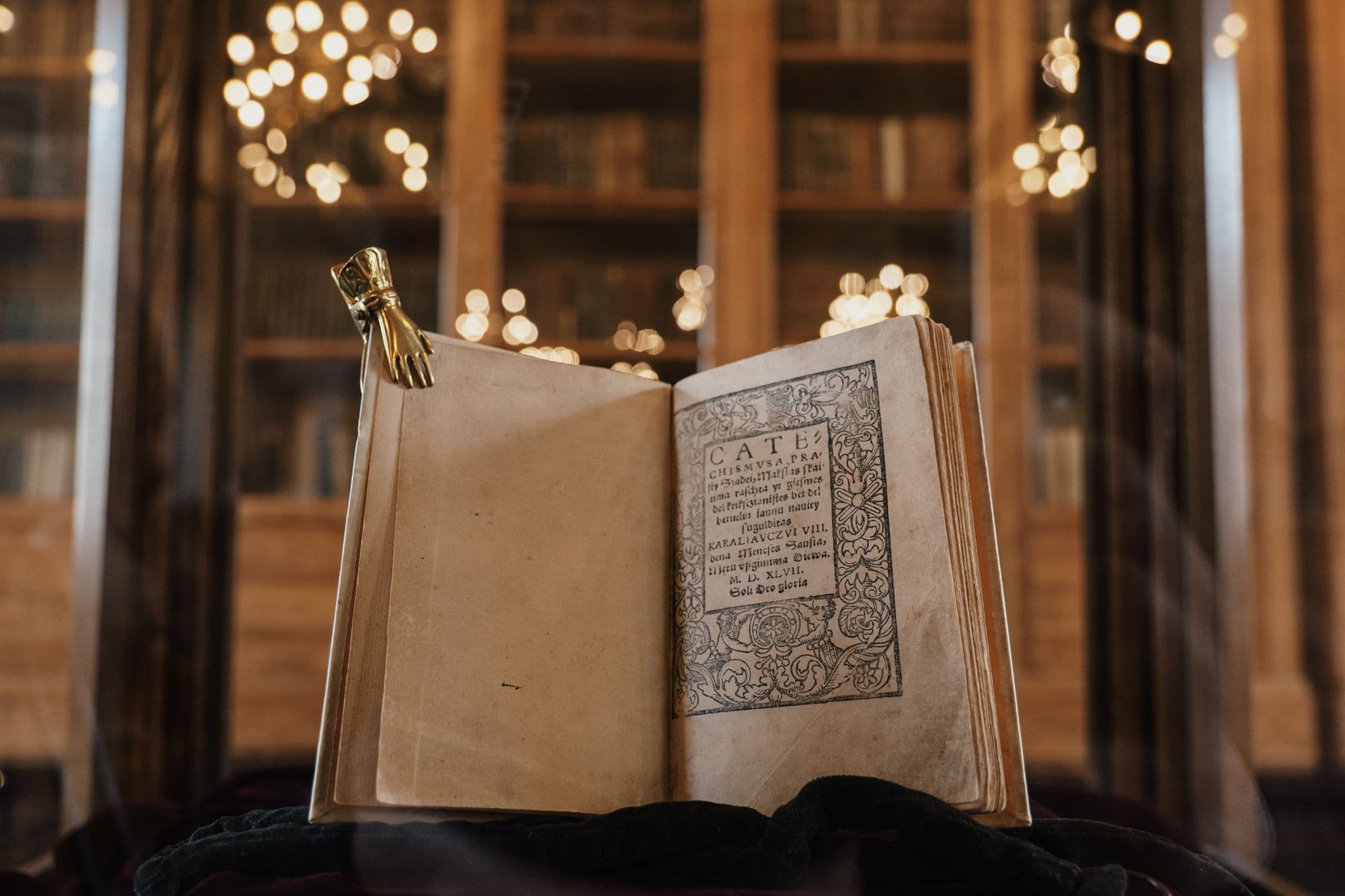
This initiative honors members of the Vilnius University community who, due to complex historical circumstances and the actions of totalitarian regimes, were expelled from the university and deprived of the opportunity to continue their studies, research, or work.