- 10 February 2026
R. Racz – the First Lithuanian Woman at CERN Studying Exotic Pentaquarks
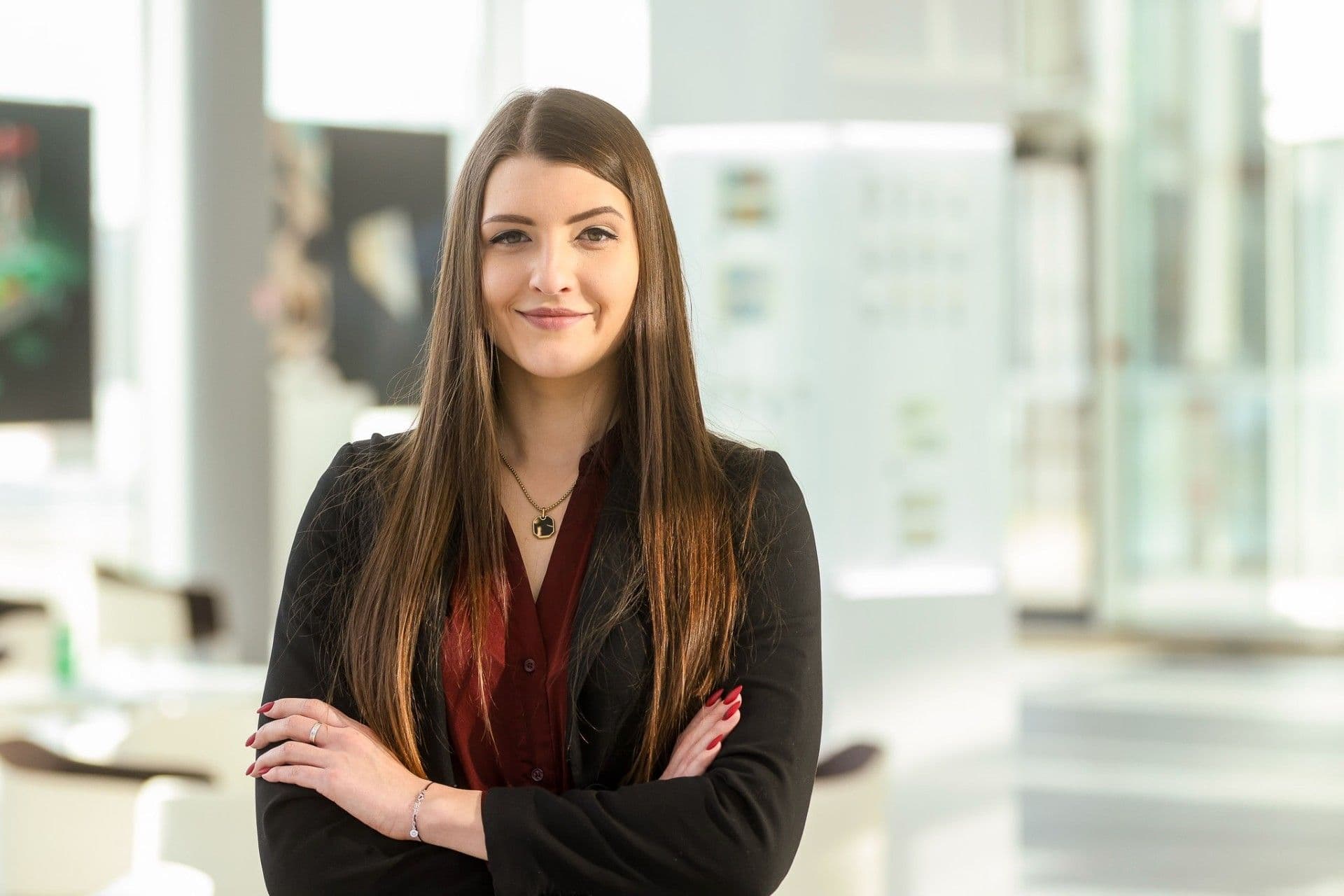
Rūta Racz, a doctoral student at the Faculty of Physics, Vilnius University (VU), is conducting her research at the European Organisation for Nuclear Research (CERN). She is the first VU doctoral student – and the first woman from Lithuania – to work on one of CERN’s flagship experiments, LHCb (Large Hadron Collider beauty).
Unravelling Events from 13.8 Billion Years Ago
When Lithuania became an Associate Member State of CERN in 2018, opportunities for Lithuanian researchers and students to contribute to world-class particle-physics research expanded significantly. They grew even further in September 2024, when VU became an official institute of the LHCb experiment.
“These newly opened opportunities are exactly what made it possible for me to begin my doctoral studies within the CERN LHCb experiment. Working in this international setting, I analyse one of the largest datasets in the history of Lithuanian science. It is a volume of data so large that even all the computers in Lithuania combined would not be enough to process it. Research on this scale requires international computing infrastructure – supercomputers around the world connected into a single shared network,” the doctoral student says.
It has been 13.8 billion years since the birth of our Universe – the Big Bang. While astronomical observations allow us to trace how the Universe has evolved, telescopes can only show it as it was about 380,000 years after the Big Bang.
“The earlier period remains ‘invisible’, because at that time the Universe did not yet have the conditions that allow light to travel freely. Experiments at CERN make it possible to study, in the laboratory, fundamental processes that took place in the early Universe and cannot be observed directly with telescopes. In this way, we can recreate conditions similar to those that existed just millionths of a second after the Big Bang,” R. Racz explains, adding that CERN’s technologies and analyses allow us to “rewind time” even further.
In CERN’s particle-physics laboratories, scientists working on the LHCb experiment seek to understand how complex matter emerges from the smallest “building blocks” of the Universe and which laws govern its behaviour. Research at LHCb helps address why the Universe looks the way it does today. “This kind of research – and the data analysis that comes with it – requires not only physics, but also mathematics, statistics, and programming, which is why my doctoral studies are so interesting and wide-ranging,” the young scientist says.
A young scientist from the Institute of Photonics and Nanotechnology at VU Faculty of Physics also highlights another advantage of this type of doctorate: flexibility. “I can do my analysis at CERN in Geneva, or in my own kitchen at 3 a.m., if I want to. For me, the opportunity to live in Lithuania while still being part of an international research centre is especially important. This doctoral programme also offers opportunities to travel – to deepen knowledge through international training schools and to present research results at scientific conferences. Compared with most doctoral studies, there is no real distance from the field’s leading experts. Working within the international LHCb community, I can communicate directly with top specialists every day – often they’re only a few messages away,” she says.
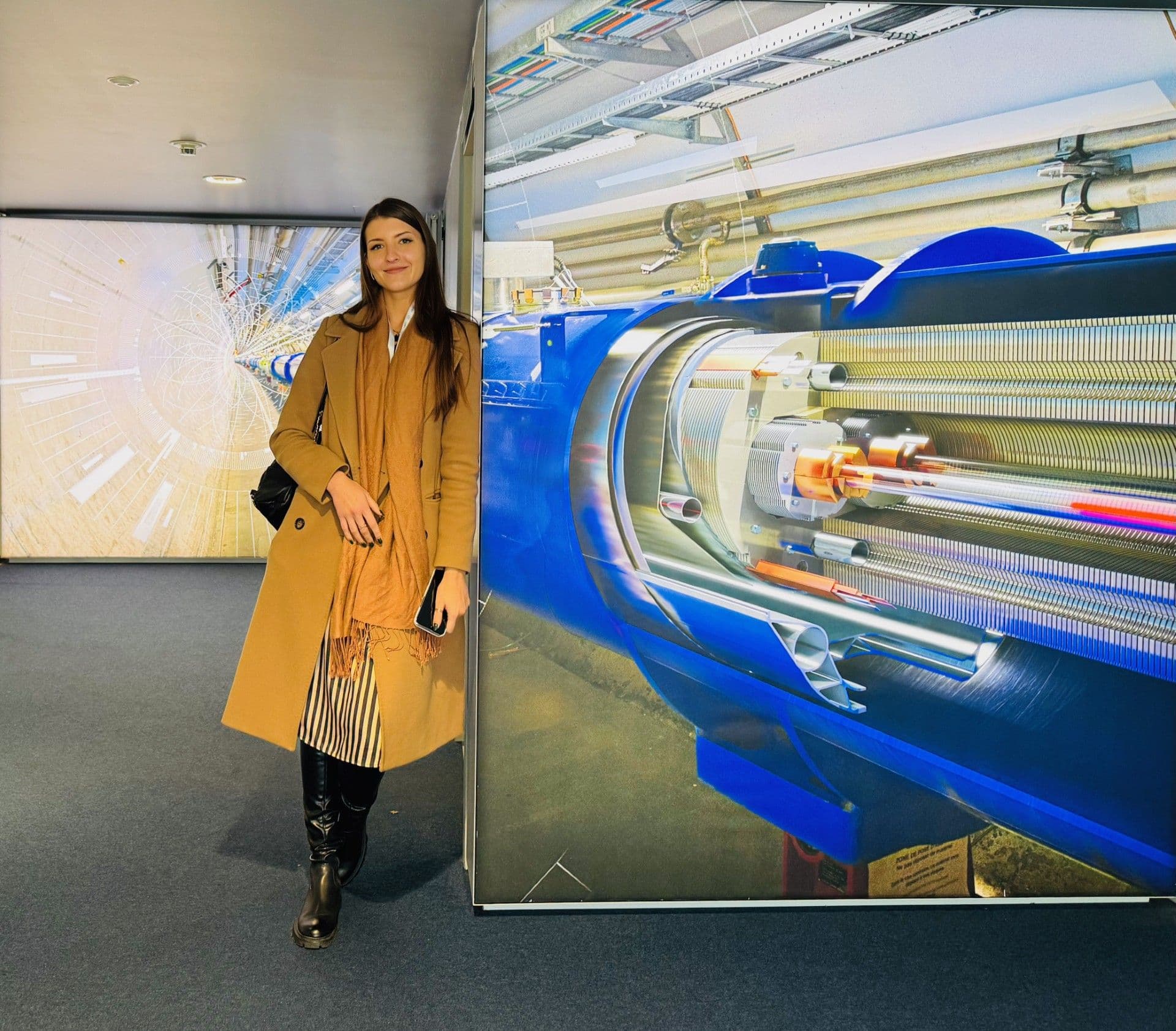
Rūta Racz. Personal archive photo
Searching for Exotic Particles
According to R. Racz, particles in the Large Hadron Collider move almost continuously throughout the year; as a result, the LHCb detectors operate for most of that time. This means their performance must be monitored in real time. To keep everything running smoothly, about 1,800 people from around the world contribute to LHCb – roughly 1,200 physicists (professors, researchers, doctoral students), along with several hundred engineers and technical specialists who ensure that the complex systems operate reliably.
“At least two people are on duty in the LHCb control room at all times. Most often, it’s the same scientists and doctoral students who are also running their own independent research and data analyses. I’ve worked such shifts as well. Since I’m more of a night owl, I often chose to take night shifts, when the control room is quieter, and I was almost alone with dozens of screens filled with numbers, diagrams, and graphs. My job was to make sure everything was running correctly and to spot any deviations in time,” she says.
One of the LHCb experiment’s primary research goals is the search for exotic and extremely rare particles. “The ordinary matter we’re familiar with – everything around us that we can touch, including ourselves – is made of protons and neutrons. These particles are stable, or in other words, long-lived: they have existed almost since the Big Bang and will continue to exist for billions of years. Protons and neutrons, in turn, are made of three quarks. But the laws of nature also allow more complex and much rarer particles to exist – built from four, five, or even six quarks,” the young scientist explains.
Her research focuses on the search for pentaquarks (particles consisting of five quarks). The LHCb experiment, thanks to the unique design of its detectors, is able to register such particles. “These are extremely rare particles that exist for an incredibly brief moment and decay almost immediately. We find them in the Large Hadron Collider, produced in particle collisions. You can compare the search for pentaquarks to trying to pick out one specific voice in a huge, noisy city,” a physicist says. Experimental and theoretical pentaquark research is carried out in only a limited number of countries – including Japan, Germany, Italy, the United Kingdom, and Lithuania.
Helping Us Understand the World
“When people learn that I work in physics, many say: ‘I wasn’t good at physics in school, so I lost interest in it later in life.’ Honestly, physics didn’t always come easily to me at school either,” R. Racz recalls.
Her interest in physics grew out of a desire to understand how the world around us works. “I wanted to understand why planes fly, why charged hair stands on end, how magnets work, or why screens respond to our touch. It wasn’t enough for me to live in a world where I see everyday phenomena but don’t understand them at a fundamental level,” she says.
R. Racz studied physics at VU. “After finishing my master’s degree, I thought that, like many people, I would move into the private sector and that would be the end of my academic path. But after a year, I realised my brain didn’t have enough work – I wanted not only to apply what I knew, but to keep learning. That’s how I arrived at particle physics – a field that studies the world at its most fundamental level,” she says.
In her interactions with school students, she notices both curiosity and doubt. “You don’t need to be the best in your class to pursue what truly interests you. Curiosity, effort and the desire to understand are the most important criteria when choosing the path of a physicist,” she adds.
R. Racz also shares her knowledge and expertise with school students, gives lectures about the world’s largest physics laboratory and scientists’ achievements, and contributes to science-communication initiatives.
R. Racz’s doctoral research is supervised by VU particle physicist Dr Mindaugas Šarpis, Head of the “LHCb Vilnius” group. In 2024, by decision of the LHCb Collaboration Board, VU was accepted as a new institute of this prestigious experiment. Two years later, the partnership reaches a new stage: this September, Vilnius will host an LHCb Week for the first time – one of the largest annual meetings of the LHCb experiment, expected to bring together around 600 physicists from around the world.
In autumn 2025, Lithuanian higher-education institutions, including VU, signed a memorandum with CERN regarding participation in the feasibility study for the Future Circular Collider project. Lithuania and CERN continue to strengthen their strategic partnership. CERN – the world’s largest particle-physics laboratory, located on the Swiss–French border – brings together researchers from more than a hundred countries to study elementary particles and the forces that govern their interactions. Lithuania became an Associate Member State of CERN in 2018.