- 28 August 2026
- Aurita Petrulytė
VU Astrophysicist: “Nancy Grace Roman is One of the Most Ambitious NASA Telescopes of the 21st Century”
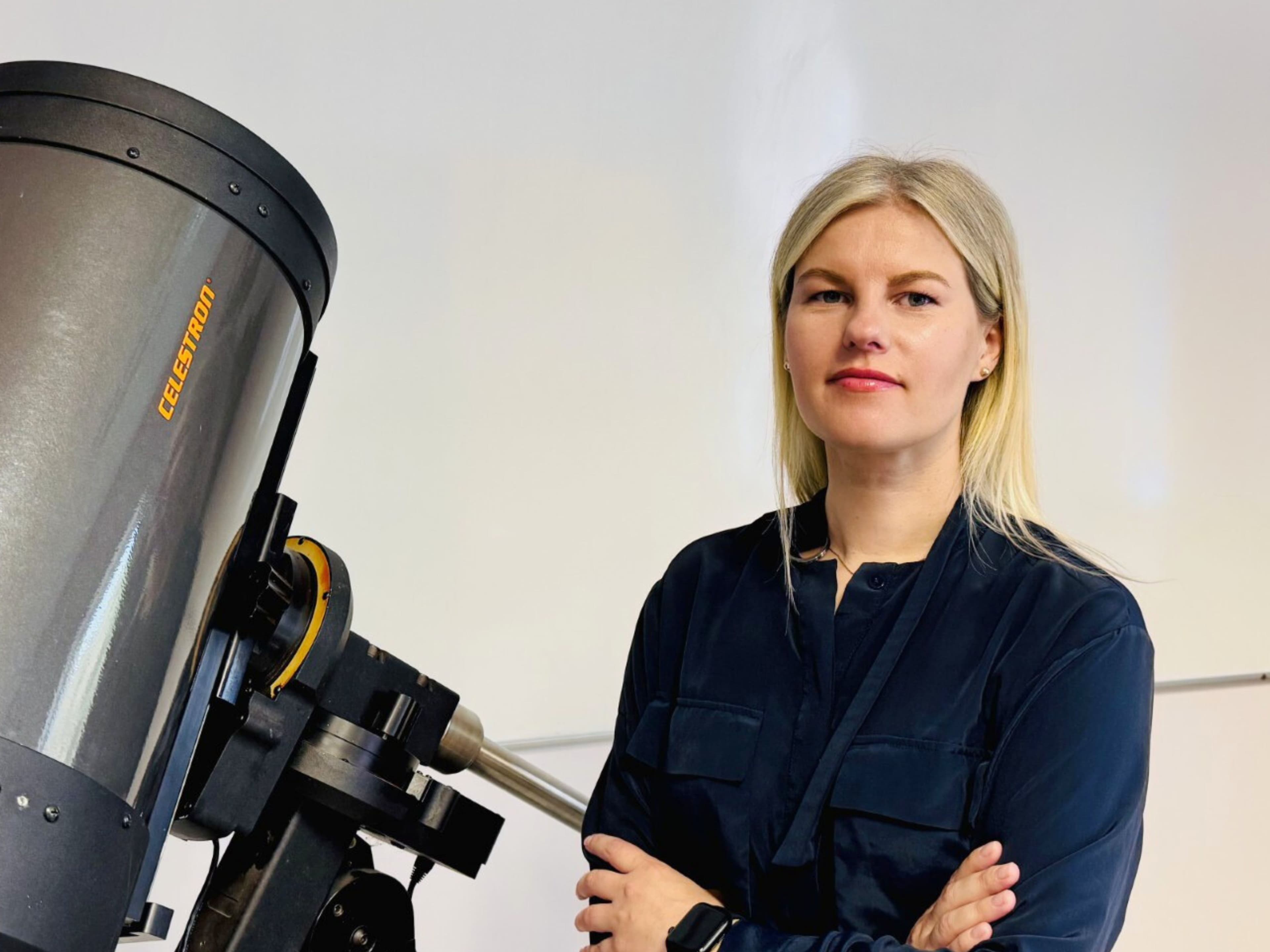
The Nancy Grace Roman Space Telescope (NGRST) is set to be launched into space on 30 August. Associate Professor Edita Stonkutė, an astrophysicist at Vilnius University (VU), describes it as one of NASA’s most ambitious space telescopes of the 21st century, designed to expand humanity’s understanding of the Universe fundamentally. This wide-field telescope will enable the observation of vast regions of the sky, the study of dark matter and dark energy, and the search for thousands of new exoplanets, including Earth-like worlds.
“Hubble’s Mother”
The telescope is named after Dr Nancy Grace Roman (born 1925). She was the first director of NASA’s astronomy programmes and one of the key architects of the Hubble Space Telescope. Whilst still at school, Dr Roman decided to devote her life to astronomy, despite the negative attitudes and scepticism towards female astronomers at the time. She joined the newly established NASA (National Aeronautics and Space Administration) in 1959.
“During her nearly two decades at NASA, she sought political and financial support for the Hubble Space Telescope: she brought together scientists, engineers and politicians, shaped the telescope’s scientific aims, and contributed to key technological decisions. Her colleagues even nicknamed her “Mother of Hubble”. And today, one of NASA’s most ambitious space telescopes of the 21st century bears her name, with a goal as bold as the one she herself once pursued – to fundamentally expand humanity’s understanding of the Universe,” says Assoc. Prof. Stonkutė.
The telescope that wasn’t meant to exist
The history of the NGRST is extraordinary. It is based on a system that was not originally designed for astronomical observations. “Following 11 September 2001, the US National Reconnaissance Office commissioned extremely powerful space-based telescopes for reconnaissance purposes. Later, part of this programme was cancelled, leaving the NRO with surplus 2.4-metre-diameter telescopes. In 2012, one of them was offered to NASA. The agency seized this opportunity, and this very system became the basis for the future Roman telescope. In a sense, this is a telescope that was never meant to exist. Designed for military purposes on Earth, it will now be used to explore the most distant galaxies and the greatest mysteries of the Universe,” explains Assoc. Prof. Stonkutė.
According to the astrophysicist, when comparing the NGRST with, for example, the James Webb Space Telescope (JWST), it stands out for its wide field of view: “If the JWST is like an extremely powerful zoom lens that allows us to peer into the most distant and oldest regions of the Universe and study them in detail, the Roman telescope is more like a wide-angle camera capable of quickly surveying vast sections of the sky. Although NGRST will not be as sensitive to fine details as the JWST, its vast field of view will enable it to create detailed maps of space and detect rare or hard-to-spot phenomena. Webb helps us uncover what the early Universe was like, whilst Roman will enable us to understand how it has evolved and taken shape over billions of years.”
The NGRST weighs around 10.5 tonnes and will operate at the stable second Lagrange point of the Sun-Earth system, approximately 1.5 million kilometres from Earth – the same location as the JWST. The new telescope’s primary mirror is the same size as Hubble’s – 2.4 metres in diameter. Nevertheless, it is superior to the latter.
“The Roman wide-field camera will cover an area of the sky approximately 100 times larger than Hubble, whilst maintaining similar image quality. This will enable the creation of unprecedented maps of the Universe, the observation of hundreds of millions of galaxies and the discovery of thousands of new planets. Put simply, Roman will be like a sky scout. To compare, Hubble is a photographer with a keen eye for detail, whilst Webb is a space detective, uncovering the deepest secrets of the Universe,” explains the scientist.
Dark energy, dark matter and new worlds
The NGRST has three main scientific objectives: to discover an Earth-like planet and to help us better understand dark matter and dark energy.
“The main challenge is to gain a better understanding of dark energy, which is thought to be driving the accelerating expansion of the Universe. The telescope will observe billions of galaxies and thousands of supernovae, enabling scientists to reconstruct the history of the Universe’s expansion with exceptional precision. And by observing the distortions in the light from distant galaxies, it will be possible to detect the influence of dark matter, which is not directly visible. Based on these observations, some of the most accurate maps of dark matter distribution in human history will be created. The third major area of focus is the search for exoplanets (planets beyond the Solar System),” says Assoc. Prof. Stonkutė.
According to the astrophysicist, over 6,350 exoplanets have already been discovered. It is expected that Roman will discover more planets beyond the Solar System than any previous space telescope. Some of these may be Earth-like, so the telescope will help answer one of the most important questions in modern astronomy: Is our planet unique, or are such worlds abundant in the Universe after all?
A method used by VU astronomers to search for planets
NGRST will search for planets primarily using the gravitational microlensing effect. This is the method used by astronomers at Vilnius University, who, in collaboration with Polish scientists, are using it to search for stellar-mass black holes in the Milky Way and who also contributed to the discovery of the exoplanet AT2021ueyL b.
“This phenomenon occurs when a star or other object passes in front of another, more distant star. The gravity of the closer star acts like a lens, briefly amplifying the light from the more distant one. If a planet orbits the first star, it causes an additional, very brief change in brightness. By analysing these changes, astronomers can determine that the planet exists and estimate its mass and orbital characteristics. This method is particularly valuable as it allows the detection of planets that are very difficult to find by other means, including small, Earth-like planets located far from their star. Most microlensing events cannot be predicted in advance, so in order to detect as many of them as possible, it is necessary to observe as large an area of the sky as possible. This is precisely where Roman has the edge over other telescopes that have searched for exoplanets using different methods. It is hoped that Roman will discover thousands of new exoplanets and significantly expand our knowledge of the diversity of planetary systems in our Galaxy,” explains the researcher.
The Roman data will combine space-based and ground-based observations
The Roman mission will create one of the largest publicly accessible archives of astronomical data in history, benefiting not only NASA and the world’s major research centres. Scientists from all over the world, including those in Lithuania, will be able to make use of this data.
“The data collected will be valuable for research into galactic evolution, cosmology, large-scale structures in the Universe, dark matter and exoplanet populations. Furthermore, the vast amounts of data will provide new opportunities to apply artificial intelligence and machine learning methods to the analysis of astronomical observations. In modern astronomy, access to telescopes is no longer as crucial. The ability to process and interpret big data is becoming increasingly important, enabling the Lithuanian astronomical community to work with the same datasets as scientists at NASA, the European Space Agency, or the world’s leading universities.
The discoveries made by the Roman mission could serve as a starting point for ground-based observations. Lithuanian astronomers will be able to contribute to international observation campaigns by using the telescopes at VU’s Molėtai Astronomical Observatory to conduct additional observations of the most interesting or unexpected objects and refine our understanding of their properties. Such a partnership between space-based and ground-based observatories is one of the most important drivers of advanced astronomical research today,” says the astrophysicist.