- 1 July 2026
- Aušra Kudirkaitė
VU Physicists Create Sensor That Detects and Locates Radiation with Precision

Scientists from the Faculty of Physics at Vilnius University (VU) have developed a sensor capable of accurately detecting radiation, identifying its sources, and determining their intensity and precise location. The device, developed by physicists at the Institute of Photonics and Nanotechnology, Photoelectric Phenomena Research Group, is designed to measure radiation doses. It can detect doses ranging from very small to very large ones, including those typical of industrial environments or nuclear emergencies, from a few gray to megagray.
“The sensor, smaller than a pea, is composed of three distinct layers, each providing unique complementary information. Because different types of radiation interact with these layers in different mechanisms, the device can distinguish and analyse a wide range of radiation signals with high precision,” Prof. Tomas Čeponis said.
An oriented triplex sensor and a method of identifying the radiation source location and its dosimeter are devoted to measuring radiation by detecting specific changes within the sensor’s materials. VU researchers have been studying the impact of radiation-induced changes on the material parameters for many years. “We aim to explain the underlying physical phenomena, the effects of radiation, and characterise the defects it causes in semiconductors. Some findings appear to have practical potential and can be applied to design novel prototype devices,” remarked Prof. Čeponis.
According to VU physicists, the device they have developed can be used not only in scientific laboratories conducting high-energy experiments, but also for monitoring radioactivity at nuclear power plants, detecting radioactive sources at nuclear accident sites, and for industrial and civil protection purposes. The sensor can also operate remotely; for example, using drones would allow a hazardous area to be examined quickly and safely.
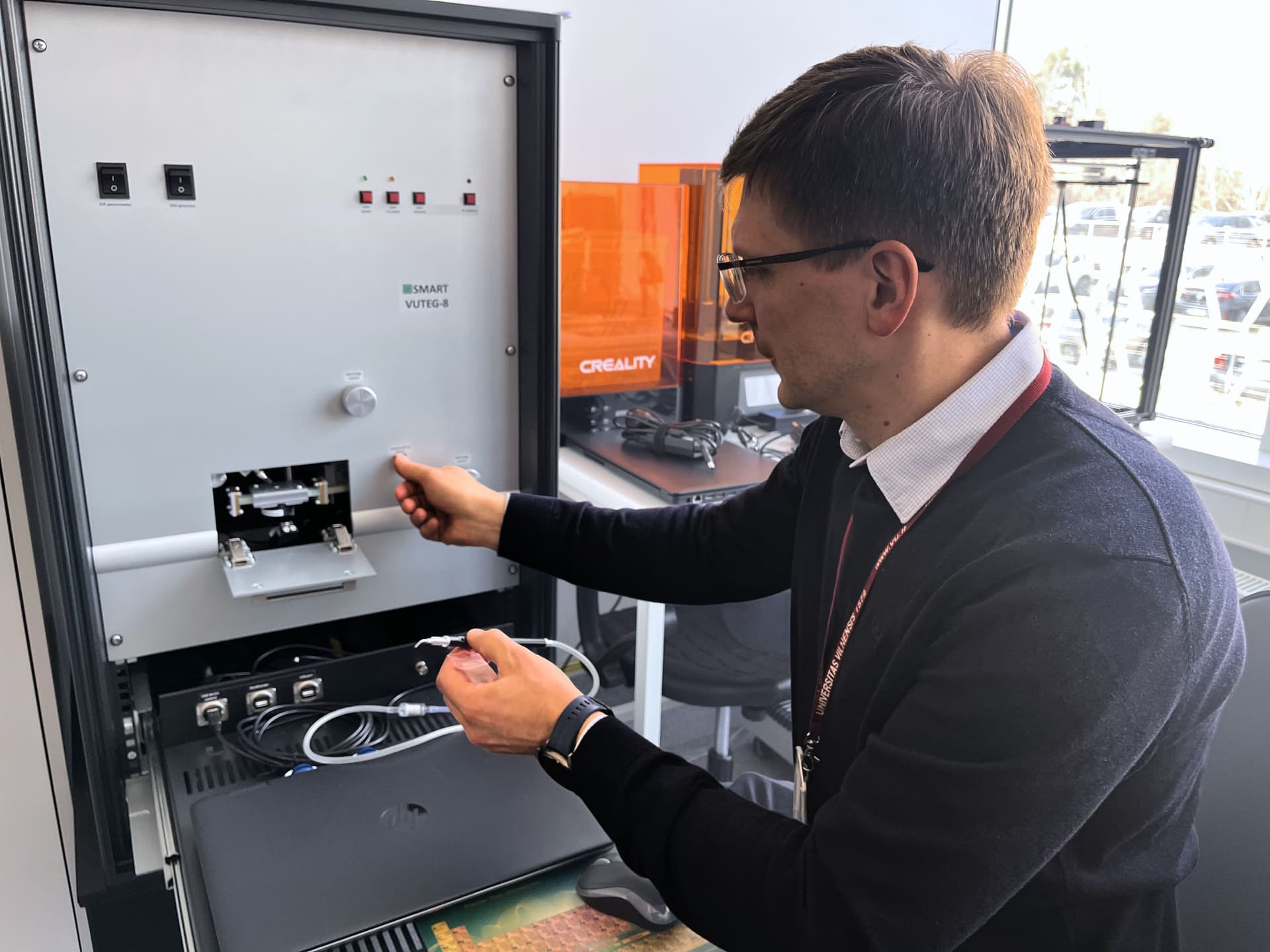
Prof. Tomas Čeponis. Photo from personal archive.
“It is possible to determine which type of radiation predominates in the environment and how the sensor has been irradiated. It can register a very wide range of radiation doses and intensities, accurately identify the direction from which the radiation is emerging in real time, and estimate the distance to the radiation source,” explained the VU physicist.
The predecessor to this device, designed for assessing the effects of ionising radiation on materials and for dosimetry, was developed by VU researchers led by Prof. Eugenijus Gaubas. The instrument has been installed and is currently in use at CERN – the European Organisation for Nuclear Research.
The triplex sensor and its readout device were patented in 2025. “The sensor consists of three layers: a scintillator, an organic ESR (electron spin resonance) sensor, and a semiconductor photosensor, whose signals are read sequentially by a dedicated device. Laser radiation illuminates the scintillator (a material that emits light when exposed to ionising radiation), and the emitted signal is collected via an optical fibre and recorded with a spectrophotometer. The semiconductor photosensor is excited by another laser source, and its microwave response is measured. The signal from the organic sensor is obtained using an ESR spectrometer. A combined analysis of these signals makes it possible to determine the radiation dose and the radiation spectrum,” said Prof. Čeponis.
For this invention, Prof. Gaubas, Prof. Čeponis, Dr Laimonas Deveikis, Dr Jevgenij Pavlov and Assoc. Prof. Vytautas Rumbauskas received the VU Rector’s Award for significant scientific achievements in the category of best applied research.