


Dinosaurs & Astrophysics: Rethinking Science with Spanish Cosmologist Prof. Vicent J. Martínez
 Prof. V. J. Martínez. Photo from the personal archive.
“Astronomers and cosmologists are fortunate to work in a field that inspires great fascination. People want to learn about the universe – it’s their universe,” says Prof. Vicent J. Martínez, a leading Spanish astronomer and cosmologist known for his research on galaxy clustering and the large-scale structure of the universe.
Prof. V. J. Martínez is also a gifted science communicator, recognised for making complex cosmic ideas accessible to the public – a mission he continues during his first visit to Lithuania and to Vilnius University (VU).
Fractals in the Sky: The Hidden Geometry of Galaxies
The first spark that drew him toward astronomy came during his studies as a college mathematics student. He realised that many of the mathematical concepts he was learning could be applied in astronomy.
The professor at the University of Valencia was the first to apply fractals in his field. Although these are often presented as abstract mathematical objects, their imprints can also be found in the universe itself – they act as a window into how matter arranges itself on the grandest scales.
“Mathematical fractals are self-similar objects at all scales. In nature, this scale invariance only occurs within a certain range of distances, and this is precisely what happens with the distribution of galaxies. They are not distributed uniformly but form a cosmic texture, with clusters, filaments, walls, and voids that behave like a fractal at certain scales. However, when considering larger volumes of the universe, galaxies trace a gradual transition to a homogeneous distribution, losing this fractal behaviour,” explains the scientist.
Tabby’s Star Riddle
Prof. V. J. Martínez was one of the authors of the Giant Planet with Trojans theory, which explains the mysterious behaviour of Tabby’s star.
Since its discovery, the Tabby’s Star has been a mystery to scientists. Its light would fade and then intensify without any discernible pattern, even though, in theory, it should have remained stable.
“Tabby’s Star displayed a very strange light curve with deep dips in brightness that appeared to be due to objects passing between the star and the observer, in this case, the Kepler Space Telescope. Our interpretation that it could be a ringed giant planet with clouds of Trojan satellites at the corresponding Lagrange points of its orbit attracted considerable attention. Unfortunately, this hypothesis had to be discarded because the observations predicted by this model never occurred,” says the professor.
Dark Matter Remains Yet Unsolved
Speaking of dark matter – one of the greatest unresolved mysteries in modern physics – the cosmologist emphasises the significance of two papers published more than half a century ago by Estonian and American astronomers.
“Dark matter was postulated almost 100 years ago, but its nature remains unknown. However, the “tipping point” in favour of dark matter was a pair of papers published 51 years ago. The Estonian astronomers Jaan Einasto, Ants Kaasik and Enn Saar and the North American astronomers Jeremiah Ostriker, Jim Peebles and Amos Yahil both published in 1974, each summarising data from many observations where dark matter was needed.
Since then, the search continues, both through astronomical projects that seek to determine astrophysical scenarios where its presence is not only evident but also its characteristics can be determined, and in large particle accelerators such as the LHC at CERN. It is possible that in the future, the Large Hadron Collider, which discovered the Higgs Boson in 2012, may discover an exotic particle compatible with cosmic dark matter. It is also possible that dark matter does not exist, and we would have to revise our cosmological paradigm. Alternative theories exist, but they are not very popular,” says Prof. V. J. Martínez.
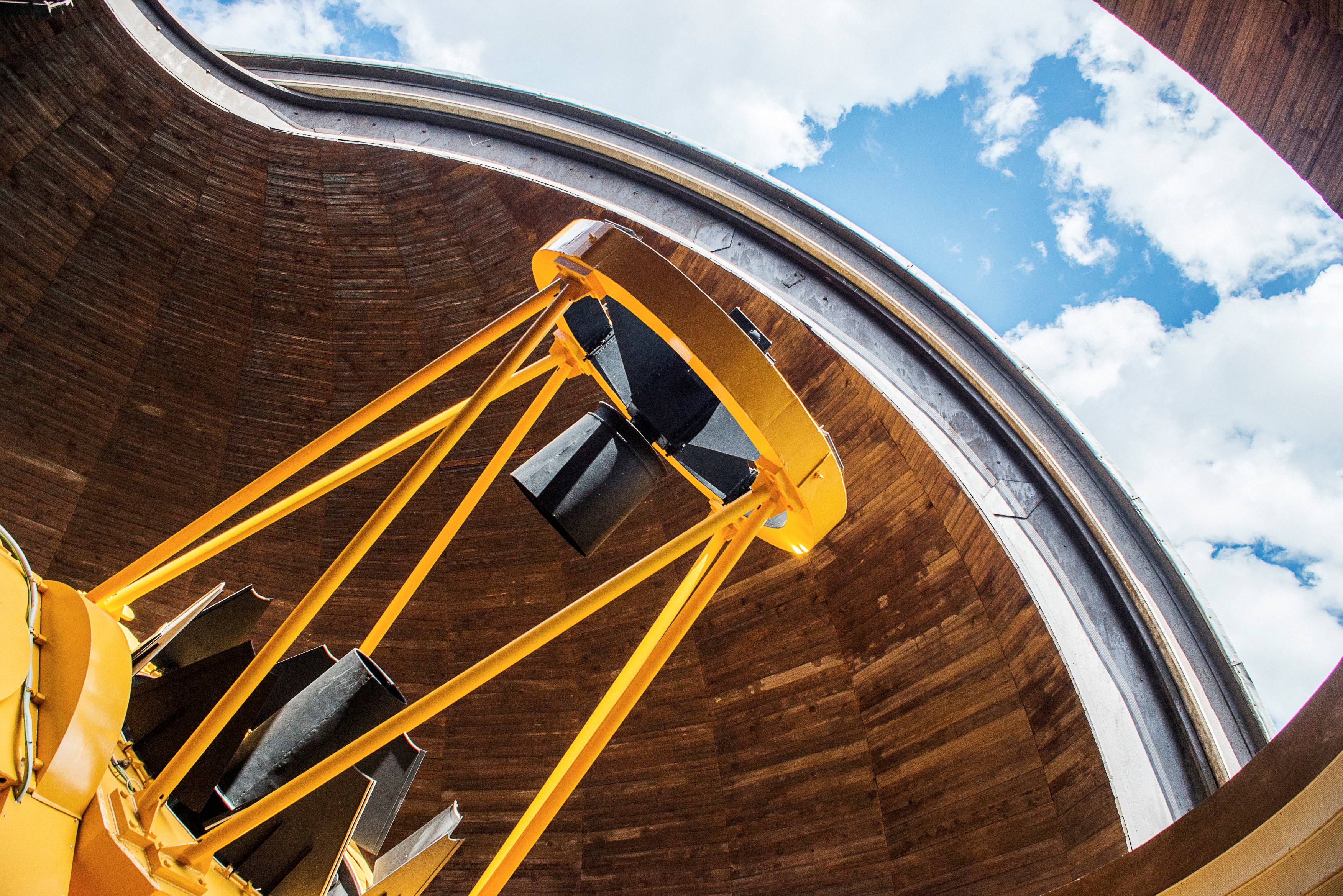 The 1.65 m telescope of the Molėtai Astronomical Observatory, Institute of Theoretical Physics and Astronomy, Faculty of Physics, Vilnius University. Photo by Andrius Zigmantas.
What Killed the Dinosaurs: Debunking Science Myths
During his visit, Prof. V. J. Martínez gave a public lecture at the VU Faculty of Physics about misconceptions in science. The astronomer views science as no different from other human activities because it operates by the same principle: when an idea is accepted as dogma by the community, it is difficult to overthrow it, regardless of whether it is true or false.
“Our “truth” is just the ideas, which we call theories, hypotheses, models and scenarios, that agree most closely with the results of observations and experiments, at a given moment. Scientists may accept things that they later reject as false,” explains a cosmologist.
Prof. V. J. Martínez challenges the meteorite theory, the most widely known explanation for the extinction of dinosaurs. While the meteorite impact remains widely known, the volcanic hypothesis presents a serious alternative. Massive volcanic eruptions in India occurred around the time of the extinction of the dinosaurs.
“There have been five mass extinctions since life appeared on Earth. We have evidence of extensive volcanic activity in almost all of them. In the last one, 66 million years ago, when the non-avian dinosaurs disappeared, two things happened: an asteroid more than 10 kilometres in diameter struck the Earth, leaving a crater in the Yucatán Peninsula, Mexico, and for hundreds of thousands of years, tremendous volcanic activity was occurring in India. The ejected lava covered an area comparable to France, leaving layers of basalt about 3 kilometres thick – these are now called the Deccan Traps. The fossil record studied by Princeton palaeontologist Gerta Keller shows that the asteroid impact occurred 200,000 years before the extinction, so it could not have been the main cause,” explains the researcher.
Baltic Connections and VU Observatories
During his visit to Lithuania, he visited the VU Molėtai Astronomical Observatory and both VU observatories, where he familiarised himself with both modern equipment and the history of astronomy in Lithuania.
“The three observatories are impressive. I visited them in reverse order of construction, from newest to oldest, but they clearly demonstrate the continuity of interest in astronomy in Lithuania over the centuries,” says Prof. V. J. Martínez.
The cosmologist sees promising opportunities for collaboration with the Astrospectroscopy and Exoplanets group at VU, especially through shared access to observatories in both countries.
“Collaboration with Estonian colleagues has been essential in my scientific career. It was very productive. The collaboration I’ve begun here in Lithuania will surely continue with future research projects involving my group in Valencia and the VU Astrospectroscopy and Exoplanets group in Vilnius,” tells the professor.