


Doctoral Integration Day: Doctoral Studies Open Paths Beyond Academia
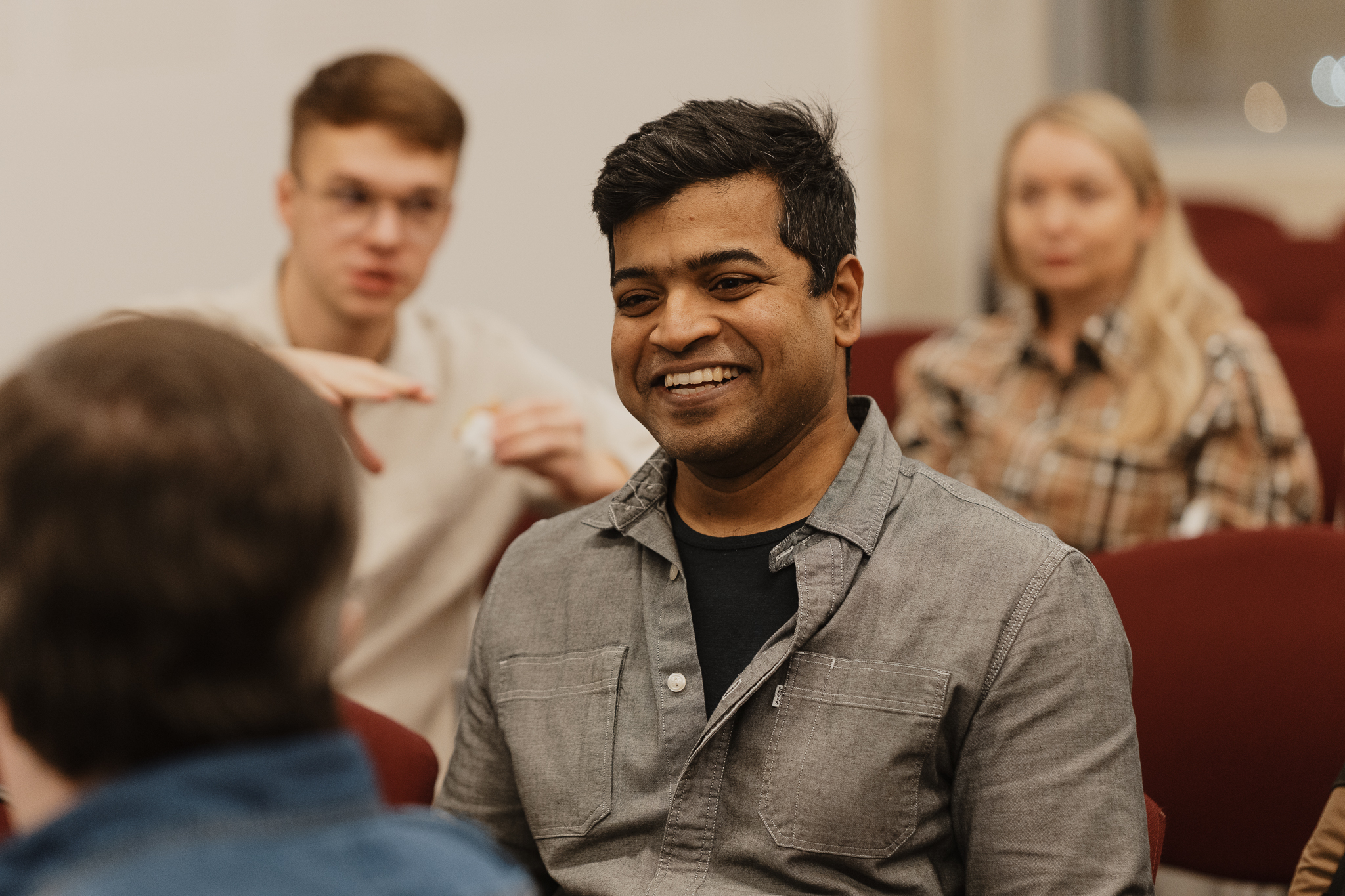 On 1 December, an event of the Doctoral Integration Day took place in the spaces of the Vilnius University Life Sciences Centre (VU LSC). Several dozen VU doctoral students from various fields of science participated in it, most of them were first-year students. The event was organised in English, also including the international VU doctoral community.
The participants were welcomed by the VU Vice-Rector for Research, Prof Gintaras Valušis. The essential aspect of his speech was the multifaceted nature of doctoral studies. According to the Vice-Rector, in Lithuania, it is often assumed that perhaps the main path after this level of studies is an academic one. However, in reality, he noted, the spectrum of skills and abilities acquired during the doctoral years can be effectively applied in many different spheres: when creating one’s own business or working in the business sector, in the public sector, in politics, and elsewhere.
After the Vice-Rector, the International Students Affairs Coordinator of the VU Students’ Representation (SA), Uršulė Barkauskaitė, spoke, presenting a new initiative for doctoral students – a programme based on the principle of mentorship, during which senior doctoral students or those who have already completed their studies (not more than seven years ago) help first-year students, who have just stepped onto the path of doctoral studies, to integrate more easily.
Those wishing to register for this programme (both as participants and as mentors) can do so here.
The event then continued with a discussion with neuroscientist, LSC Professor Urtė Neniškytė. The conversation was moderated by Doctoral Studies Coordinator Gabija Strumylaitė.
With the professor, who began her academic journey at VU and later continued her doctoral studies at the University of Cambridge (United Kingdom), the discussion centred on the many challenges faced by doctoral students – from the subtleties of time management to relationships with supervisors – and the broad career opportunities after studies. The audience actively engaged in the discussion, asking questions about preparing proposals for research projects, the development of artificial intelligence (AI), or the application of doctoral competencies in the labour market.
“The event was very enjoyable because it helped me to set my mindset for the studies, to get acquainted with some colleagues, and to learn about mentoring opportunities. The most striking and surprising aspect for me was Urtė’s optimistic view of the use of artificial intelligence tools – in her opinion, AI is not capable of replacing either the profession of a researcher or the value of science as an impartial process of explaining reality,” said first-year doctoral student in management, Dovilė Bajoraitė-Dijokienė, reflecting on the Integration Day.
“Coming from mathematics, I found it very interesting to hear a neuroscientist describing how her research works in a laboratory setting. My work is different, as we do not have a laboratory, and our research is mostly about developing new mathematical results or running computer simulations, but I still found many useful principles and strategies that can be applied in mathematics,” said first-year mathematics doctoral student from Italy, Luca Zanardelli.
He also appreciated the warm and supportive atmosphere of the event and noted that the vision of the PhD presented at the beginning of the session – not only as an academic but also as a personal journey – impressed him and made him reflect on what kind of researcher he himself would like to become.