


Ready to Defend: How the VU Community Contributes to National Defence
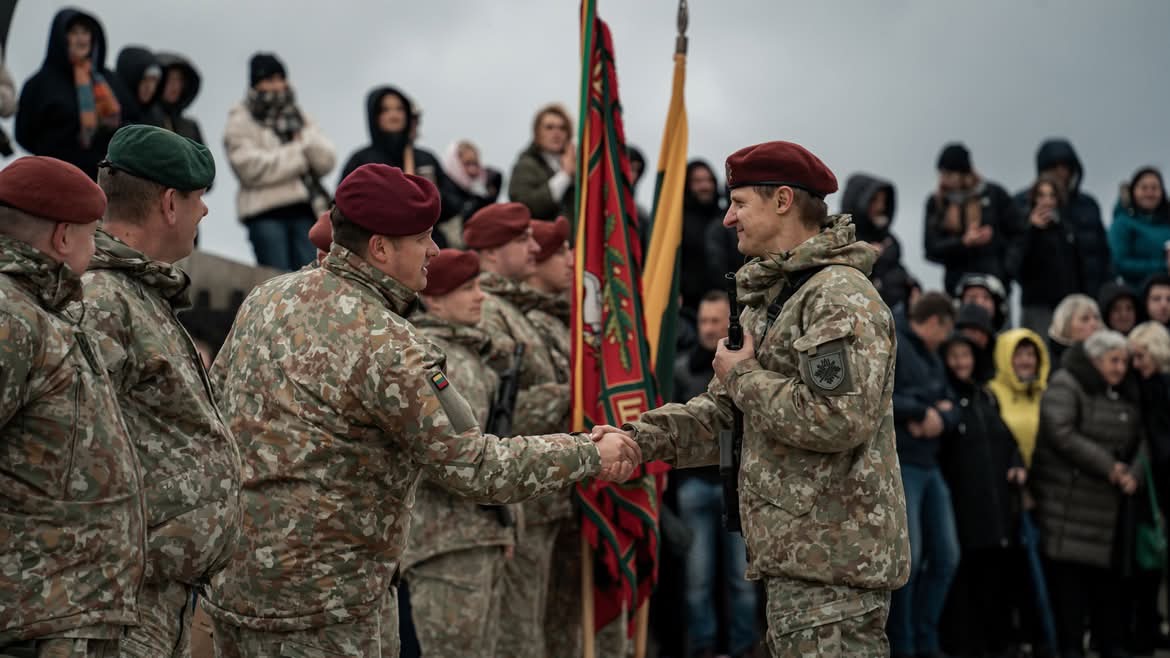 As the geopolitical situation in the region has worsened in recent years, increasing numbers of people are seeking ways to contribute to Lithuania’s defence, and members of the Vilnius University (VU) community are no exception. VU representatives who have joined the Lithuanian National Defence Volunteer Forces (KASP from ‘Krašto apsaugos savanorių pajėgų’) or the Lithuanian Riflemen’s Union say that involvement in civil resistance not only helps them acquire new skills and a greater sense of confidence but also strengthens their understanding that the security of the country largely depends on the determination of its citizens to defend it.
A Commitment to Lithuania Leads to KASP Service
Prof. Linas Mažutis, a researcher at the VU Life Sciences Center, joined KASP this year and completed the basic training for volunteer soldiers just over a month ago. The researcher explains that he decided to join KASP out of a deeply rooted belief in the future of his country.
‘The more people in our country are ready, know how to act in case of war, and can handle a weapon, the less likely others will be to attack us. They will understand that the majority of society is prepared and capable. If only one or two percent of people know how to act in war, such a country is easy to occupy,’ Prof. Mažutis said.
‘We cannot rely solely on Germans or Americans for our defence; we must demonstrate through our own actions that we are ready to defend ourselves,’ he added.
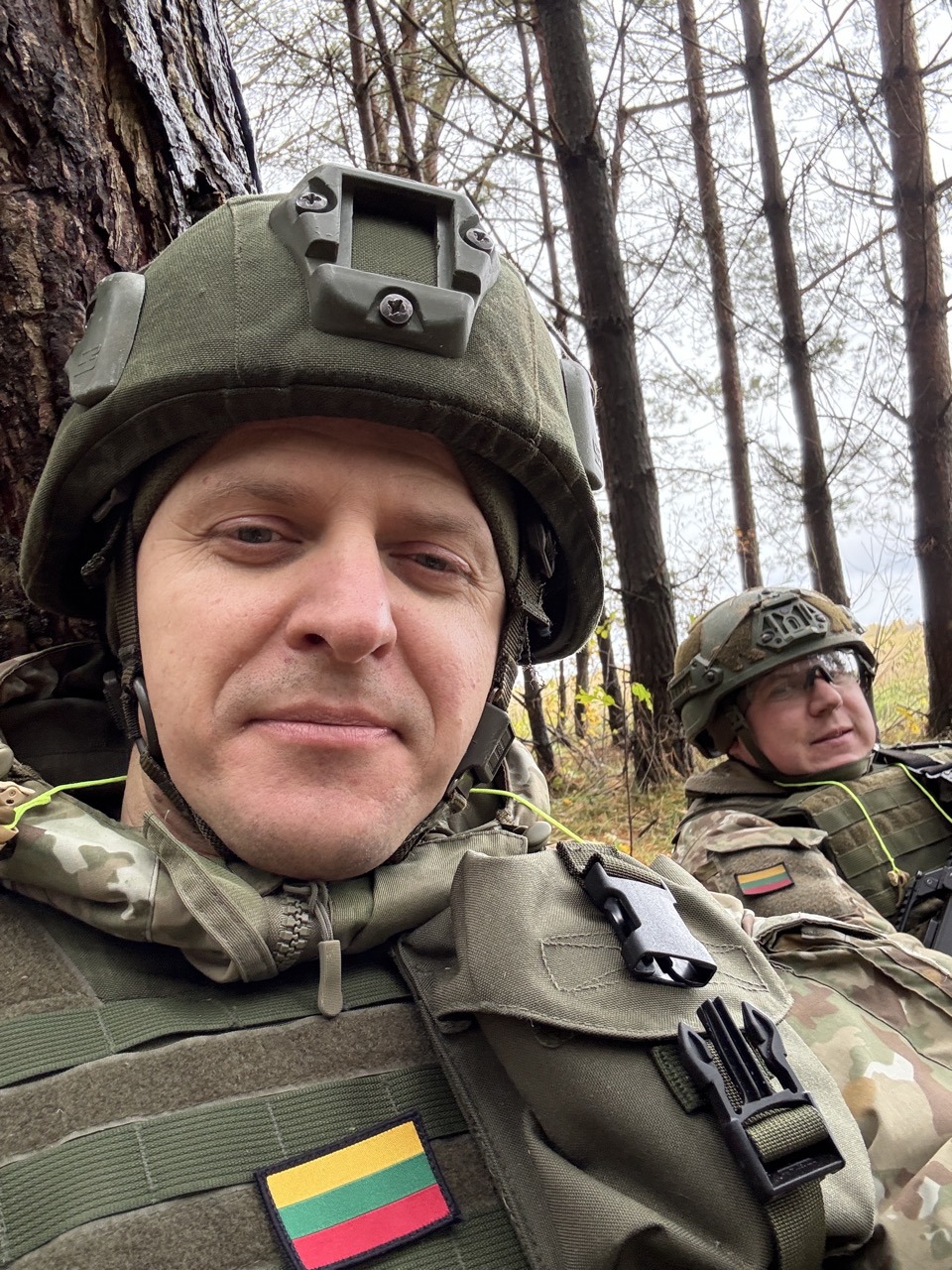
According to the Professor, the basic training for volunteer soldiers lasted three weeks. The first two weeks focused on knowledge building, including studying material, learning map reading, and acquiring specific military skills. ‘The last week was dedicated to physically demanding tasks. It was one of the toughest physical challenges I have ever faced,’ the researcher admitted.
‘We had to pass the ‘deadly loop’ by crawling, creeping, and rolling. All of this while wearing our full kit: helmet, gun, and vest. I have never imagined crawling on the ground could be so exhausting, especially uphill. As you crawl, the sand slides beneath you – you feel like you’re moving nowhere while the sand slips away,’ Prof. Mažutis recalled.
Upon completing the training, the Professor was recognised as the best marksman. He reflects on the sobering reality of using a weapon: while shooting at a target, you become a target yourself. ‘In war, someone is your target, but you are also somebody’s target. It gives you a clear insight that war must be avoided at all costs,’ he said.
‘Even exhausted, as you are taken back to the barracks in an off-road Unimog truck, you know that tomorrow will be the same. It gives you a vivid understanding of what daily life would be like in case of conflict,’ the Professor added.
‘All citizens share a duty: to defend their castle’
Augustė Burinskaitė, a doctoral student at the VU’s Faculty of History, says she joined the Lithuanian Riflemen’s Union while still at school.
‘I grew up pounding the streets of Vilnius, which probably explains why I was drawn to spending quality time outdoors – in forests, under a starry sky. Carrying a 20-kilogram backpack and spending sleepless nights in a soaking-wet sleeping bag during winter snowstorms, all while preparing for final school examinations, was the price I paid as a young Riflewoman – and I paid it with pleasure. There are many interesting and diverse patriotic organisations in Lithuania, but I believe that the desire to challenge oneself, combined with determination and mindfulness, is a distinctive and unifying feature of all members of the Riflemen’s Union,’ said the doctoral student.
Burinskaitė was sworn in as a Riflewoman in March 2014. ‘As we used to joke with our brothers and sisters at the time, the Riflemen’s Union consisted mostly of children and elderly people,’ she recalled. In November of the same year, Augustė joined ‘Saja’ – the Lithuanian Riflemen’s Student Corporation. She explained, ‘In ‘Saja’, which was restored in 2010 by several ambitious Riflemen and a group of like-minded students, we successfully combine civic engagement with a good sense of humour, intellectual curiosity, and physical resilience – even though our members come from different backgrounds spanning more than 30 specialisations, we all embody the Riflemen’s values. We are even considering establishing an academic riflemen’s company – we just need to decide on a motto. Should we be known as those carrying a rifle in a library or those holding a book in the trenches? Perhaps both.’
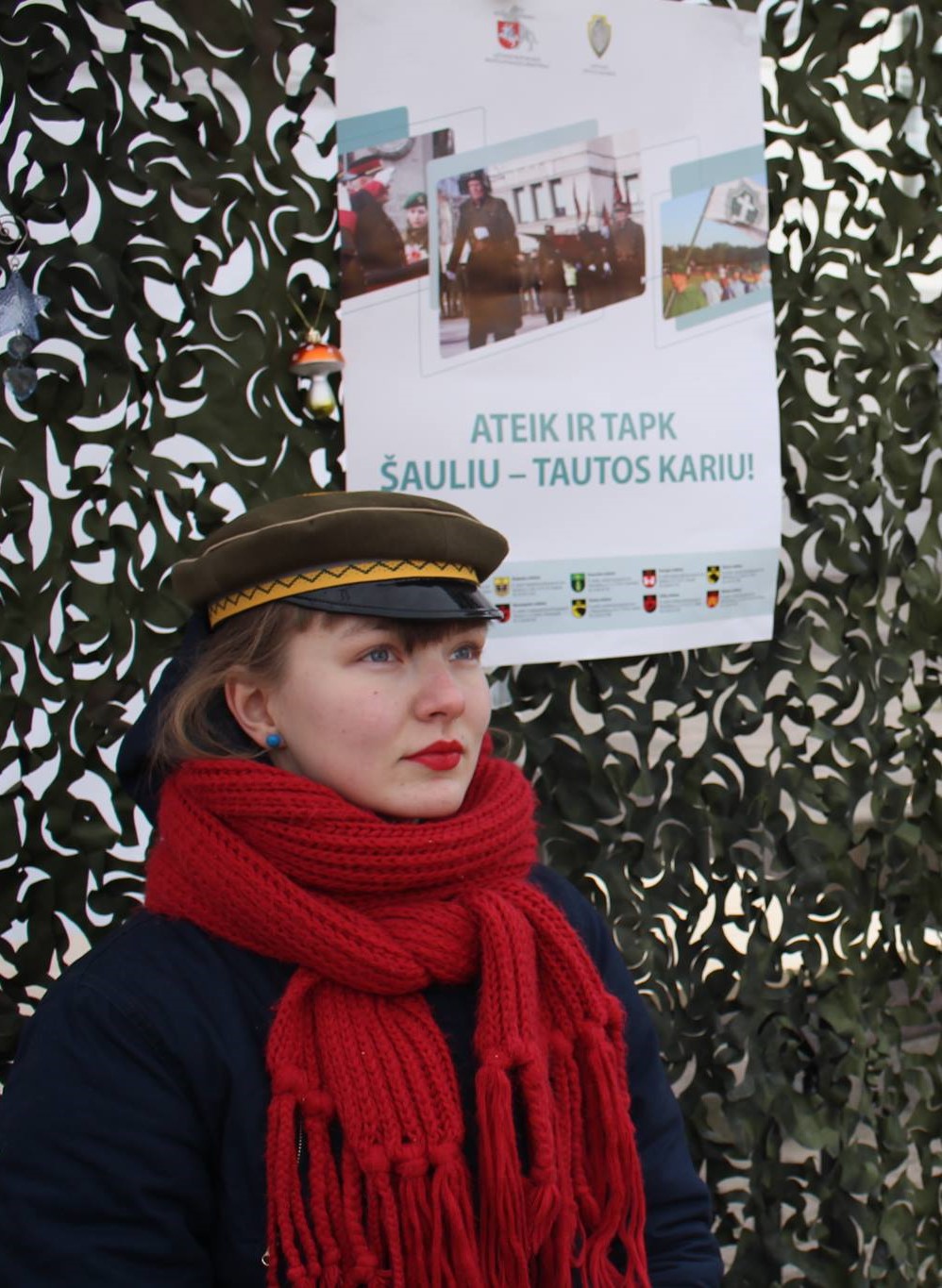 The doctoral student is not only a member of the Riflemen’s Union, but she has also served in the KASP. According to her, this experience helped her gain moral and physical strength and improve her tactical skills.
‘Yet I gained even more. I saw firsthand that love for Lithuania is shaped by values and attitudes rather than nationality. Most of my commanders and many of my fellow soldiers were of Slavic origin. With mosquitoes humming, blueberries ripening, branches cracking from frost in Šalčininkai, squirrels jumping from tree to tree looking for nuts, and while warming ourselves by the fire, I heard them say it again and again: ‘This is my home. I will defend it,’ Burinskaitė recalled, speaking warmly of her fellow volunteer soldiers.
Asked how she would encourage those who are considering, but still hesitant about, contributing to national defence, Burinskaitė says that not participating is far more frightening: ‘The scariest thing in a crisis is not knowing what to do – feeling helpless. We amount to nothing when we are divided. Even our cherished individualism cannot exist without a community. Every citizen has a duty to defend their castle in one way or another. It is entirely human to have doubts, but doubts can wear you down over time. That’s why I encourage people to talk, ask questions, and show interest.’
Burinskaitė added that Riflemen’s Union units engage in a wide range of activities that do not necessarily require special physical preparation, but rather individual expertise.
‘In return, you gain a community and friends who are ready to help, plenty of useful knowledge, and encouraging winks from Vladas Putvinskis, the founder of the Riflemen’s Union, watching over us from the sky – right up until the very end. If you feel this calling, do not hesitate – students and female academics included. I’m with you,’ Burinskaitė emphasised.
Joining KASP brings a sense of security
Dr Tomaš Božerocki, a lecturer at the VU’s Faculty of Communication, joined KASP in August last year, hoping to contribute to national defence. According to him, KASP training focuses on teaching soldiers how to act in extreme situations – to stay calm, think clearly, and respond effectively.
The interlocutor claims that he is proud of his experience with KASP: ‘When Russia launched its full-scale invasion of Ukraine in February 2022, I felt deeply insecure and kept asking myself: what if? My family and I decided to stay in Lithuania – after all, what use would we be elsewhere? But then came the question: if we stay, what next? These questions no longer trouble me, because now I know the answers.’
In addition to his service in KASP, Dr Božerocki completed civil resistance training organised by the Mobilisation and Civil Resistance Department under the Ministry of National Defence, after which he became an instructor.
He encourages students and colleagues who wish to contribute to national defence not to be afraid and to look for ways to apply their skills. ‘One can join not only KASP, but also the Riflemen’s Union, or military commandant’s offices. The key is to identify where your interests lie. KASP offers extensive combat training and shooting practice, but there are also opportunities in areas such as psychological resilience and information warfare,’ he explained.