


VU Scientists Aim to Develop a Biosensor to Enhance Cancer Diagnostics
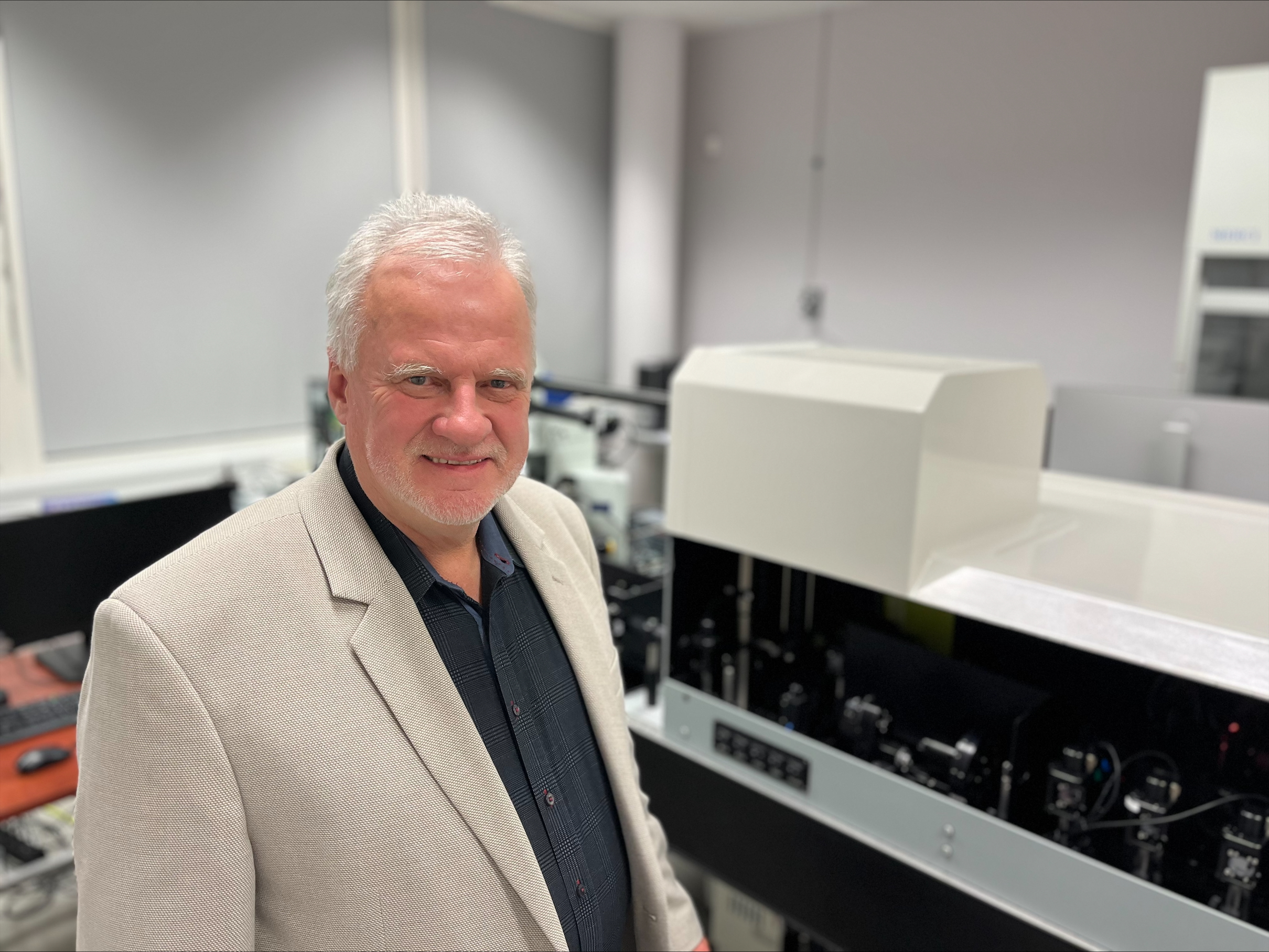 Prof. Valdas Šablinskas. Photo from personal archive.
Vilnius University (VU) scientists are working on a project that may advance cancer diagnostics. In order to develop highly sensitive biosensors, one of the most effective methods in material science is applied – Surface-Enhanced Raman Scattering, SERS. The project is led by Professor Valdas Šablinskas from the Institute of Chemical Physics at VU Faculty of Physics.
“The goal of the project is to develop a controllable and scalable plasma nanotechnology to fabricate plasmonic nanomaterials-enhanced SERS sensors for low-cost, rapid, sensitive, and reliable detection of cancer spectroscopic biomarkers. Partners in Taiwan, employing strongly ionised gases, have developed a new method for producing surfaces that amplify the Raman scattering signal more effectively than conventional plasmonic surfaces. At the beginning of December, the plasmonic surfaces required for this project have already arrived from Taiwan and are ready for the studies,” VU Prof. V. Šablinskas says.
The SERS method, using plasmonic surfaces obtained from Taiwan, will enable much more precise analysis. The Raman scattering spectrum is directly linked to the molecular vibrations. The frequencies of these vibrations depend on the strength of the chemical bonds within the molecule and the atoms that compose it, providing valuable insights into molecular structure.
“This method is particularly valuable for the study of biological tissues, as all biological cells are composed of molecules. When molecules are adsorbed onto a metallic substrate or the surface of metal colloidal nanoparticles, conditions can be formed for the excitation of surface plasmons that, in turn, enhance Raman scattering. Surface plasmons arise when light interacts with the free electrons on a metal surface, causing fluctuations in their density. If the frequency of the light wave coincides with the oscillation frequency, resonance occurs. This resonance produces an intensified electromagnetic field at the metal surface, greatly increasing the Raman scattering of the nearby molecules. Using such surfaces can amplify the Raman signal by up to tens of millions of times, providing highly sensitive and accurate insights into the structure of the molecular systems under study,” Prof. V. Šablinskas explains.
The Lithuania-Taiwan project “Plasma-Engineered Surface-Enhanced Raman Scattering Sensors for Sensitive and Selective Detection of Cancer Biomarkers” is being conducted by physicists Prof. V. Šablinskas, Dr Rimantė Bandzevičiūtė, Dr Sonata Adomavičiūtė-Grabusovė, together with Dr Martynas Talaikis from VU Life Sciences Center and Prof. Arūnas Želvys from VU Hospital Santaros Clinics and National Taiwan University of Science and Technology (NTUST).