MSCA Postdoctoral Fellowships
Vilnius University invites motivated researchers with a strong track record to apply for MSCA Postdoctoral Fellowships with VU as the host institution. MSCA PFs are among Europe’s most prestigious research schemes, supporting researchers’ career development while strengthening their creative, innovative capacity and promoting excellence in research. They target researchers holding a PhD who wish to acquire new skills through advanced training, international, interdisciplinary and inter-sectoral mobility and implement original and personalised research project. Applications are made jointly by the researcher and a host institution.
VU as your host institution
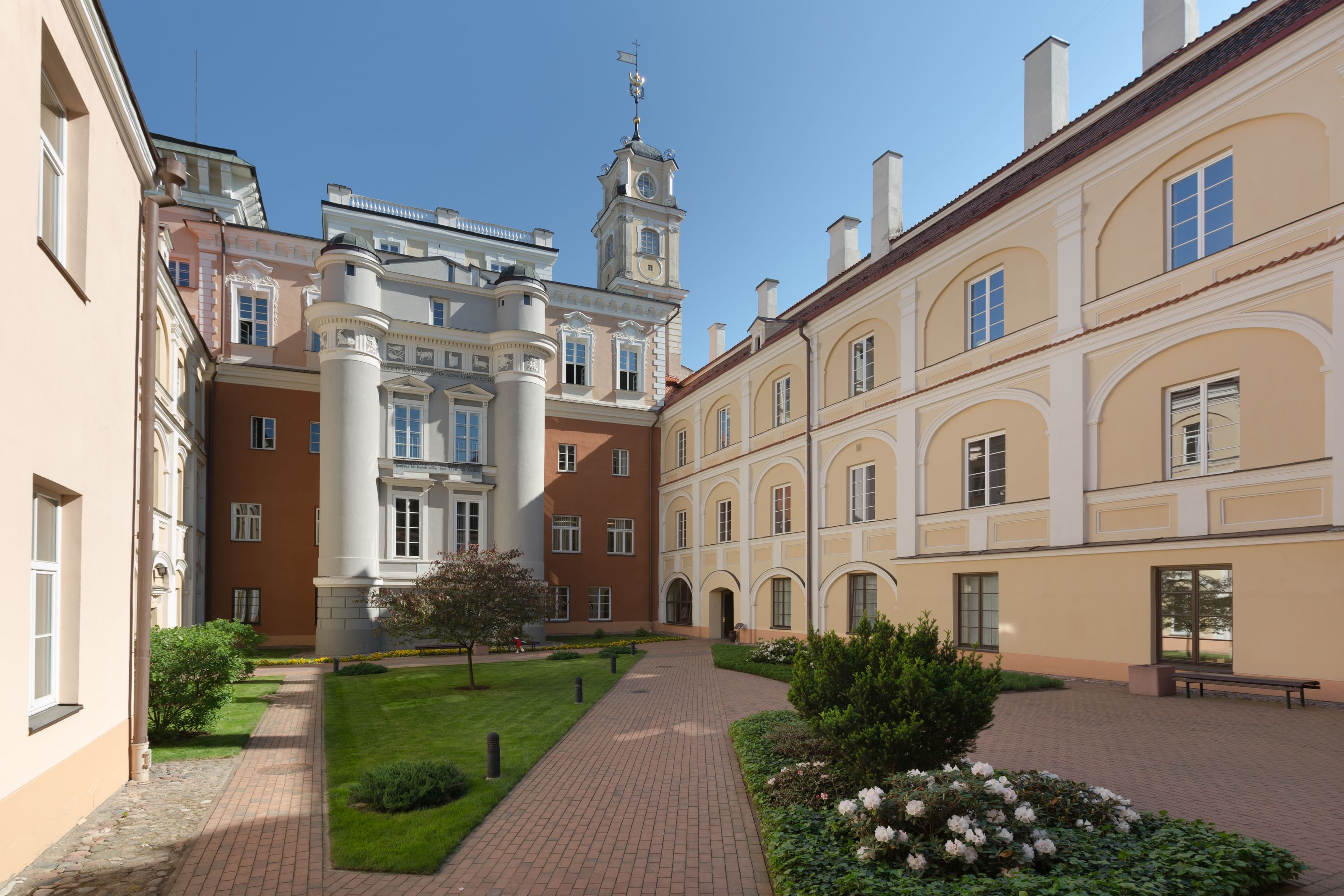
Founded in 1579, VU combines centuries of academic excellence with a strong contemporary research culture. As the largest university in Lithuania, it comprises 15 academic units and brings together more than 3,400 academic staff and over 26,000 students. Its active research community is supported by extensive infrastructure, including research institutes, 3 university hospitals, the oldest academic library in the Baltics, 3 botanical gardens, and an astronomical observatory, creating a fertile environment for scientific discovery and innovation.
VU consistently ranks as the top university in the country, exceling in both education and a broad range of fundamental and applied research. Recognized among Central and Eastern Europe’s leading research institutions, it fosters cutting-edge, interdisciplinary research and maintains strong partnerships within a global academic network.
VU is part of the Arqus European University Alliance, a network of nine research-intensive universities with strong ties to their regions: Granada, Graz, Leipzig, Lyon 1, Maynooth, Padova, Wroclaw, Minho and Vilnius. Arqus supports the exchange of best practices, sharing resources, and fosters joint doctoral and postdoctoral initiatives that help researchers build their careers. Through high-quality training and a dynamic international environment, Arqus is a vibrant hub for talent from across the globe.
Types of postdoctoral fellowships
European Postdoctoral Fellowships (EPF) are open to researchers of any nationality who wish to engage in R&I projects by either coming to Europe from any country in the world or moving within Europe.
Duration: 12-24 months.
Global Postdoctoral Fellowships (GPF) are open to European nationals or long-term residents who wish to engage in R&I projects with organisations outside EU Member States and Horizon Europe Associated Countries.
Duration: 24-36 months (12-24 months outgoing phase in a non-associated Third Country & 12 months mandatory return phase to a host organisation in Europe).
Additional funding opportunities
Boost your chances of success with ERA Fellowships! If you are applying for the European Postdoctoral Fellowship with a host institution in a widening country (such as Lithuania), and your proposal is not funded under the MSCA PF call due to budget limitations, it will automatically be resubmitted to the ERA Fellowships call, which will give your project an additional opportunity to receive support.
Additional incentive available for researchers applying with host institutions in Lithuania! The Government of the Republic of Lithuania has transferred some European Regional Development Fund (ERDF) funds to the Horizon Europe programme, enabling the European Commission to finance more well-evaluated MSCA PF projects submitted with Lithuanian institutions.
Worldwide secondments and placements in the non-academic sector
Researchers may include a secondment, within the overall duration of their fellowship in any country worldwide for 1/3 of the standard fellowship duration in the case of EPF and for 1/3 of the outgoing phase in the case of GPF.
At the end of the project both EPF and GPF can be extended by an additional period of up to 6 months to support researchers seeking a placement to work on R&I projects in an organisation from the non-academic sector established in an EU Member State or Horizon Europe Associated Country.
Eligible applicants
- Mobility rule: fellows must not have resided or carried out their main activity (work, studies, etc.) in the country of the beneficiary (for EPF), or the host organisation for the outgoing phase (for GPF) for more than 12 months in the 36 months before the call deadline.
- Excellent researchers of any nationality. However, researchers applying for GPF must be nationals or long-term residents of EU Member States or Horizon Europe Associated Countries.
- Supported fellows must be in possession of PhD at the call deadline (applicants who have successfully and unconditionally (no further requirements/corrections that need to be addressed) defended their doctoral thesis but who have not yet formally been awarded the doctoral degree will also be considered eligible to apply).
- Up to 8 years full-time experience in research from the date of award of the doctoral degree at the call deadline (exceptions: maternity/paternity leave, career breaks, compulsory national service, long-term sick leave, work outside research, research outside Europe for reintegrating researchers).
- All domains of research and technological development are eligible for funding.
- Fellows in the research areas covered by the Euratom Research and Training Programme 2021-2025 must be nationals or long-term residents of an EU Member State or Euratom Associated Country
- Although it is not a formal eligibility requirement, a strong track record significantly increases the candidate's chances of being funded. Please also bear in mind that if you receive a score of less than 80%, you will not be able to resubmit your proposal involving the same recruiting organisation (and, for Global Postdoctoral Fellowships, the associated partner hosting the outgoing phase) for the next MSCA PF call.
Applicable unit contributions
MSCA PFs provide an attractive allowance to cover your living, family, research, travel costs and secures funds to cover indirect costs of the host organisation.
Contributions for the recruited researcher per person-month | Institutional unit contributions per person-month | |||||
| Living allowance | Mobility allowance | Family allowance (if applicable) | Long-term leave allowance (if applicable) | Special needs allowance (if applicable) | Research, training, and networking contribution | Management and indirect contribution |
| EUR 6350 (EUR 5702 for Lithuania)* | EUR 710 | EUR 660 | EUR 7060 x % covered by the beneficiary | requested unit** x (1/number of months) | EUR 1000 | EUR 650 |
*A country correction coefficient applies to a living allowance based on the cost of living in different countries.
**The pre-defined categories are as follows: EUR 3 000, EUR 4 500, EUR 6 000, EUR 9 500, EUR 13 000, EUR 18 500, EUR 27 500, EUR 35 500, EUR 47 500, and EUR 60 000.
Considering differences in the cost of living in different countries, a country correction coefficient applies to a living allowance. For European Postdoctoral Fellowships, this coefficient applies to the country of the beneficiary. For the Global Postdoctoral Fellowships, two different country correction coefficients apply – for the outgoing phase and for the return phase. The country correction coefficient for Lithuania is 89,8% , the living allowance amounts to €5702,30 before tax.
Postdoctoral researchers will be employed at VU under a full-time employment contract.
The above rates apply to postdoctoral researchers working on their project full-time, but they also may, in agreement with the supervisor and beneficiary and with prior approval by the granting authority, implement the action on a part-time basis (min. 50% FTE).
During the implementation of the project, the researcher’s total professional time commitment must not exceed 100% FTE.
Postdoctoral fellows must work at the premises of the host institution. Teleworking from abroad is not permitted.
Support services at VU
VU Research Projects Office (research@cr.vu.lt) is ready to support you by providing guidance and consultations on preparing and submitting your MSCA PF application. Contact us if you have any questions.
Support offered:
- Assistance with eligibility checks
- Help in finding a supervisor at VU
- Support during the preparation and submission of the MSCA PF proposal
- Personalised consultations and support in addressing applicants’ questions
- Proposal review
- Guidance material with tips for proposal writing and information about VU, including details of its training, support services, and hosting arrangements.
Application process
Eligibility check
Make sure that you are eligible to apply for the MSCA PF. Please refer to the Guidelines on the Calculation of 8-years Research Experience in MSCA PF and use the MSCA-PF Self-assessment Tool for the Calculation of the 8-years Research Experience (the Guidelines and the Self-assessment Tool for the 2026 call will be available later this year). The VU Research Projects Office can assist you with verifying your eligibility for the programme.
Finding a supervisor
Search for a suitable supervisor or a potential host faculty by browsing:
- VU researchers’ hosting offers on EURAXESS (expected to be announced in March)
- Websites of VU academic units
- Research Teams search
Contacting a supervisor
Contact the supervisor directly to express your interest in a joint MSCA PF application. Please include the following documents:
- Curriculum Vitae
- List of publications
- Proposal summary
Endorsement of a candidate
Request an endorsement letter from the supervisor, send it to the VU Research Projects Office (research@cr.vu.lt) and start preparing your MSCA PF project proposal.
Getting acquainted with the funding scheme
Read the call documents and guidance material thoroughly. Make sure that you fully understand the aims, rules and requirements of the programme. If you have questions, reach out to VU Research Projects Office.
Writing a proposal
The VU Research Projects Office will provide you with proposal templates and share guidelines on how to register on the EC Funding & Tenders Portal and initiate your MSCA PF application with VU. You will prepare your project with support from your supervisor and the VU Research Projects Office team.
Proposal review
The VU Research Projects Office will review your proposal Part A and can provide feedback on draft Parts B1 and B2 once they are completed or nearly final. Please submit your draft by August 9, 2026. As review slots are limited, we strongly encourage you to contact us as early as possible.
Submission of a proposal
Submit your proposal until September 9, 2026. However, we strongly recommend doing this at least 48 hours before the deadline to allow time to check for any technical issues that could prevent submission and to avoid system congestion.