|
Faculty
Faculty of Physics |
|

|
Scope of studies and length
120 ECTS credits, 2 years |
|

|
Qualification awarded
Master in Physical Sciences |
|

|
Application deadline*
29 January
8 February
15 April
|
|

|
Language
English |
|

|
Tuition fee per year
Depends on study pathway.
See details here |
|

|
Start of studies
1 September
|
 |
City
Vilnius |
APPLY NOW
This program offers a comprehensive curriculum that spans from fundamental principles to advanced research topics in photonics and its interdisciplinary applications. Graduates will be equipped to explore and manipulate matter and optical phenomena at the nanometric scale, develop innovative imaging tools for complex biological systems—from cells and tissues to clinical applications—and contribute to the creation of next-generation optical technologies.
Programme coordinator: Aix-Marseille University (France).
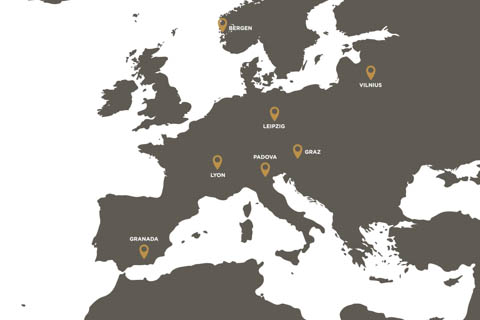
Partners: Karlsruhe Institute of Technology (Germany), University of Barcelona (Spain), Tampere University (Finland), Vilnius University (Lithuania).
Programme structure
All information about the study programme structure available here.
Key Learning Outcomes
Graduates will become highly qualified international-level specialists in photonics and nanotechnology. They will:
- have the capacity of analyzing a scientific problem and presenting possible solutions in optics and photonics;
- have the necessary scientific culture to provide answers in interdisciplinary topics linking physics and biology;
- be able to present scientific results and write scientific proposals;
- will be able to cooperate with industry on applied projects;
- will know the companies’ way of thinking, the problems companies using photonic technologies are facing, and what companies expect from photonic master-graduate persons;
- will know how challenging (and exciting) is research work.
Programme Specific Requirements
All information about application requirements and procedure is available on the official website of the study program.
Information about Entry requirements here.
Information about the Application procedure here.
Why choose this programme?
- The EuroPhotonics Master’s program provides high-level international training, combining strong theoretical foundations with advanced practical applications in photonics. Because studies take place across several leading European universities, students gain valuable experience in multicultural academic and research environments, while also building a broad professional network.
- The program offers scholarship opportunities as well as mobility pathways among the partner institutions for both EU and non-EU students. This allows students to personalize their study and research direction, complete internships in world-class laboratories or industry settings, and strategically shape their professional profile and future career path.
|
What comes after?
-
Graduates can work in photonic, optical and laser technologies, integrated photonics or optical sensor manufacturing companies.
-
They may also pursue a scientific career by continuing doctoral studies in photonics, optics, laser technologies, either in academia or in industry.
|