|
Faculty
Faculty of Physics |
|

|
Scope of studies and length
120 ECTS credits, 2 years |
|

|
Qualification awarded
Master in Technological Sciences |
|

|
Application deadline*
8 February
|
|

|
Language
English |
|

|
Tuition fee per year
5538 € |
|

|
Start of studies
1 September
|
 |
City
Vilnius |
APPLY NOW
This programme is designed to deepen knowledge and skills in intelligent photonics, a field that combines light technologies, artificial intelligence, and signal processing.
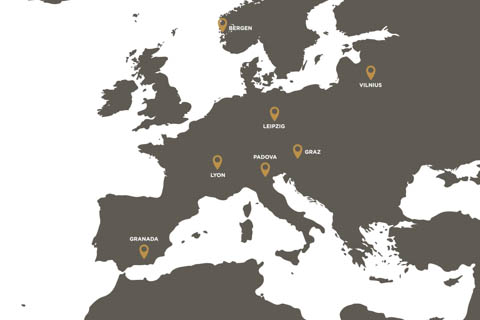
Programme coordinator: Université Jean Monnet (France).
Partners: Vilnius University, Université Paris-Est Créteil (France) and University of Eastern Finland (Finland), in cooperation with other academic and industrial partners.
Programme structure
All information about the study programme structure is available here.
Key Learning Outcomes
Graduates of the iPSRS programme will be able to:
- have the capacity of analyzing a scientific problem and presenting possible solutions in optics and photonics;
- design and apply optical systems, machine learning algorithms, biometric recognition systems, micro/nanotechnology devices, and innovative photonics solutions;
- conduct comprehensive research in laboratories and industry, including the detection of hazardous substances, analysis of biological systems, counterfeit detection, automotive safety, and production control solutions;
- work in international teams, manage projects, present research results, and develop professional networks across Europe.
Application deadline and Specific Requirements
- Admission period: October 10, 2025 – February 8, 2026. Start of studies: Autumn 2026.
- Bachelor’s degree (180 ECTS), preferably in engineering, computer science, nanotechnology, or physics. Final-year students are also eligible to apply.
- English language proficiency: minimum B2 level.
- Admission documents: academic evaluations and diploma, proof of English language proficiency, Curriculum Vitae (CV), two letters of recommendation from academic staff members, copy of passport or ID card, birth certificate, 2–4 minute video introduction (video CV ).
- Applications must be submitted online here.
- Important: applicants who have previously received an Erasmus Mundus scholarship are not eligible to apply. Self-funded students must provide proof of financial means.
Why choose this programme?
- The programme combines photonics, artificial intelligence, signal and image processing, and micro/nanotechnology.
- It provides in-depth theoretical and practical knowledge through the application of cutting-edge light and artificial intelligence technologies in the fields of security, industry, and medicine.
- Special emphasis is placed on practical training: students participate in projects, internships, and complete their master’s thesis in a company or research centre.
- The programme is focused on preparing future specialists and researchers capable of addressing global challenges related to the safety of people, goods, and the environment.
- Extensive financial opportunities are available: students may receive an Erasmus Mundus scholarship of up to €33,600 and a 100% tuition fee waiver.
|
What comes after?
-
Graduates can work in photonic chip design start-ups, integrated photonics or optical sensor manufacturing companies, and in the fields of security technologies, defence and border control solutions, medical diagnostics, biosensors, or image analysis innovations.They may also pursue a scientific career by continuing doctoral studies in photonics, optics, laser technologies, either in academia or in industry.
- They may also pursue a scientific career by continuing doctoral studies in photonics, optics, artificial intelligence, signal processing, or micro/nanotechnology, either in academia or in industry.
|