- 8 September 2026
- Gintarė Bidlauskienė
Kaja Kallas Discusses Europe’s Geopolitical Challenges with Vilnius University Students
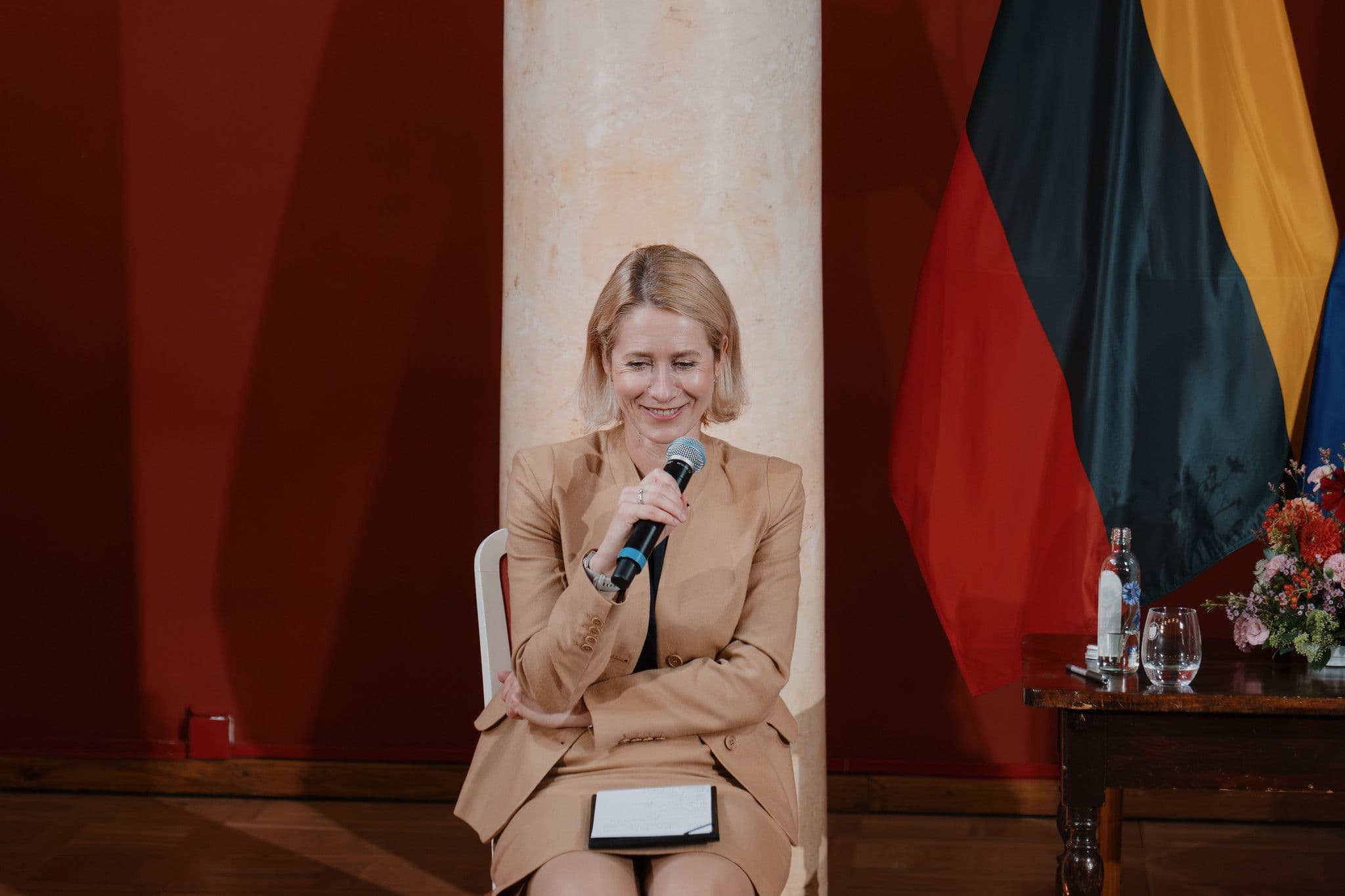
On 8 September, Kaja Kallas, Vice-President of the European Commission and High Representative of the European Union (EU) for Foreign Affairs and Security Policy, visited Vilnius University (VU). During her official visit to Lithuania, she met with VU Rector Prof. Rimvydas Petrauskas. Their discussion focused on the future of Europe, the European Universities initiative and the role of universities in a changing Europe.
Later, Kallas joined VU students for a discussion entitled “Europe’s Geopolitical Moment” in Aula Parva. The discussion was moderated by Prof. Margarita Šešelgytė, Director of the VU Institute of International Relations and Political Science.
At the beginning of the discussion, Kallas stressed that she wanted it to be a frank and open conversation about the topics the students themselves wanted to raise. Their questions covered Russia’s hybrid threats and the war in Ukraine, Europe’s role in possible peace negotiations, the voice of Eastern Europe in the EU, women’s participation in diplomacy, the rise of radical political ideas, the role of young people in politics, and the skills higher education should provide in a period of geopolitical uncertainty.
Speaking about cyber attacks, information attacks, sabotage and other hostile acts linked to Russia across Europe, Kallas warned against treating them as isolated incidents. In her view, once these events are looked at together, a very different picture emerges.
“If you put all these things on the map, then you can see that actually everybody is under attack. It’s not the eastern flank countries – the threat is really for everybody. We are saying constantly that we are not at war, but if you look at the Russians, they are clearly waging this shadow war against us. Sabotage is a tool in war. Cyber attacks are a tool in war. If we are saying that this is not it, it is a bit of wishful thinking. And if we are in this wishful thinking, then we don’t prepare properly because we don’t consider this seriously enough,” Kallas said.
Speaking about possible negotiations over Ukraine’s future, Kallas stressed that the issue should not be framed simply as a question of territory. Territory is not only about lines on a map, but about the people who live there and what happens to them afterwards. She recalled the experience of Eastern Europe after the Second World War: while Western European countries were rebuilding their prosperity and well-being, on the other side of the Iron Curtain there were mass deportations, mass killings and the destruction of national elites. Kallas also referred to her own family history: her mother was deported to Siberia in 1949.
On political radicalisation, Kallas pointed to the contrast between an increasingly complex world and people’s desire for simple solutions. She argued that radical and populist political forces exploit this by offering simple slogans while avoiding the question of how their promises could actually be delivered in practice.
“Whoever promises you simple answers to complex questions is lying. He’s lying. There is no simple answer, but people want to hear that,” Kallas said. She added that the important question is whether such promises are actually doable and how they would be implemented in practice.
Kallas also spoke about the courage required to stand up for one’s convictions. Recalling her own early experience in politics, she said that when a young politician finds themselves in a room with more experienced colleagues and feels that the majority is wrong, there are three options: to stay quiet, to go along with what is popular, or to speak up.
“The third option, and that’s the hardest option, is to stand up and say: ‘This is wrong. I don’t think you’re right.’ And this is super hard,” Kallas said. She added that although speaking up can be uncomfortable, remaining silent when you believe something is wrong can stay with you long afterwards.
The EU High Representative and VU students also discussed women’s participation in peace talks, Europe’s defence capabilities and military production, her experience of coordinating the positions of 27 EU Member States, young people’s choices for the future, the impact of artificial intelligence on human cognitive abilities, information warfare, and the role of universities in strengthening intellectual resilience. Kallas also reflected on the idea that universities may increasingly need to function as a kind of “brain gym”, helping people preserve and develop their cognitive abilities in an age of rapidly advancing technology.
The agenda of Kallas’s visit to Lithuania focuses on European security and defence, support for Ukraine, sanctions against Russia, EU enlargement, and Lithuania’s preparations for its Presidency of the Council of the EU in 2027. During the visit, Kallas also met with President Gitanas Nausėda, Prime Minister Mindaugas Sinkevičius, Speaker of the Seimas Juozas Olekas, Minister of Foreign Affairs Kęstutis Budrys, and Minister of National Defence Robert Kaunas. She attended the annual meeting of the heads of Lithuania’s diplomatic missions and, following her visit to VU, was scheduled to visit the Padvarionys Border Guard Station.
Kaja Kallas has served as the EU High Representative for Foreign Affairs and Security Policy and Vice-President of the European Commission since December 2024. From 2021 to 2024, she served as Prime Minister of Estonia, and from 2018 to 2024, she led the Estonian Reform Party. She was a Member of the European Parliament from 2014 to 2018, having previously served as a member of the Estonian Parliament (Riigikogu). Before entering politics, she worked as a lawyer and attorney. In her current role, Kallas leads the EU’s Common Foreign and Security Policy, with key areas of responsibility including European security and defence, support for Ukraine, and the EU response to cyber and hybrid threats.