- 28 July 2026
- Gabrielė Rimkutė
Measured Quality of Multidisciplinary Heart Failure Care: Patients Learn to Live with the Disease, Live Longer and More Active Lives

Patients with heart failure in Lithuania can live longer and more active lives when they receive well-organised care supported by a multidisciplinary team of specialists. This conclusion was reached by Prof. Jelena Čelutkienė from the Clinic of Cardiovascular Diseases at the Faculty of Medicine of Vilnius University (VU), together with colleagues from Lithuania and Sweden, after analysing Lithuania’s experience in developing and implementing a multidisciplinary heart failure management programme.
Under this programme, patients receive care from a team of professionals representing different fields, including cardiologists, nurses, pharmacists, rehabilitation specialists and other healthcare experts.
The study showed that the quality of specialised services can be objectively assessed, and that adapting successful international practices to the Lithuanian healthcare system can significantly improve patient care.
The findings were published in an article entitled „How to Implement Recommendations on Multidisciplinary Heart Failure Management Program Into Practice? Lithuanian Experience“ in the internationally peer-reviewed journal The American Journal of Cardiology.
Based on international recommendations and best practice, a national heart failure care programme was developed and implemented in Lithuania. Between 2016 and 2022, 3,168 patients who received multidisciplinary heart failure care at twelve specialised heart failure clinics were followed. The researchers analysed the stages of programme implementation, organisational solutions, quality indicators, and process and clinical outcomes based on data from the National Health Insurance Fund.
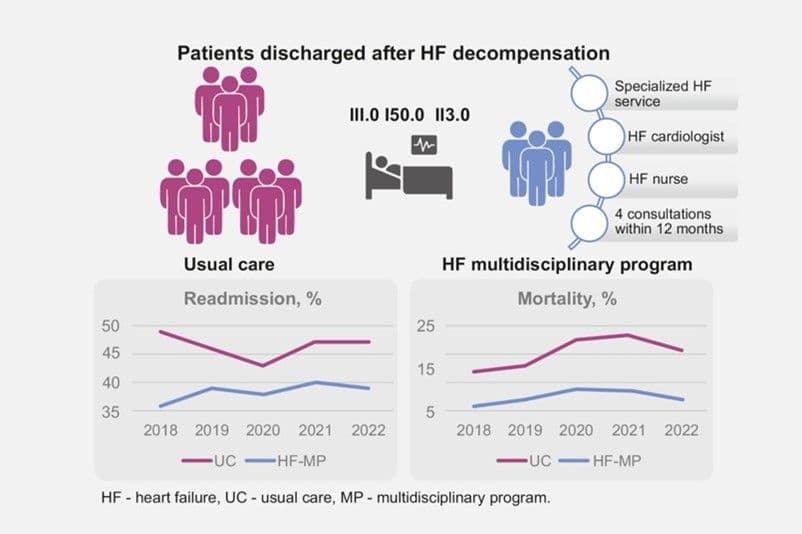
Design and effectiveness of the Heart Failure-Multidisciplinary program intervention. Illustration by the authors of the research.
The study revealed that patients participating in the multidisciplinary heart failure management programme achieved better survival outcomes. Their probability of surviving for one year after hospital treatment was 2.4–2.9 times higher compared with those receiving usual care, while the probability of surviving without readmission due to heart failure increased by 1.3–1.7 times. Assessment of patients using the six-minute walk test and self-reported questionnaires showed significant improvements in their functional status, quality of life and self-care skills.

Prof. Jelena Čelutkienė. Photo from the Faculty of Medicine archive.
This joint work by Lithuanian and Swedish heart failure specialists demonstrates that high-quality clinical practice developed in one country can be successfully transferred and adapted in others. The key is to adapt it to local conditions and invest in effective implementation. “Lithuania secured €2.7 million in European Union funding to expand the network of specialised heart failure clinics to 35 clinics. The implementation of evidence-based solutions can successfully transform the healthcare system at a national level. The next step is to ensure that all patients discharged after an episode of worsening heart failure receive these effective services,” says the study’s author, Prof. Čelutkienė.
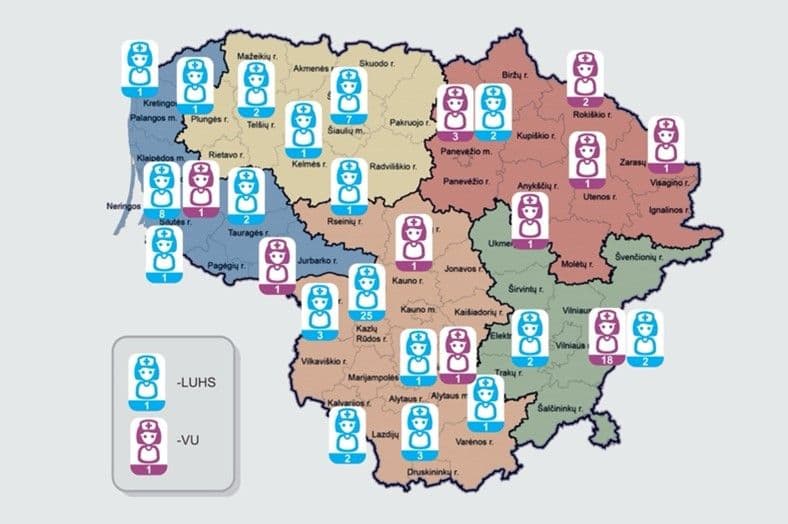
Specialised heart failure nurses who received training at Vilnius University and at the Lithuanian University of Health Sciences (LUHS) until 2023. Illustration by the authors of the research
This publication represents an important contribution by Lithuanian specialists to international heart failure care practice, demonstrating that the successful implementation of a multidisciplinary care model requires close collaboration between physicians, nurses, health policy-makers and international experts.