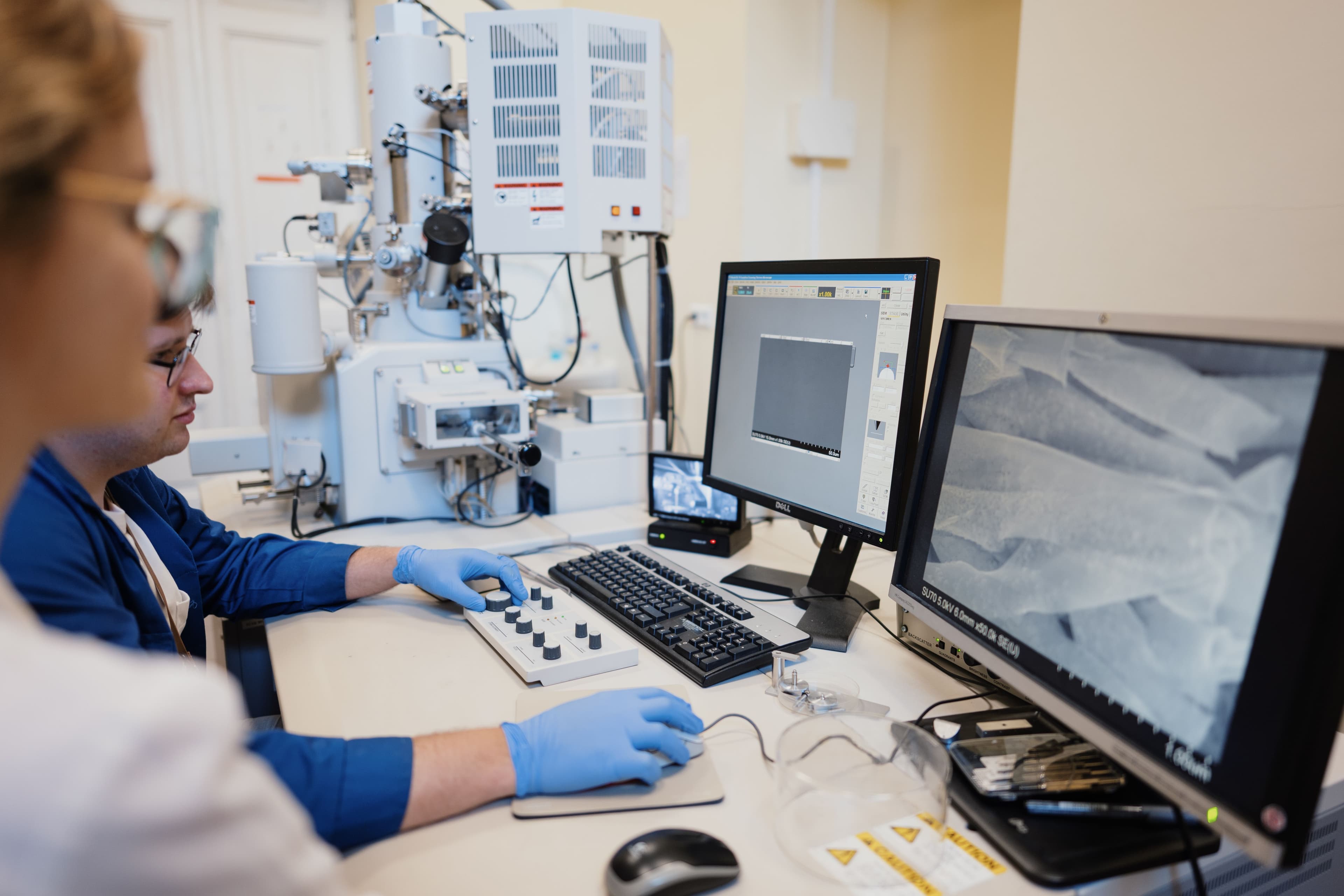
Nanochemistry and Entrepreneurship
Nanochemistry and Entrepreneurship is an interdisciplinary programme designed to equip you with expertise in nanochemistry combined with entrepreneurial skills. You will learn to design and investigate nanomaterials, apply chemical and technological knowledge to the development of innovative products, and cultivate an entrepreneurial mindset. The programme is delivered in collaboration with the VU Business School.

Programme plan
Programme plan
By studying in this programme, you will acquire in-depth fundamental knowledge of nanomaterials chemistry and practical research skills, enabling you to analyse data, make decisions under uncertainty, and develop innovations. A portion of the courses is delivered at the VU Business School. Research projects together with the Master’s thesis make up half of the programme, ensuring active engagement in advanced research. The programme prepares specialists capable of creating and developing new nanomaterial products and implementing entrepreneurial ideas in a competitive international market.
Admission requirements
Entry qualification
Undergraduate diploma (or higher)
A Bachelor’s degree or its equivalent in Physical Sciences (Chemistry), Life Sciences (Biochemistry), Technological Sciences (Chemical Engineering or Material Engineering).
N. B. for non-EU/EFTA applicants: The gap since your completed Bachelor degree should not exceed five years.
The applicant’s education should include at least 50 credits in chemistry or equivalent fields. The scores in chemistry or equivalent subjects cannot be lower than 70 % of the maximum.
A motivational interview is organized in the case of providing more detailed information about programme selection factors, knowledge in the field of chemistry and English language skills.
Applicant should submit a motivation letter and at least 1 academic reference.
The entry qualification documents are accepted in the following languages: English / Lithuanian.
Often you can get a suitable transcript from your school. If this is not the case, you will need official translations along with verified copies of the original.
Translation is considered to be official when it is bound together with the certified true copy of the original document and is confirmed by the translator’s signature. Documents issued in English, Lithuanian must be certified true copies and do not require translation.
Language requirements
English
The following language certificates are accepted for study programmes taught in English: IELTS Academic 6.5+, TOEFL iBT 81+, Cambridge English Exam 176+, Pearson PTE Academic 59+, LanguageCert IESOL B2, Duolingo English Test 120+, Password Skills Plus 6.5+ or another language proficiency certificate equivalent to B2 CEFR (Common European Framework of Reference for Languages).
If your first language is English and/or if you have a university degree in English, you will be exempt from providing an English language test score.
Other requirements
A motivation letter must be added to your application.
Territory requirements
Applicants from Bangladesh, Nepal and Pakistan must submit OMPT-G (Online Mathematics Placement Test) Certificate (minimum passing grade – 60%).
Admission steps
1
2
3
4
5
6
Learning outcomes
- Conduct research and apply knowledge in practice. You will understand the context and future prospects of nanomaterials chemistry, conduct independent research, assess its reliability, and make informed decisions based on the research results.
- Analyse and interpret data. You will critically evaluate scientific and business information, systematically analyse alternative solutions, and present research findings convincingly to both specialists and the general public.
- Solve problems creatively. You will integrate knowledge of chemistry, technology, and business; generate original ideas for nanomaterial products; make innovative decisions in uncertain situations; lead interdisciplinary projects; and evaluate their validity.
- Develop responsibly and share knowledge. You will work independently and in teams, take initiative and leadership, ensure safe practices in laboratories and industry, uphold professional and business ethics, continuously improve your competencies, and plan your career development.
Financing
- 6 000 EUR for non-EU students / 5 641 EUR for EU students
Tuition fee
Students who are citizens of the European Union, the European Economic Area countries and of other foreign countries, admitted to non-state-funded places in the first year of first-cycle and second-cycle studies through the University’s foreign student application system, must pay the annual tuition fee within 15 calendar days from the date of the offer to study.
After the student pays the tuition fee, he receives the final acceptance letter. Then our International Relations Office provides the necessary information related to obtaining a temporary residence permit in Lithuania and sends a mediation letter to the student by e-mail (for non-EU citizens).
Application fee
The application fee is €100 per application. Each applicant can choose up to three programmes within one application.
Online applications will only be processed once the application fee has been paid.
Please note that the application fee is non-refundable. Make sure you read the admission requirements and deadlines carefully before submitting your application, as the fee cannot be refunded if you are found to be ineligible or miss a deadline.
Scholarships for Master's

Career prospects
What's next?


