- 24 November 2026
- Žiedūnė Kiznytė
Cities in the Face of Climate Change: How Can Municipalities Prepare?
Climate change is altering not only our environment but also people’s health, quality of life, and cities themselves. Can extreme heat be linked to higher suicide rates? What solutions are helping Vilnius reduce pollution and manage the consequences of downpours? How should Lithuanian municipalities prepare for future climate challenges? Assoc. Prof. Justas Kažys of the Department of Hydrology and Climatology of the Faculty of Chemistry and Geosciences of Vilnius University (VU) discussed these questions.
Climate change and mental health
Assoc. Prof. Kažys, together with colleagues from public health and psychology, has joined the international interdisciplinary research network ‘CliMent’, which aims to investigate and mitigate the effects of climate change on mental health in Europe. Mental health is a broad field in which it is important to understand how different groups of people respond to a changing climate and extreme weather.
‘One of the fields of research currently being examined is the link between extreme weather and the suicide rate in Lithuania. It has been established worldwide that extreme heat is associated with higher suicide rates. I expected to find a similar signal in Lithuania. In my analysis, on extremely hot days the number of suicides may increase on average by roughly 15–20 per cent compared with the usual level for that season. However, the statistical relationship is not strong, so this result must be assessed with caution,’ said the researcher.
According to the Associate Professor, the relationship is stronger and visible when examining the periods before, during, and after a heat episode separately. Nevertheless, the Lithuanian data sample is not large, and suicide is a very complex process, so we are talking about an observed link, not a proven causal relationship.
‘Interestingly, in my analysis, a negative correlation emerged with cold: the colder the weather, the fewer suicides are recorded. This relationship appears stronger than the relationship with heat, but it is difficult to explain for now because, in some research results obtained by other researchers so far, the trend is the opposite. Whether in hot or cold weather, it is important to understand that psychological health is influenced by many social, cultural, economic, and health factors. A broader interdisciplinary study would be needed to better understand the possible mechanisms and the significance of climate change,’ he said.
Climate change mitigation initiatives in Vilnius
The impact of climate change on people and their health underscores the importance of not only monitoring the changes underway but also taking action to mitigate them. Cities play an especially important role here – from reducing transport pollution to nature-based solutions that help create a healthier living environment. Low-emission zones are one of the ways for cities to reduce transport pollution, improve air quality, and create a healthier, more comfortable living environment for residents. Assoc. Prof. Kažys acknowledged that, in theory, this is a very good idea, but in practice, such an initiative is often implemented rather narrowly.
‘In Vilnius this zone has been implemented in a rather limited way. Since 1 January 2025, a small triangle in the Old Town has been designated as a low-emission zone. For now this measure does more to inform and promote rather than impose restrictions. It reminds drivers to consider what car they are driving and whether it is necessary to take this particular route. There is also a lack of data on how the introduction of this zone has changed residents’ habits and what share of drivers now choose a different route,’ said the researcher.
No less important is that introducing such a small zone does not reduce overall car flow but simply shifts it to nearby streets.
‘Within the low-emission zone itself, noise and pollution from cars decrease, and air quality improves, so it is more pleasant to spend time in outdoor cafés. But if cars are simply diverted to other streets, the pollution may move elsewhere. Such a measure does not, in itself, solve the city’s transport problem unless the overall flow of cars is reduced. For a greater impact, the low-emission zone should cover a much wider area – perhaps most of the Old Town. Good examples can be found in Berlin, Copenhagen, and other European cities, where car traffic in the centre has long been restricted,’ the researcher listed examples.
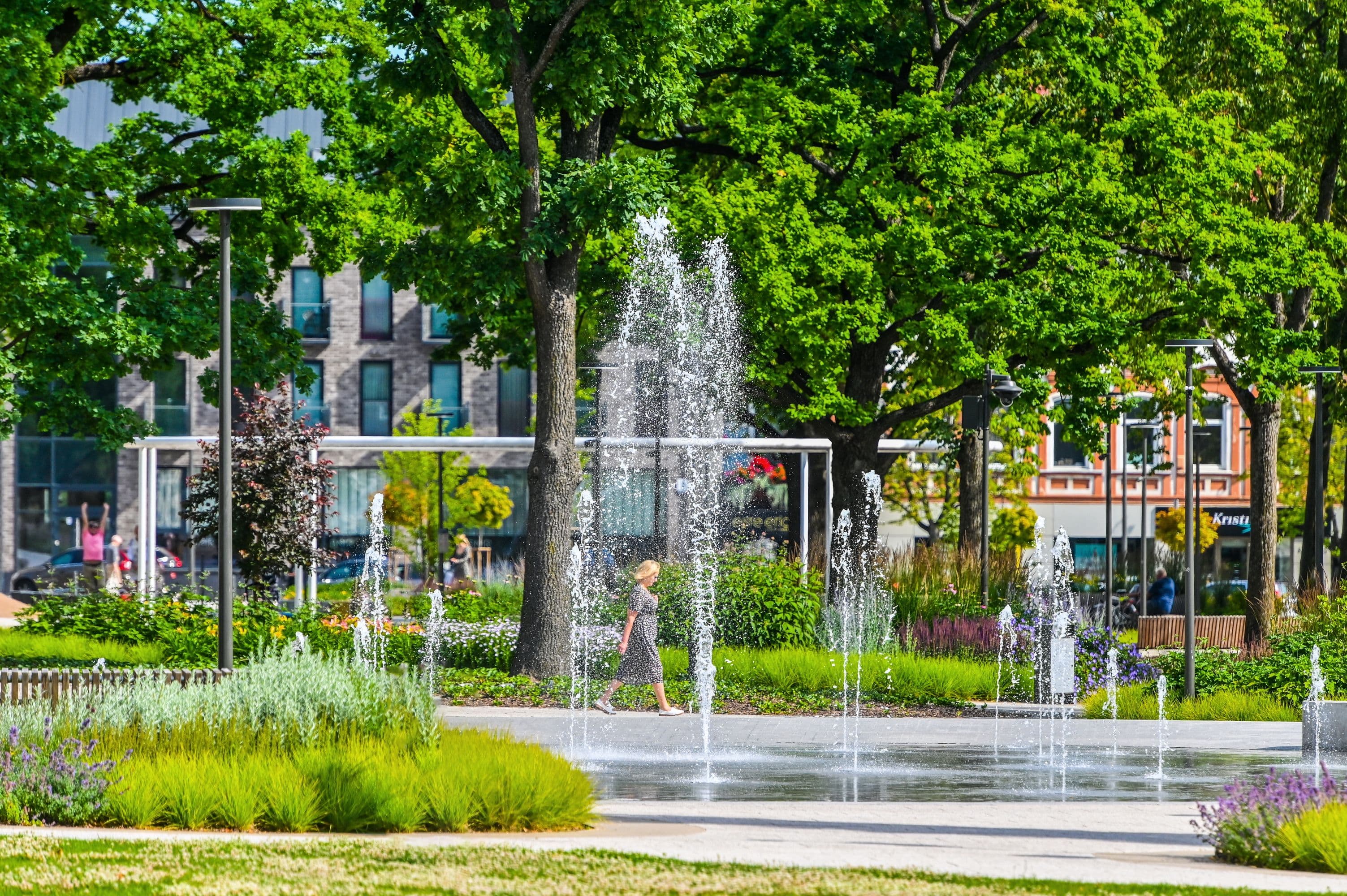
Nature-inspired initiatives to mitigate climate change can also be found in Vilnius. One of them is urban tree belts, which mitigate the effects of heat, improve air quality, support biodiversity, and attract pollinating insects. Another solution is green roofs.
‘There are not many vegetated roofs and buildings in Vilnius, but we already have a few good examples. They include the green building in the Vilnius University Botanical Garden, the ‘Žali’ shopping centre opened in Balsiai, and a 1,000 m² sedum carpet installed on the roof of the Lazdynai swimming pool,’ said Assoc. Prof. Kažys.
We can also be glad that Vilnius streets are flooding less and less during downpours. This change relates to the rainwater collection and retention solutions implemented.
‘The Saltoniškės ponds were built to collect the water of sudden downpours and help protect Geležinio Vilko Street from flooding. A water reservoir has also been built in the Ozas Reserve, creating a more natural water body at the same time. Water can be not only channelled away through pipes but also retained in special basins or in filtering soil. Water that has been naturally purified can later be reused or returned to the environment,’ said Assoc. Prof. Kažys.
Vilnius University’s role in the ‘neŠYLAM’ initiative
VU, together with Vilnius City Municipality, is carrying out the project ‘neŠYLAM’ (‘Don’t Heat Up’), which aims to develop a programme to promote climate neutrality and implement climate-friendly ideas proposed by city residents themselves.
‘The main mission of the Vilnius University team in the project was educational and instructional. We prepared educational materials to introduce people to climate change issues and the dangers it poses in cities and specifically in Vilnius. The materials cover seven areas related to climate change mitigation – from households and waste to nature-based solutions and sustainable transport. These materials can be found on the ‘neŠYLAM’ website,’ said Assoc. Prof. Kažys.
The project also seeks to implement climate-friendly ideas proposed by city residents. For this purpose, a climate fund was established during the project.
‘The essence of the project was to create a mechanism through which residents or organisations could contribute financially, allocating funds to small climate change mitigation projects. The municipality and experts would select the initiatives, and funding could range from a few thousand to about 10,000 euro,’ said the researcher.
The 2026 call received almost 60 applications, of which 8 ideas were funded, ranging from exploring urban nature and community gardens to reducing food waste, responsible consumption, and saving energy. Part of the funds were project funds, and the rest were raised in Vilnius.
‘To me, this idea seems beautiful and meaningful, because such initiatives encourage trust in local government and the understanding that the well-being of your own courtyard is just as important as that of the whole city. It is also very important that, after the project ends this year, the initiative will live on and in 2027 the fund will be fully financed with private funds,’ said Assoc. Prof. Kažys.
Adapting to climate change: what should municipalities do?
In dealing with the effects of climate change, it is important not only to curb environmental pollution but also to adapt to changes that are already underway. Assoc. Prof. Kažys, together with colleagues from VU and the Center for Environmental Policy, is preparing climate change adaptation plans for municipalities. They assess what climate changes are likely, which areas or sectors are more susceptible, and which adaptation measures could be the most effective.
‘It is impossible to implement all measures at the same time – that would require a great deal of funds and resources. It is therefore important to set priorities and choose solutions that would be effective and would contribute not only to adaptation but also to climate change mitigation and the preservation of biodiversity,’ said the researcher.
Assoc. Prof. Kažys and his colleagues have, up to this point, prepared seven climate change plans for municipalities, which the councils of the municipalities of Tauragė, Panevėžys, and Ukmergė have already approved. Rūta Taučikienė, Chief Specialist of the Urban Infrastructure Division of Panevėžys City Municipality Administration, said that the changing climate is already having a direct impact on the social, economic, and environmental indicators of Panevėžys City Municipality.
‘The main aim of implementing climate change adaptation measures is to reduce the negative consequences of climate change as much as possible. During the preparation of the climate change adaptation plan, the current situation was assessed, described by environmental and climate indicators and their trends, so that the risks posed by climate change and the effectiveness of implementing adaptation measures could be assessed as accurately as possible,’ she said.
Taučikienė singled out three key measures that, once implemented, would help reduce the impact of climate change on the urban environment and residents’ health, increase the city’s resilience to extreme weather phenomena, and improve residents’ quality of life.
‘To increase the city’s resilience to the effects of climate change, the city plans to develop green infrastructure, increase the availability of green spaces and shade, create urban tree belts for pedestrians and cyclists, and apply green solutions in buildings and public spaces. Measures to reduce the effects of heat are also planned – reducing the area of surfaces that heat up, installing water-spray systems, fountains, and public drinking-water stations. To ensure that infrastructure functions in extreme climate conditions, the city plans to manage rainwater more sustainably, develop permeable green areas that absorb surface water, and adapt rainwater drainage systems to extreme precipitation, thus reducing the risk of flooding,’ she said.
These measures reflect not only an aim to address specific challenges posed by climate change but also a broader approach to strengthening urban resilience. The development of green infrastructure, the reduction of heat effects, and more sustainable rainwater management show that adaptation to climate change covers different areas of the urban environment and infrastructure. It is precisely the importance of such an integrated approach that Assoc. Prof. Kažys also stressed:
‘It is important to me that climate change is assessed in an integrated way. Sometimes projects lead to very different areas, but the common denominator remains – how changing climate conditions affect cities, the environment, and people, and what we can do to be better prepared,’ said the associate professor.