History

Hinc itur ad astra
On the wall of the Vilnius University Astronomical Observatory is the inscription Hinc itur ad astra – ‘from here the way leads to the stars’. The University was founded in the 16th century, when Renaissance, Reformation, and Catholic Reformation ideas were flourishing. Vilnius University is considered one of the oldest universities in Central and Eastern Europe.
The University also occupies a significant place in the history of European higher education, and the old campus itself holds many elements of historical significance. From the 14th century, and for the next two centuries, the University of Kraków held the title of the easternmost university in Europe. In the 16th century, Vilnius took over this role, extending its intellectual influence beyond the borders of both ethnic Lithuania and the multinational and multi-confessional Grand Duchy of Lithuania by casting the light of knowledge across the wider Central and Eastern European region through the dissemination of scientific knowledge and learning.
Some of the achievements of the Jesuit university were significant throughout Catholic Baroque Europe, even influencing non-Baroque Europe, including the poetry of Motiejus Kazimieras Sarbievijus (Maciej Kazimierz Sarbiewski) and the logic, rhetoric, and theology of Martynas Smigleckis (Martinus Smiglecius).
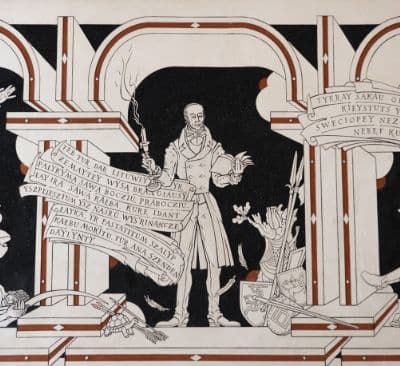
The Old Vilnius University Era
Vilnius University gradually moved from the Baroque to the Enlightenment. Even the annexation of Lithuania by the Russian Empire in 1795 did not hinder this progress. According to many contemporaries, the early 19th-century University stood on an equal footing with the most advanced higher education institutions in Europe.
Through its scientific schools, studies, and influence on society, the University educated many important figures, including Simonas Daukantas – a pioneer of the Lithuanian national revival – as well as renowned poets from the Grand Duchy of Lithuania who became leading figures of Polish modern culture and prophetic voices of their nation: Adomas Mickevičius (Adam Mickiewicz) and Julius Slovackis (Juliusz Słowacki).
All of them witnessed not only the apogee of the University’s development but also the tragedy that befell it – in 1832, after the suppression of the Polish-Lithuanian uprising, the Russian Empire closed the University, thereby ending an epoch that can be called the old Vilnius University era.
The Modern University
A new era in the University’s history began in 1990, when Lithuania regained its independence, and Vilnius University restored its autonomy. The motto Hinc itur ad astra symbolised the academic dreams and aspirations of earlier times.
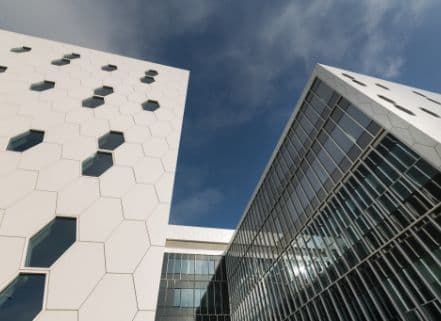
In the period of regained independence, this symbolic function has perhaps been best embodied by the modern Center for Physical Sciences and Technology in Saulėtekis, which conducts research in laser and light technologies, organic materials, chemistry, and semiconductor nanotechnology.
The façade of this building bears no inscription, but the goals and ambitions of the modern University are reflected in the hexagonal windows – where an ordinary eye may see only fragments of a honeycomb, an expert eye recognises the true symbolism: the crystal lattice of graphene, one of the strongest materials, created at the beginning of the 21st century.

From the Stars to Bacteria
Physical and life sciences are currently key fields of study at the University. The new slogan – somewhat ironically – could be ‘from here the way leads to bacteria’. However, the achievements are anything but ironic.
Research into bacteria, viruses, molecules, and DNA structures has gained international recognition in recent years. Vilnius University has announced the discovery of unique, previously unknown signalling molecules and a protein capable of precisely editing DNA to modify the genome in specific ways. As a result, Professor Virginijus Šikšnys was among the nominees for the Nobel Prize.
The Center for Physical Sciences and Technology is situated next to the modern joint Life Sciences Center, which could easily rival its neighbour as a symbol of the modern University: the complex comprises cube-shaped buildings with exteriors reminiscent of cellular structures.
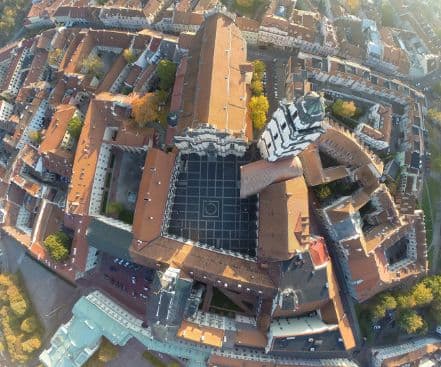
University DNR
Since the restoration of Lithuania’s independence, the University has constantly had to navigate between the demands of global competition and the needs of the State, while balancing the roles of a technocratic institution and a classical educator.
The strength of modern Vilnius University, and its aspiration to be as academically robust as graphene, is measured not only by its historical mission but also by various formal assessments. Yet what best symbolises today’s University are the two key strands of its identity, intertwined like a DNA spiral: its passionate efforts to adapt to the needs and trends of a rapidly evolving world, and the enduring traditions that have survived since its establishment.
The first strand represents the technical and life sciences that replaced (or evolved from) 17th-century logic. The second reflects the poets of the 17th century, who, in (post)modern times, are often referred to as humanists.
Thus, while the University enjoys the fruits of its DNA research, its own DNA has remained unchanged since its foundation.
Milestones in the History of Vilnius University
On the initiative of Bishop Valerijonas Protasevičius (Walerian Protasewicz) of Vilnius, the Jesuits came to Lithuania and, in 1570, founded the Vilnius Jesuit College.
On 1 April, the King of Poland and Grand Duke of Lithuania, Stephen Báthory, issued a letter of privilege to establish the Vilnius Academy. Later, on 30 October, Pope Gregory XIII issued a decree approving the reorganisation of Vilnius College into a university. The official name of the institution became the Jesuit Academy and University of Vilnius (Academia et Universitas Vilnensis Societatis Jesu).
After the dissolution of the Society of Jesus, the University was taken over by the State, which established the Commission of National Education.
The University was renamed the ‘Principal School of the Grand Duchy of Lithuania’ (Schola Princeps Magni Ducatus Lithuaniae). The University, like the entire State, entered an era of reform, which was interrupted by the final partition of the Polish–Lithuanian Commonwealth.
The Grand Duchy of Lithuania was annexed by the Russian Empire, and the University was renamed the ‘Vilnius Principal School’ (Schola Princeps Vilnensis) (1797).
The Russian Empire implemented educational and higher educational reforms. The University was granted a statute that made it a model for other universities in the Empire, and it was renamed the ‘Imperial University of Vilnius’ (Vilenskij imperatorskij universitet – Imperatoria Universitas Vilnensis).
Following the suppression of the Polish–Lithuanian uprising, the Russian Empire closed the University.
After World War I and the collapse of the Russian Empire, the governments of the newly emerging Polish and Lithuanian states sought to restore the University in Vilnius. On 5 December, the State Council of Lithuania adopted the Statute of Vilnius University.
Polish forces occupying Vilnius managed to reopen the University, renaming it after Stephen Báthory (Uniwersytet Stefana Batorego).
The University of Lithuania was re-established in the temporary capital, Kaunas, and in 1930, was renamed ‘Vytautas Magnus University’ (Universitas Vitoldi Magni).
When Lithuania regained Vilnius, the Polish period in the University’s history came to an end. The Lithuanian University was moved from Kaunas to Vilnius and renamed ‘Vilnius University’.
After the first Soviet occupation, Vilnius University was forcibly Sovietised and subjected to ideological control.
Vilnius University was re-Lithuanianised but soon fell under Nazi occupation and was closed again in 1943.
After the second Soviet occupation, Vilnius University was reopened by the Soviet authorities and renamed Vilnius State University.
Vilnius University was named after Vincas Kapsukas, a man who had no merit for either the University or Lithuania. During the commemoration of its 400th anniversary, the University held the longest name in its history – Vilnius Order of the Red Banner of Labour State University of Vincas Kapsukas.
After Lithuania regained independence, the University restored both its autonomy and the name of Vilnius University.
Recovering Memory

Recovering Memory
The initiative honours members of the University community who, as a result of totalitarian regimes and historical upheavals, were denied the opportunity to complete their studies or continue their academic work.