- 6 November 2026
- Dr Rasa Navickaitė, Institute of International Relations and Political Science
How Did Myths About Homosexuality Take Shape in Lithuania?

In 1993, Lithuania decriminalised homosexual relations between men; however, public attitudes changed far more slowly than the legal framework. For a long time afterwards, homosexuality continued to be associated with crime, illness, moral decline, and an alleged threat to children. It could be argued that, during the early years of the country’s independence, the press shaped the norms for discussing homosexuality. Some of the myths and stereotypes that took root at the time continue to surface in politics today, hindering the advancement of human rights in Lithuania.
An object of curiosity
During the Soviet period, homosexuality was rarely mentioned in Lithuanian public discourse and was almost always portrayed negatively – as a pathology, a crime, or a character flaw.
It was only after the restoration of independence, when the media gained more freedom, that a more diverse discourse on same-sex attraction began to emerge. However, the tabloid press always feeds on scandal. Coupled with the media’s weak ethical self-regulation, this meant that professional boundaries were often crossed in the pursuit of readers’ attention. LGBT people – lesbians, gay men, bisexual and transgender people – were depicted through entrenched stereotypes and sensational stories, many of which were fabricated.
The 1990s were a contradictory period: beliefs inherited from the Soviet era, new ideas arriving from the West, as well as genuine curiosity and openness towards sexual minorities all coexisted. The Lithuanian press frequently featured prominent LGBT figures from abroad, including Elton John, Ellen DeGeneres, Martina Navratilova, George Michael, and Dana International. There were debates about whether same-sex marriage and gender-affirming surgery for transgender people should be permitted, while daily newspapers readily published photographs of Pride marches and the first officially recognised same-sex weddings held abroad.
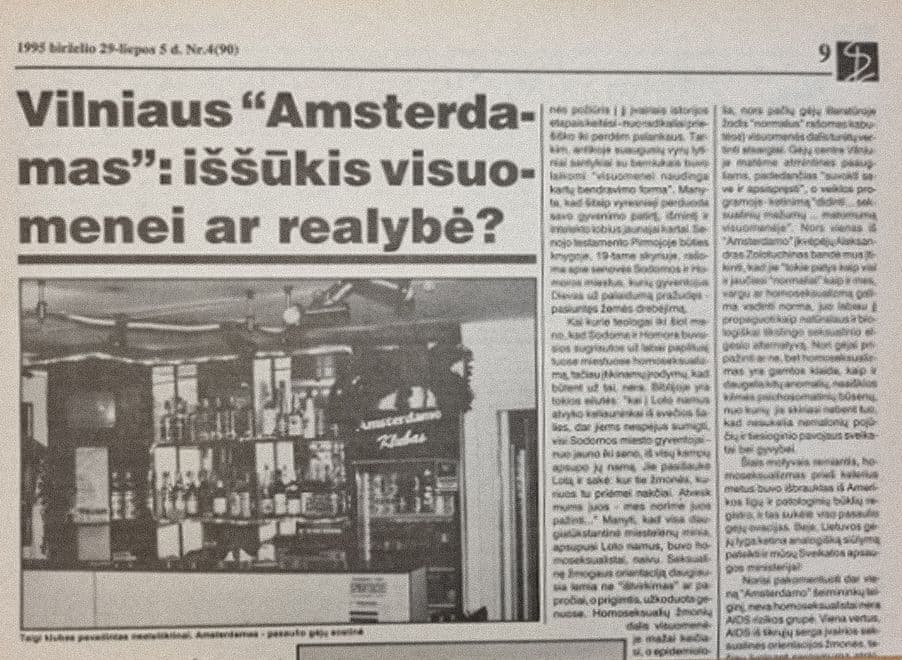
In 1995, the daily newspaper Lietuvos rytas published Lithuania’s first coming-out story featuring a gay male couple: Vladimir Simonko and Eduardas Platovas, the founders of the Lithuanian Gay League (LGL), spoke publicly about their relationship. The country’s first lesbian couple also came out publicly that same year. In 1997, ornithologist Algirdas Knystautas and his partner held an unofficial wedding ceremony at Vilnius Cathedral Basilica. Even the daily newspaper Respublika (which later became infamous for homophobic articles) covered the event in relatively neutral terms, although it placed the word ‘wedding’ in quotation marks.
The alleged threat to children
Despite positive representations of homosexuality, which played an important role in LGBT people’s self-understanding and in educating the wider public, the press continued to reproduce many harmful stereotypes inherited from the Soviet era. Numerous articles depicted sexual minorities – with coverage focusing primarily on gay men – as inseparable from secret double lives, the criminal underworld, sexually transmitted diseases (particularly AIDS), and the sexual abuse of minors, or paedophilia.
This last stereotype was perhaps the most damaging and remains deeply rooted in the thinking of some sections of society. It also continues to fuel fears about children being raised by same-sex couples. Such fears are still exploited by homophobic movements. One example is the ‘Great Family Defence March’, held in Lithuania in 2021, which framed its activities as a defence of children and the traditional family against LGBT ‘ideology’.
How this homophobic stereotype of gay people as an alleged threat to children became entrenched during the post-Soviet period – and where it originated historically – can be traced through material collected from LGL’s archive of press clippings, dating from 1994 onwards, other archival sources, and historical research on the Eastern European region.
The ‘p-word’
In Soviet Lithuania, Article 122 of the Criminal Code, which criminalised sexual relations between men, made no distinction between consensual sexual relations between two adults, coercive sexual acts, and violence against minors. Introduced in 1934 during the Stalinist repression, the article remained widely used to persecute gay men until the collapse of the Soviet regime.

Research by historian Dan Healey has shown that, as early as the period of the Russian Empire, the word ‘pederast’ – borrowed from ancient Greek and originally referring to relations between an adult man and an adolescent boy – became synonymous with homosexuality. Over time, the word and its various abbreviated forms evolved beyond derogatory labels, becoming embedded in the internal hierarchy of Soviet prisons and entering the vocabulary of the KGB and the militia, including in Lithuania.
Like the aforementioned Stalinist law, this terminology helped reinforce the false association between homosexuality and the sexual abuse of children – an association that persisted even after Lithuania regained its independence. Even the 2001 edition of Tarptautinių žodžių žodynas (Dictionary of International Words) still listed two meanings for ‘pederast’: its ancient sense, described above, and a supposedly neutral term for a homosexual man. It was not until 2021 that the State Commission of the Lithuanian Language formally classified the word as derogatory and advised against its use.
In Soviet pseudoscientific discourse about gay men, homosexuality was closely linked with the sexual exploitation of young people. This false conflation persisted for many years, particularly among people with medical and legal training. In 1989, the magazine Mokslas ir gyvenimas (Science and Life) published what was probably one of the first supposedly ‘educational’ articles on homosexuality. In the article, entitled ‘The Same Sex’, venereologist Jonas Lelis made the unfounded claim that ‘approximately 30–40% of homosexuals exhibit a deeply troubling trait – sexual attraction to children and adolescents, which is known as pederasty.’
Today, mental health professionals agree that sexual orientation – whether homosexuality, bisexuality, or heterosexuality – is unrelated to sexual attraction to children, or paedophilia, and that violence of any kind cannot be equated with sexual orientation.
The continuation of stereotypes
It is hardly surprising that the false equation of homosexuality with paedophilia, firmly entrenched during the Soviet era, continued to shape public discourse in the early years of Lithuanian independence. Throughout the 1990s, the Lithuanian press often treated the two concepts as interchangeable. In 1995, for instance, the newspaper Sargyba published an article about a man’s sexual abuse of minors under the headline ‘HOMO...’. That same year, Lithuania was shaken by revelations that the Catholic priest A. V., who served in Šiauliai, had sexually abused minors in his care. Articles in Lietuvos rytas described the priest’s actions as ‘homosexual relations’. This careless use of terminology gave the impression that homosexuality was inherently linked to the abuse of minors.
The stereotype was further reinforced by conspiracy theories circulating in the media about the alleged moral threat posed to Lithuanian youth by foreigners: examples included articles entitled ‘Foreigners Search the Baltic States for Cheap Boys’ and ‘Recordings of Young Men Engaging in Sexual Acts Were Sent Abroad’. One particularly striking example was a 1994 article in Respublika about the death of a young Lithuanian man in London. Although the journalist provided no evidence linking the young man’s tragedy to the sexual orientation of the British man from whom he had rented a room, even such a detail as a bed decorated in light blue was presented as ‘proof’ of homosexuality and sexual exploitation, since that colour had been associated with homosexuality during the Soviet period.
The recurring motif of the ‘decadent West’ undoubtedly originated in the ideological rhetoric of the Soviet Union, which sought to portray the communist system as morally upright while depicting capitalist Western Europe and the United States as dangerous places marked by moral decay. Although the imagined West became a political and cultural ideal in independent Lithuania, some of these old-standing stereotypes persisted even after the country began integration into the European Union.
The hunt for gay men
While the Lithuanian press had not yet divided into clearly defined camps on LGBT issues during the 1990s, the situation changed in the new millennium, when the Respublika Media Group emerged as a leading platform for homophobic rhetoric. In January 2000, the tabloid newspaper Vakaro žinios launched a targeted campaign against an imagined ‘secret gay world’. Drawing on rumours and speculation, the article ‘The Gay Mafia’ described an alleged system of patronage within the media and ‘the highest government institutions: municipalities, ministries, and the Seimas’, supposedly created by gay men in influential positions. In a reversal of the actual power dynamics typical of conspiratorial thinking, a vulnerable social group was portrayed as a powerful elite posing a threat to the majority.
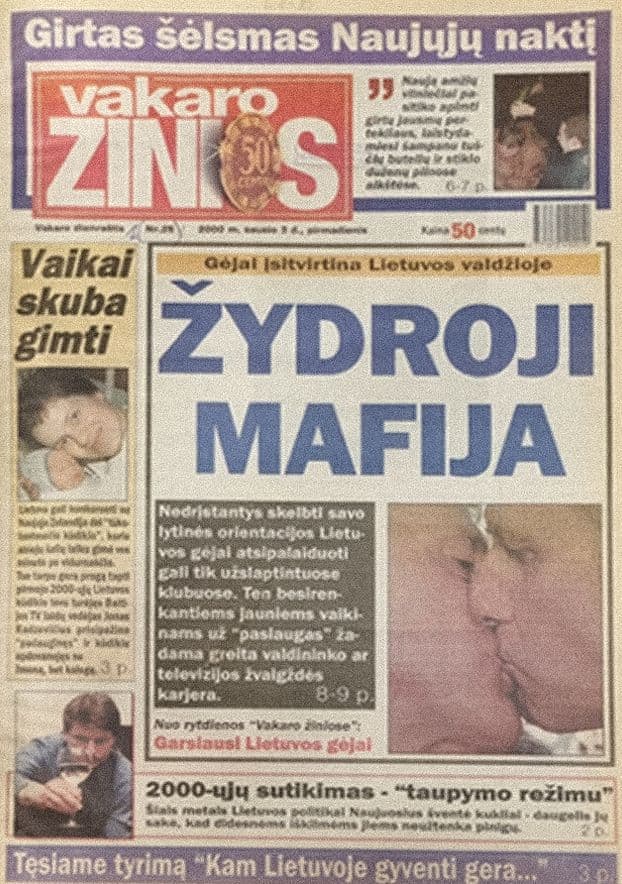
Following this article, over the course of three weeks, Vakaro žinios published a series of articles under the title ‘Gays’ (later renamed ‘People Call Them Gay’), which identified 13 prominent men as allegedly homosexual. This witch-hunt sparked a public debate about the limits of media freedom, while one of the men who had been ‘outed’ successfully pursued legal action over the violation of his privacy. Having discovered that controversy boosted sales, however, the Respublika Media Group continued to escalate the issue over the following years, resorting to increasingly aggressive rhetoric, degrading illustrations, and conspiracy theories.
Despite more than two decades of such coverage, the media group has never been held accountable for inciting hatred against gay people.
Moral panic
Starting with 2000, as Lithuania embarked on the process of joining the EU, claims about the supposed political influence of LGBT organisations became increasingly widespread in public discourse. Lietuvos rytas suggested that EU membership would entail requirements to legalise same-sex marriage. Kauno diena, meanwhile, portrayed EU financial support for LGBT organisations as the ‘promotion of homosexuality’, supposedly incompatible with Lithuania’s national values.
The new Criminal Code, which entered into force in 2003, provoked particularly intense moral panic; by repealing Article 122(2), it established the same age of consent for both heterosexual and homosexual relations. The Respublika Media Group used the opportunity to revive conspiracy theories portraying gay men as sexual predators. The newspaper Vakaro žinios published an article entitled ‘A Government Gift to Child Molesters’, with the subheading ‘Gay Men in Lithuania Can Now Have Sex with Minors and Go Unpunished’. The Catholic Church also contributed to this manufactured scandal, increasingly presenting itself in the press as a moral authority on such matters. In 2004, the Lithuanian Bishops’ Conference issued a statement urging politicians to ‘do everything possible to prevent Lithuania from becoming a magnet for paedophiles, people of ‘non-traditional’ sexual orientation and ‘sex tourists’. This further blurred the distinctions between these concepts.
The recurring portrayal of homosexual people as paedophiles, warnings about LGBT organisations that supposedly ‘promote’ homosexuality using EU funds and wield considerable political influence, and similar harmful stereotypes in the press of independent Lithuania can be seen as precursors to the amendments to the Law on the Protection of Minors adopted in 2009. This notorious legislation, modelled on Russia’s ‘gay propaganda’ law, effectively enabled objective information relating to LGBT people to be censored in Lithuania for more than 15 years.
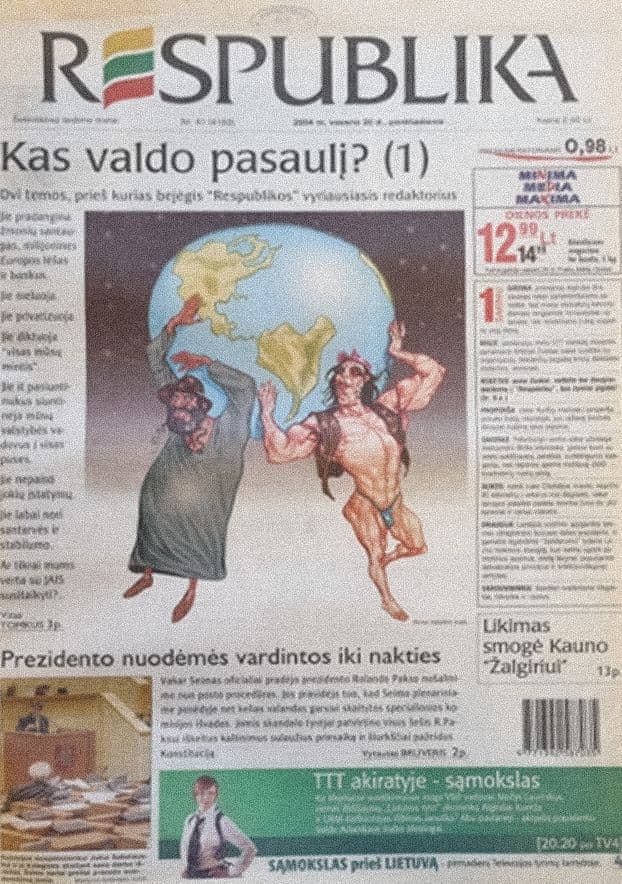
The portrayal of LGBT people as a threat to children is also characteristic of the far-right anti-gender movement that has emerged in many European countries over recent decades. Having replaced openly homophobic rhetoric with more abstract references to ‘gender ideology’, this movement reached Lithuania after 2010 and became established as part of civil society, most often drawing on the authority of the Catholic Church. As in other Eastern European countries, the anti-gender narrative promoted in Lithuania rests on the claim that LGBT rights have supposedly been imposed by ‘Western liberal elites’ and are incompatible with the local national culture.
The combination of Soviet-era stereotypes and more recent opposition to Western values, repeatedly expressed in public discourse since the restoration of Lithuania’s independence, appears to have contributed to the persistently negative attitudes of a large proportion of society towards same-sex partnerships, marriage, and parenting. This partly explains why the situation regarding LGBT rights in Lithuania remains among the least favourable in Europe.
This project has received funding from the Research Council of Lithuania (LMTLT), agreement No S-PD-24-139.