- 11 November 2026
- Ugnė Lisauskaitė
How Do You Teach a Robot to Walk? A Vilnius University Student Sought Answers in the US
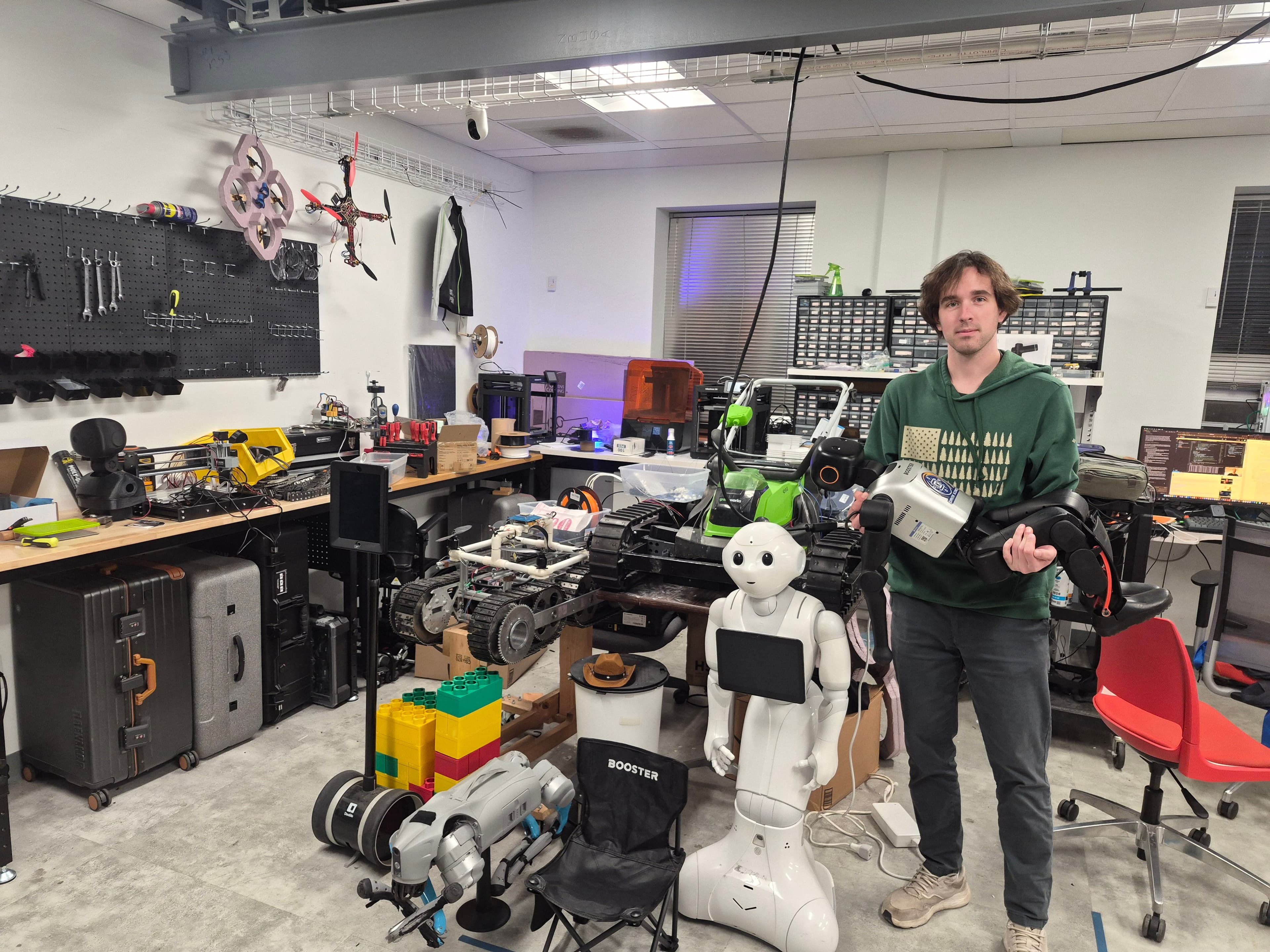
How do you transfer human movements from a video to a humanoid robot? How can a robot be taught not only to walk, but also to mimic a human gait? Kyrylo Kolesnichenko, a student at the Kaunas Faculty of Vilnius University (VU) who conducted robotics research in the United States, is addressing these questions and contributing to robotics research.
K. Kolesnichenko, a fourth-year student on the Bachelor’s programme in Information Systems and Cybersecurity, completed an internship at the Advanced Telerobotics Research Laboratory (ATR Lab) at Kent State University (US). There, he contributed to the development and training of motion models for humanoid robots and experimented with artificial intelligence methods and robot platforms.
‘It was a unique opportunity to work hands-on with real robots, since I hadn’t encountered anything like this at any of the other universities where I studied,’ says K. Kolesnichenko.
How Do Humanoid Robots Learn to Move?
For a humanoid robot to move like a human, it is not enough to programme its steps. Robots must learn to choose the right movements, maintain balance, and adapt to various situations. One way to achieve this is through reinforcement learning. This method allows robots to learn to choose actions based on the feedback they receive.
It is precisely this method that K. Kolesnichenko, a student at Vilnius University’s Kaunas Faculty, is applying in his research. At the Advanced Telerobotics Research Laboratory, he has conducted experiments both in a virtual simulation environment and with real robots. Currently, the student is developing and training the ‘Booster K1’ humanoid robot model, designed for robotic movements and their demonstration.
‘Working in the lab allowed me to apply my knowledge of information technology, software development, artificial intelligence tools, cybersecurity system analysis, and technical communication. The experience I’ve gained will also be useful when preparing academic papers, including my Bachelor’s thesis,’ says K. Kolesnichenko.
The Path to Robotics Research – Through an Exchange Programme
A Vilnius University student’s journey into robotics research began during an exchange semester at Kent State University. Intrigued by the course ‘Software Development for Robotics’ taught by Dr Jong-Hoon Kim, an associate professor of computer science and director of the ATR Laboratory, he approached the professor about the possibility of joining the laboratory’s activities. At first, he collaborated with one of the lab’s doctoral students, and after the exchange semester ended, he began a research internship.
‘I believe that research truly broadens your horizons and teaches you things you wouldn’t normally learn in a classroom,’ says K. Kolesnichenko.
Such research isn’t limited to the lab. The robot motion models he developed were also used in a robot fashion show project in New York. In the lab, the student also contributed to other projects related to human–robot interaction and the capabilities of humanoid robots, and sometimes the researchers take the robots for a walk around the university campus or city centre to showcase them to the public.
International Experience Paved the Way into the World of Robotics
The opportunity to get involved in research arose through the international mobility programmes offered by the Kaunas Faculty of Vilnius University. Seeking to broaden his academic knowledge and experience a different academic environment, Kyrylo spent part of his studies at Tampere University in Finland, the University of Vermont, and Kent State University in the US. This experience allowed him to gain a deeper understanding of the field of robotics and enhance his research skills.
His studies at the Kaunas Faculty of Vilnius University provided Kyrylo with a solid foundation in computer science and encouraged him to delve into more complex technological fields. He was encouraged to engage in research by his lecturer, Associate Professor Dr Martas Ambraziūnas, who also helped him prepare his first research paper. The paper was presented at the international conference ‘Information Society and University Studies’ (IVUS 2026). The study examined how structured task presentation can help address issues in the functioning of vision and language models.
Another significant experience was his participation in the international robotics and automation conference ‘IROS 2026’. There, K. Kolesnichenko, together with Associate Professor Jong-Hoon Kim and PhD candidate Irvin Steve Cardenas, presented research on how humanoid robots learn movements from stage video recordings.
‘At the IROS conference, I was most interested in motion reorientation, humanoid motion, and robot learning,’ the student explains.
Inspired to Consider Studying Robotics
Among the most memorable presentations, K. Kolesnichenko highlights the ‘Olaf’ robot developed by Disney Research and the ‘Chasing Autonomy’ project at the California Institute of Technology (Caltech). By participating in ‘AGIBOT’ and ‘PaXini’ events, the student also established connections with representatives of the robotics industry.
‘By interacting with specialists from different fields, I realised what problems the industry is tackling and what skills are needed to contribute to advances in robotics. It’s important for a researcher to step out of the lab and meet with practitioners,’ K. Kolesnichenko shares his impressions.
His experience in research and international collaboration has encouraged the student to consider pursuing a master’s degree and a doctorate in robotics.
‘For those considering international opportunities or participation in research, I advise you not to hesitate – feel free to take the initiative. Apply for exchange programmes, network with researchers, and don’t be afraid to try new things,’ urges K. Kolesnichenko.