- 29 October 2026
- Gabrielė Rimkutė
How Is the Brain Saved? School Pupils Take Part in a Stroke Simulation as Part of ‘Student for a Day’
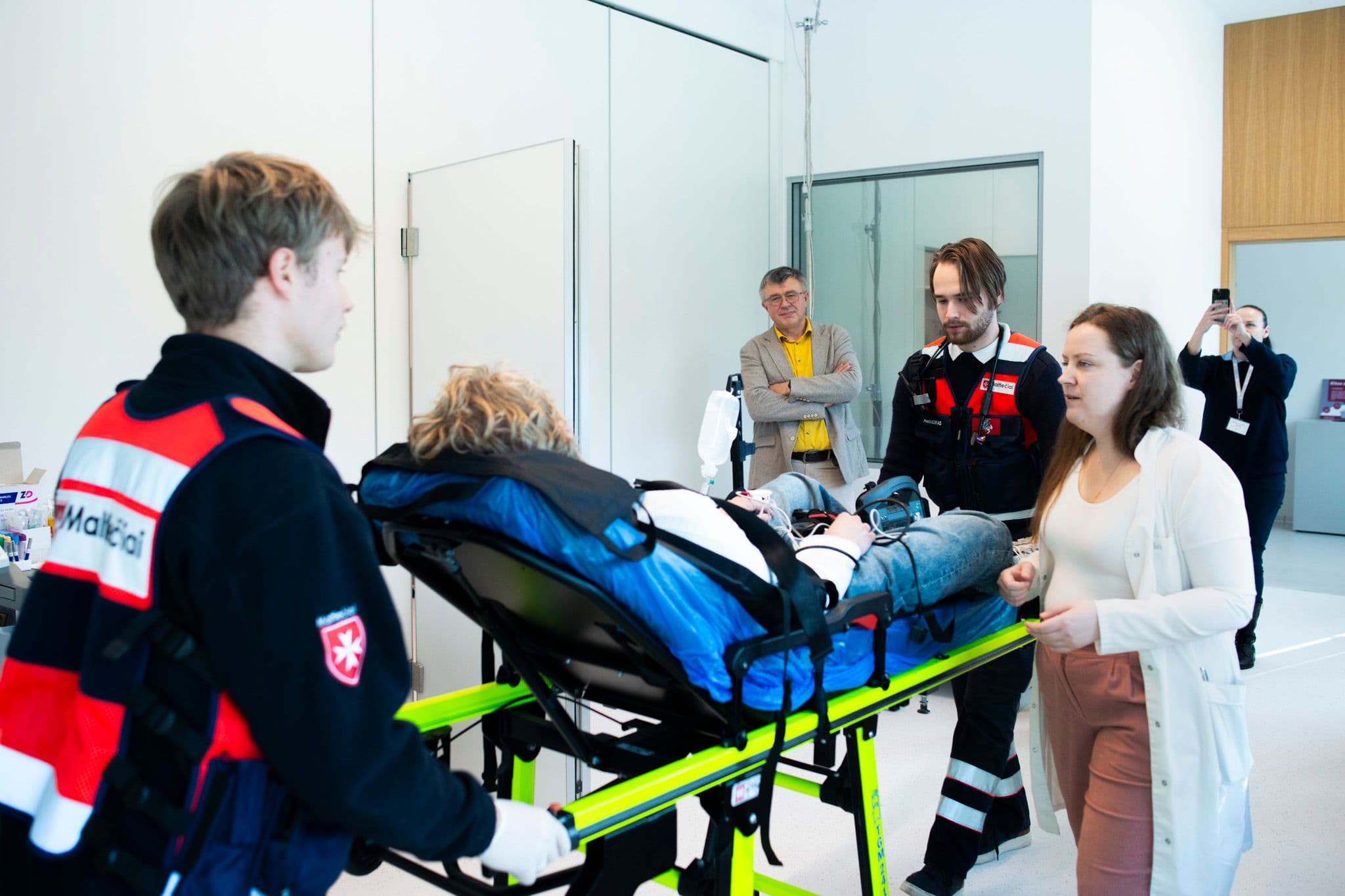
World Stroke Day, marked on 29 October, serves as a reminder of the importance of recognising the signs of stroke and seeking emergency medical assistance as quickly as possible. These issues were the focus of a lecture and simulation session held on 12 October as part of Vilnius University’s (VU) ‘Student for a Day’ initiative at the Medical Simulation Centre of the VU Faculty of Medicine. Pupils in Years 10–12 had the opportunity to follow the journey of a patient experiencing a stroke, from the home environment to the hospital’s intensive care unit, and gain first-hand insight into the work of healthcare professionals in a situation where every second can make the difference between life and death.
The stroke simulation was led by Dr Aleksandra Ekkert, neurologist and Associate Professor at the Clinic of Neurology and Neurosurgery of the VU Faculty of Medicine, and Prof. Dr Dalius Jatužis, neurologist and Dean of the VU Faculty of Medicine. They were supported by Paulius Uksas, an emergency medicine physician and Head of the Emergency Department at Republican Vilnius University Hospital; Erikas Tarvydas, a volunteer paramedic and Andrius Gudauskas, First Aid Programme Coordinator from the Order of Malta Relief Organisation; volunteer medical students Ainė Mameniškytė and Domas Drazdauskas, along with Renata Juknevičienė and Karolina Keinaitė from the Medical Simulation Centre of the VU Faculty of Medicine.
According to the organisers, although the public is aware of the importance of recognising stroke symptoms and calling for emergency assistance without delay, few people fully appreciate what happens in practice: what takes place when a patient arrives at hospital, how their condition is assessed, what decisions doctors must make and how emergency treatment is organised. The pupils explored these questions not only by attending a lecture delivered by neurologists but also by actively participating in realistic clinical scenarios.
The pupils explored several scenarios involving stroke management, including mechanical thrombectomy, intracerebral haemorrhage and thrombolysis. They learnt about the principles of emergency department operations, clinical decision-making and collaboration between specialists from different medical disciplines.
During the simulations, participants encountered a patient presenting with stroke symptoms, including numbness in the arms and legs, facial asymmetry, deviation of the gaze to one side, an inability to speak and impaired movement. They observed a simulated transfer of the patient for computed tomography scanning and analysed the resulting images with Assoc. Prof. Dr Ekkert. The pupils also saw how clinicians assess a patient's condition, determine the appropriate treatment and organise ongoing care. This included calculating and administering medication, monitoring blood pressure at frequent intervals and preparing the patient for thrombectomy.
For Emilija, one of the participants of the event, the stroke simulation left a very positive impression: 'Everything was incredibly realistic and engaging. I particularly enjoyed learning about brain computerised tomography scans and seeing how specialists interpret them. As I would like to study medicine in the future, this experience has further inspired me to explore the field. I am very glad we had the opportunity to visit the VU Medical Science Centre, where we received a warm welcome and had many of our questions answered,' she said.
Across the three simulations, the pupils not only learnt to recognise the signs of stroke but also gained an understanding of what it means to make critical decisions when every second counts. They also observed how healthcare professionals communicate with a patient's relatives, asking targeted questions to obtain essential information needed to assess the patient's condition.
‘Time is brain’ is a well-known phrase in medicine, quoted by Prof. Dr Jatužis, who explained that a rapid response and effective teamwork among specialists can help save millions of nerve cells. ‘When deprived of their blood supply, brain cells die extremely quickly. Up to 32,000 neurons are lost every second, equivalent to the brain ageing by 8.7 hours. In one hour, irreversible damage results in the loss of so many cells that it would be equivalent to ageing by 3.6 years. A stroke lasting ten hours can, in effect, 'take away' as much as 36 years of life,’ he explained.
According to Assoc. Prof. Dr Ekkert, the students’ enthusiasm and curiosity were particularly impressive: “Many young people stayed after the lectures to ask additional questions and express their gratitude. One of the students who approached me is already involved in a research project, while another had travelled all the way from Klaipėda specifically to attend. This level of interest is truly remarkable. I was also impressed by how thoughtful and logical the students’ questions were. If these young people are to become our future medical professionals, that makes me very happy,” she said.
On World Stroke Day, it is important not only to raise public awareness of the signs of stroke and the need for emergency treatment but also to encourage young people to explore medicine in greater depth. This meaningful, engaging and hands-on introduction to stroke diagnosis and treatment gave the pupils an opportunity to gain a closer insight into the medical profession, better understand the responsibilities of healthcare professionals and perhaps take their first step towards a future career in medicine.