- 26 November 2026
- Assoc. Prof. Giedrė Balčytytė Faculty of Philology, Lect. Simona Žalytė-Linkuvienė, Šiauliai Academy
Modern Soundscape: Do We Live in a State of Auditory Overload?
The abundance of sounds in a person’s living environment forms an integral part of it, yet we rarely consider how consciously listening to, perceiving, and interpreting sounds enriches our daily experience. In most cases, we perceive ambient sounds as a continuous background, and, in urban spaces, simply as general noise. However, the city is a particularly rich and dynamic landscape of distinct sounds. The bustle of the streets, the hum of traffic, human voices, echoes of cultural life, signals generated by public spaces and technology, as well as natural and ambient sounds all intertwine, reflecting the rhythm and change of the modern city. Each city has its own unique acoustic portrait – a distinctive soundscape shaped by its urban structure, cultural life, social processes, and the daily habits of its residents.
Today, the soundscapes of the world’s major cities are an important subject of interdisciplinary research. Scientists are increasingly analysing how the sonic environment affects people’s well-being, attention, and relationship with their surroundings – whether urban sounds help them feel at ease or, on the contrary, become a constant source of irritation. What acoustic portrait does the Lithuanian capital present today? Does the soundscape of Vilnius create acoustic comfort, or is it increasingly characterised by auditory overload?
What shapes the soundscape of a city?
To better understand the soundscape of a city, it is first worth looking at what it consists of. The acoustic environment of a city is made up of many sounds of various origins: the roar of traffic, the voices of people and sounds of their daily activities, the signals emitted by electronic devices, and the noisees produced by natural elements such as weather phenomena, water, or fauna. The urban soundscape also includes acoustic phenomena generated by technology and infrastructure: sounds from construction, repair work, industrial activity, utility systems, or building equipment. Cultural-acoustic events such as concerts, church bells, celebrations, or other sounds from public spaces are an equally important part of the acoustic character of a city.
City sounds rarely exist in isolation from each other. They merge, overlap, and together create an acoustic profile specific to each urban space, which, over time, becomes not only part of a city as a physical environment but also an independent research object. The Canadian composer, educator, and environmental sound researcher Raymond Murray Schafer, who initiated the World Soundscape Project in the late 1960s, is considered one of the key pioneers of contemporary soundscape research. This project has fundamentally changed the perception of the sonic environment of a city. Sounds are viewed not only as a source of noise but also as part of a city’s identity, conveying important cultural, social, historical, and ecological information.
Today, soundscape research is carried out in many cities around the world. Sound archives are created, disappearing acoustic phenomena are documented, changes in city sounds are recorded, and sonic heritage collections are created.
Such research is carried out in Vilnius, too. However, in the capital, the main focus so far has been on environmental noise monitoring – the impact of traffic noise and strategic noise mapping. Nevertheless, Vilnius is interesting not only as a subject of noise measurement. The acoustic character of the city is formed by the rather rare intersection of different urban layers: a compact historical centre, busy transport arteries, large residential areas, abundant green spaces, and rapidly changing modern public spaces.
This acoustic diversity is complemented by artistic and cultural initiatives that have been growing in number in recent years, inviting us to explore Vilnius not only by sight but also by sound. Sound walks are organised, sound art projects are implemented, listening workshops and various experimental forms of city experience are developed, encourage experiencing familiar spaces in new ways and noticing sounds that reveal so much about the environment.
Conscious listening reveals more
Perhaps even more importantly, such initiatives bring back into the spotlight one of the crucial yet increasingly overlooked processes in the modern city – conscious listening. Unlike hearing, which is a physiological and mostly passive process, listening requires active focus, the selection of acoustic information, its interpretation, and the construction of meaning. In other words, a person not only registers the sounds in the environment, but also consciously decides which of them are worth focusing on.
International initiatives also promote a culture of conscious listening. Celebrated every year on 18 July, World Listening Day marks the birthday of Raymond Murray Schafer, a pioneer of soundscape research. It invites people to stop, pay attention to ambient sounds, and rediscover the everyday sonic world. The ability to notice, recognise, and interpret ambient sounds fosters a sense of belonging to a place and helps to recognise the rhythm of the city and its cultural identity.
When the city becomes too loud
Unfortunately, people’s ability to listen consciously has its limits. Like attention or visual systems, hearing is not designed to process an unlimited amount of information either, so if there are too many sound stimuli in the environment, they may become an additional burden in the long run. This phenomenon is called auditory overload.
Auditory overload is not always related to an excessively high intensity of sound. It may also manifest itself in situations where a person is exposed to several competing, unexpected, unwanted, or unpredictable sounds at the same time. Such environments can make it hard to concentrate and can even hinder communication.
In the modern city, the rapid growth of technology-generated sounds is also contributing to the rise in auditory overload. Warning signals, notifications, sounds from electronic devices, and constantly operating infrastructure have become relatively new elements in people’s sonic environment, significantly transforming the daily listening experience.
Therefore, the question of where the threshold for auditory overload lies is increasingly linked today not only to environmental noise measurements but also to the daily experiences of city residents. It is becoming increasingly important to understand how people hear, perceive, and evaluate the sonic environment around them, how they feel in public spaces, and how much effort even the simplest everyday activities – such as focusing, communicating, or simply being in the city – require.
What do residents of Vilnius hear?
A study carried out by Vilnius University researchers in 2026 sheds light on how changes in the sonic environment are reflected in the experiences of present-day residents of Vilnius. It involved 282 residents of the capital who were surveyed about their sonic experiences and well-being in several public spaces in the city: public transport, railway and bus stations, cafés, bars, restaurants, parks, as well as cultural and leisure venues. The study aimed to uncover how the soundscapes of these spaces affect the residents’ emotional well-being, focus, communication, experiences of auditory overload, perception of acoustic comfort, and conscious listening practices.
One of the most striking findings was that residents of Vilnius are quite sensitive to the sonic environment around them. Almost half of the respondents indicated that ambient sounds often attract their attention, even if they are focused on something else at the time, such as work, reading, chatting, or resting. Nevertheless, the majority of the respondents see Vilnius as relatively calm rather than noisy. However, this does not mean that the city’s sonic environment always meets their expectations. What matters to residents of Vilnius is not so much the number of sounds as their nature – whether they are appropriate to a specific place or situation and whether they interfere with communication, relaxation, and concentration.
Café bustle does not always create a cosy atmosphere
The importance of the sonic environment is particularly pronounced in cafés, bars, and restaurants – places that are usually associated not only with food but also with rest, meetings and conversations. More than half of the respondents (56%) consider that acoustic comfort is not given enough attention in these locations.
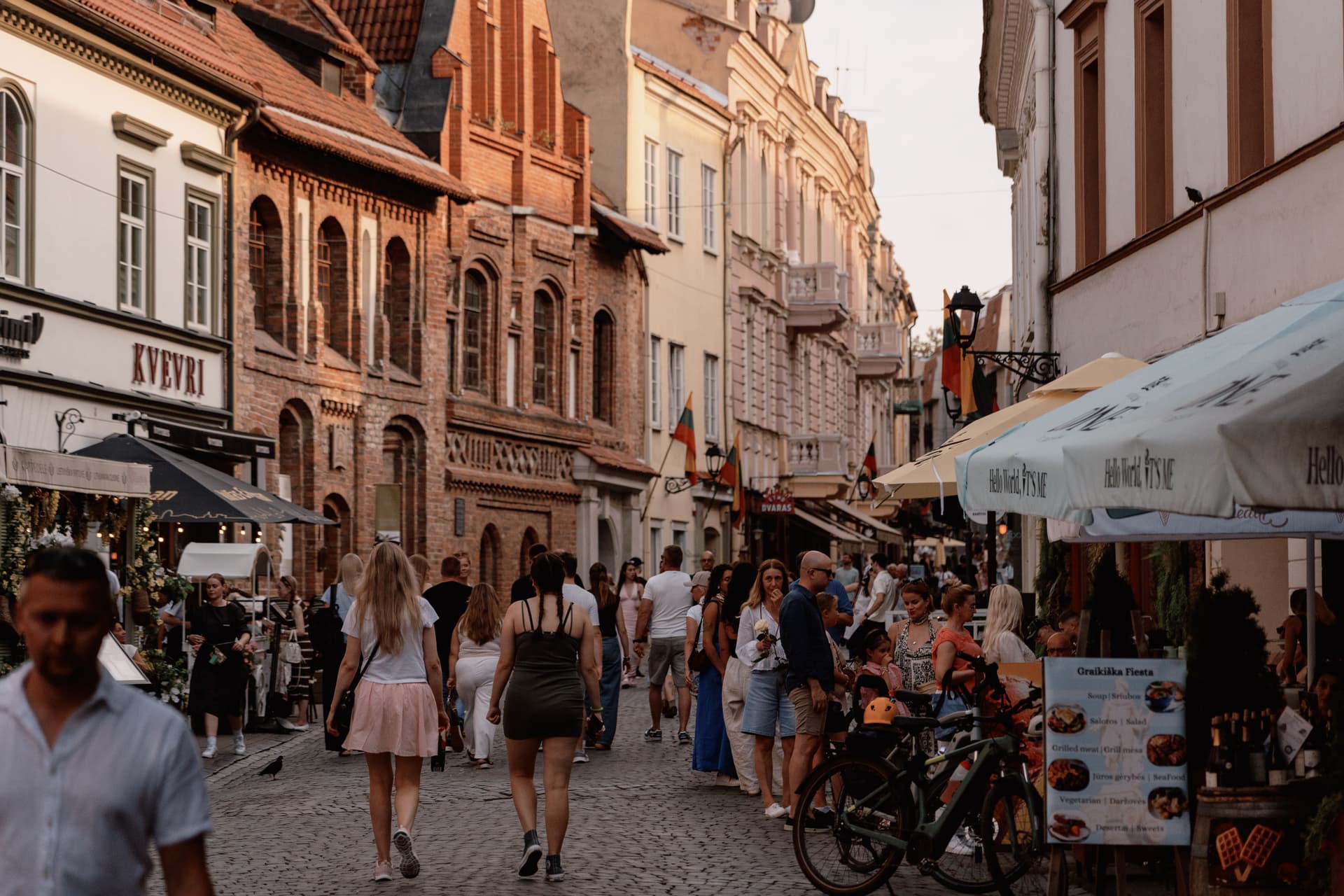
The most commonly mentioned issues included music that was either too loud or unsuitable for the place, a general buzz or echo, conversations among other customers or staff, exacerbated by sometimes poorly considered spatial layouts, phone calls, remote meetings, and unwelcome noise caused by children. In other words, residents of Vilnius do not expect silence in cafés, but they do expect to be able to communicate without raising their voices and to relax as part of the environment rather than having to fight against it.
The sonic environment on public transport is the most bothersome
Travelling by public transport and the sonic environment at railway and bus stations drew more criticism. A large proportion of the respondents reported a lack of clearer, higher-quality, and more up-to-date passenger information announcements, with appropriate sound clarity and volume. Even more comments were made about rail travel outside the city, but a more common point was the behaviour of fellow passengers rather than the dissemination of information, i.e. respect for the acoustic comfort of other passengers.
As many as 79% of the respondents indicated that at least occasionally, they find it difficult to concentrate, rest, or shut out environmental stimuli while travelling. The most common types of disturbances were loud phone calls, conversations on the loudspeaker, audio played on mobile phones or tablets without headphones, games, and other content from personal devices, unwittingly becoming the centre of everyone’s attention. Meanwhile, city buses and trolleybuses were relatively well regarded, with only around 30% of the respondents indicating they frequently experienced significant acoustic disturbances.
Green spaces – oases of tranquillity in the city
A completely different side of Vilnius can be experienced in parks and green spaces. Here, the respondents mostly mention birdsong, the rustling of trees, and the sounds of wind and water. As many as 43% of those surveyed identified these as the most noticeable and pleasant sounds, while 78% described the sonic environment of Vilnius city parks as tranquil or mostly tranquil.
Interestingly, Vilnius residents seek not only visual but also auditory respite in parks and green spaces. These places offer a brief escape from the city’s more intense sonic environment. However, tranquillity in parks does not equal silence for residents. More often, it is an opportunity to listen more consciously to the environment and hear different kinds of sounds – more natural, less intrusive.
The study showed that for residents of Vilnius, such conscious listening to the environment is not a common practice. When asked how often they consciously listen to ambient sounds, more than half of the respondents (56%) replied that they do so only occasionally, most often when the environment is peaceful or certain sounds are particularly appealing to them.
Sounds from cultural spaces enrich experiences
In the study, residents of Vilnius viewed the sonic environment of museums, galleries, and theatres favourably. As many as 58% of the respondents described these spaces as calm, conducive to concentration, and enriching the visitor experience. However, it is curious that only a small proportion of the respondents (20%) pointed out how sound is used in these spaces, including their acoustics, sound effects, background sounds, or the artistic value they create. This suggests that the invitation to conscious listening in cultural spaces often goes unnoticed. It shapes the visitor experience, yet rarely becomes the centre of attention itself.
The sensation of auditory overload is growing stronger
Meanwhile, auditory overload is becoming an increasingly familiar part of daily life for Vilnius residents. As many as 41% of the respondents reported experiencing it occasionally, particularly in busier urban areas or during peak times, while another 34% said they experienced it in certain situations.
Importantly, residents of Vilnius do not usually associate auditory overload with a single noise source, but rather with situations in which too many different sounds demand attention simultaneously. This can be a combination of various sources – traffic noise, conversations, signals from technological devices, or audible content in public spaces.
The results of the study suggest that the sounds of a modern city are often related not so much to the city’s infrastructure or the design of its public spaces, but rather to changing patterns of behaviour in public spaces, the use of technology, and decreasing sensitivity to general acoustic comfort.
Each time we choose how loudly to speak, whether to use our phone’s loudspeaker in a public space, and whether to leave room not just only for our own listening experience but also for that of others, we each contribute to creating a pleasant urban sound culture based on mutual respect.