- 20 October 2026
- Vilnius University information
New VU ‘Spectrum’ Magazine Out Now: Why Do We Believe in Conspiracy Theories?
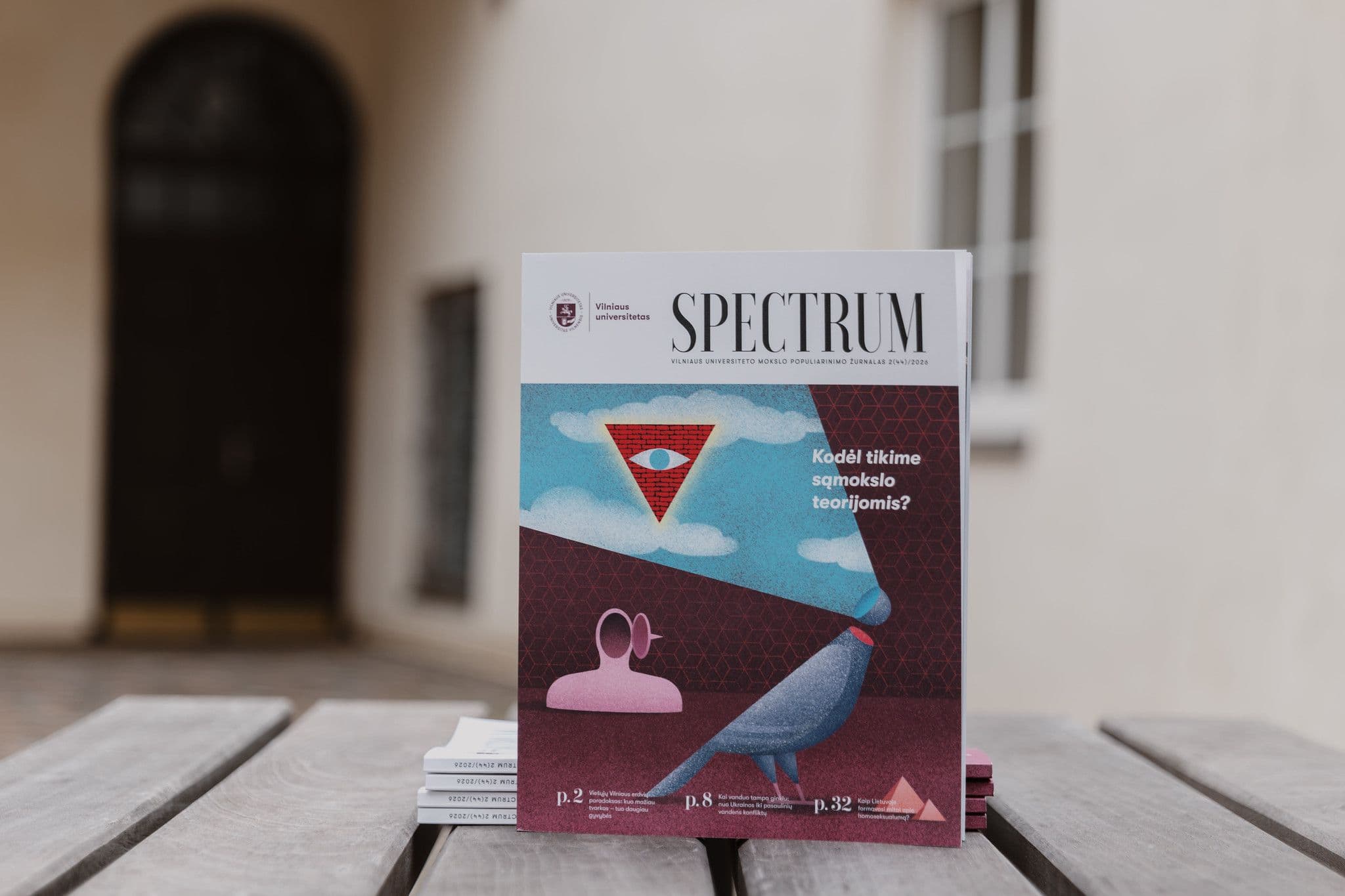
Why do people believe in conspiracy theories? Can a smartwatch help doctors diagnose disease? How does water become a tool of geopolitical pressure? And why has the Arctic become an arena of rivalry between world powers? Explore these questions and more in the latest issue of ‘Spectrum’, Vilnius University’s (VU) popular science magazine.
For the first time, the magazine has been published in both Lithuanian and English, bringing VU researchers’ ideas and findings to an international audience.
In this issue, VU researchers discuss how less well-maintained public spaces in Vilnius can become more vibrant, what new threats viruses circulating among animals may pose to humans, how water can turn from a vital resource into a weapon, what a smartwatch can tell us about our health, why film festivals have become a battleground for international influence, and how myths about homosexuality developed in Lithuania.
The magazine also explores how we experience urban sounds, why advertising prompts even rational thinkers to make poor financial decisions, how immune system disorders may be linked to changes in behaviour and personality, as well as whose voices dominate coverage of abortion in foreign media, how financial literacy relates to online safety, and why a quick answer from artificial intelligence does not always lead to a sound legal decision. Some topics also remind us that science can reveal surprising aspects of the human body – such as how an extremely rare allergy to semen can become life-threatening.
The lead article examines the psychological and social mechanisms behind our tendency to look for hidden causes and unseen culprits. VU psychologist Dr Vytautas Jurkuvėnas explains why even clear-headed thinkers may come to believe conspiracy theories, including claims that the Earth is flat or that reptiles control the United States.
According to the researcher, conspiracy theories often appeal to people because they offer simple and clear answers to complex questions. They can provide a sense of security and control, fulfil a need to belong to a particular community, or make people feel they know more than most. Interestingly, education or IQ alone does not protect against belief in conspiracy theories: a predisposition towards a particular way of thinking can also play an important role.
Conspiracy theories are dangerous because they may undermine trust in science and institutions, influence people’s health and political decisions and, in extreme cases, lead to harmful actions. The psychologist stresses that people rarely start out believing the most extreme conspiracy theories; instead, they are gradually drawn into them, particularly when going through a crisis or joining a closed online community. Therefore, discussing conspiracy theories requires both debunking them and understanding what makes them so appealing.
VU’s ‘Spectrum’ magazine makes science accessible and seeks distinctive ways to communicate it visually. In this issue, visual artist Marija Benetytė illustrated some of the scientific topics, while the photo essays by VU photographer Tomas Laurinavičius enriched the narrative.