- 3 November 2026
The Paradox of Vilnius Public Spaces: Less Order, More Life
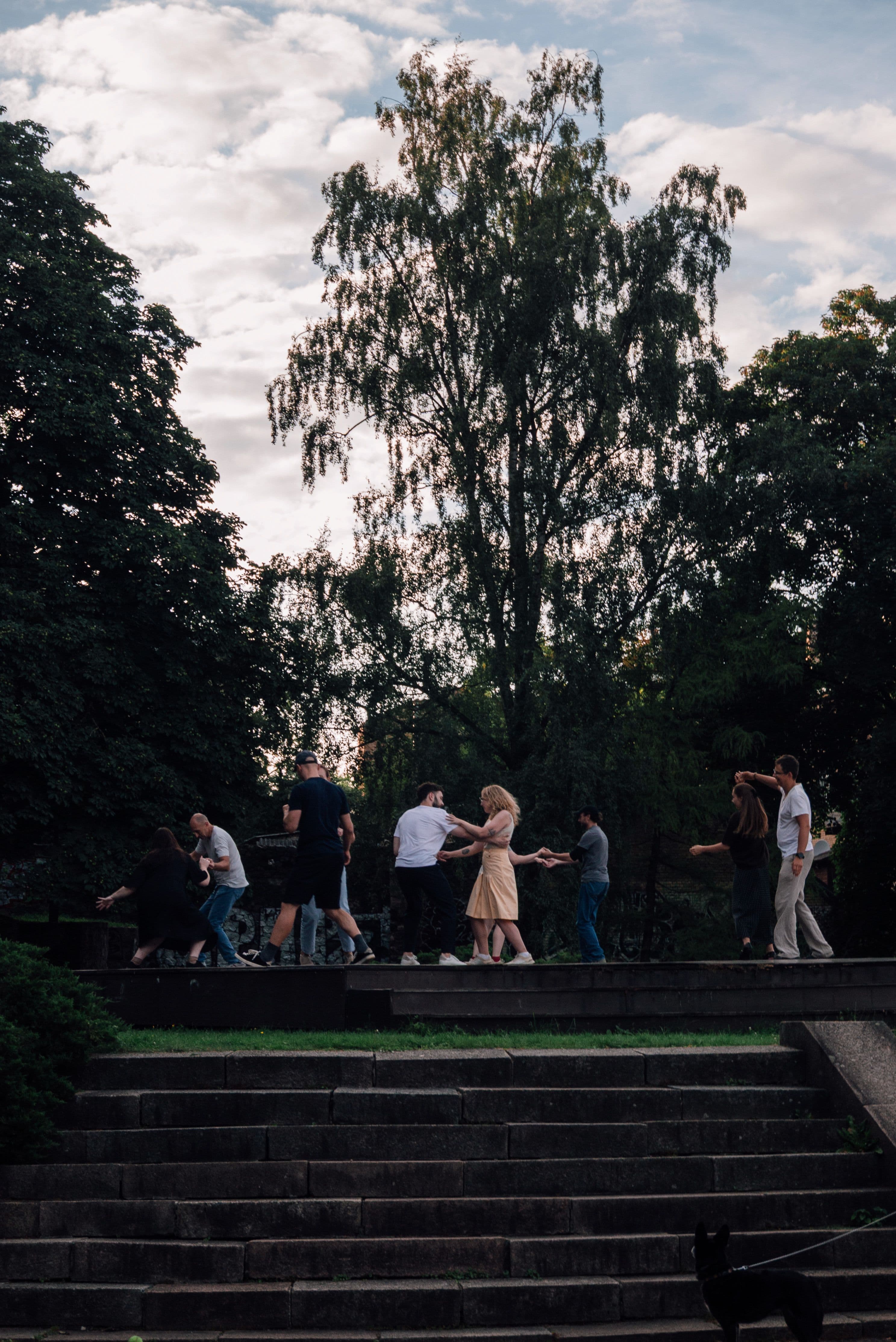
Passers-by afraid to step onto the grass, people hula-hooping beside memorials, dogs being groomed in public, a homeless woman watering flowers, people sitting glued to their phones, and others celebrating life by dancing on the foundations of a Soviet monument – all this is part of everyday life in Vilnius public spaces. It also reveals a broader context: when public spaces are redeveloped, not only does their appearance change, but so do the ways in which people interact, the activities they engage in, and their relationship with these places.
This is precisely the conclusion reached by researchers who spent more than a year studying of public spaces in Vilnius. Although renovated squares and parks may look more aesthetically pleasing and orderly, they become less socially diverse and leave less room for spontaneous life. Spaces that have retained their authenticity, meanwhile, remain livelier, more diverse, and, it seems, increasingly valued by city residents themselves.
Renovation transforms spaces and their visitors
The study examined five public spaces in the historic centre of Vilnius – the Bernardine Garden, Reformation Park, Lukiškių Square, Sapiegų Park, and Petras Cvirka Square. These are some of the capital’s most prominent public spaces, whose (non-)redevelopment has fuelled public debate for years and become a battleground for different visions of the city.
We wanted to understand how these spaces function in everyday life: who visits them, what people do there, and how renovation has changed the way they are used. The Bernardine Garden was reconstructed in 2013, Lukiškių Square – in 2017, Reformation Park – in 2021, while Sapiegų Park and Petras Cvirka Square have avoided radical redesign since Lithuania regained independence.
From spring 2025 to spring 2026, 64 long-term ethnographic observation sessions were conducted across these five public spaces; 56 visitors were interviewed; and the study also drew on earlier sociological, anthropological, and historical research into these sites. The study was conducted by Dr Veronika Urbonaitė-Barkauskienė from the Faculty of Philosophy, sociology students Aistė Puidokaitė, Miglė Marščionkaitė, and Orinta Našlėnaitė, and a Faculty of History student Miglė Lipinskaitė.
The observations revealed a clear difference between radically renewed spaces and those that have avoided comprehensive reconstruction during the period of the country’s independence. Our observations showed that renovated spaces attract a considerably less socially diverse range of visitors. Before renovation, Sereikiškės Park (the former name of the Bernardine Garden), Reformation Park, and Lukiškių Square were frequented by a very colourful range of members of society, who coexisted in these spaces. They were never short of young people from different subcultures or residents of the surrounding neighbourhoods from the highest to the very lowest social classes, while the age profile of visitors was equally diverse. We still observe this diversity in Sapiegų Park and Petras Cvirka Square, but the renovated spaces present a different picture.
The renewed parks and squares have acquired not only a different aesthetic character but also a kind of social filter. It feels as though an invisible yet very clearly perceivable form of ‘face control’ were at work. These spaces now tend to attract mainly people from the upper social classes, youth, and young families with children, while members of subcultures and lower-income residents are gradually withdrawing from places gleaming with newness and order. Or they find their own ways of taming them.
How do the ‘excluded’ adapt?
We observed that ‘excluded individuals’ employ certain tactics to adapt to the changed environment. Some visit the renewed public spaces only after dusk or early in the morning (except for Bernardine Garden, which is locked at night). Others choose more secluded corners, not as polished or shrouded in greenery, where it feels cosier to settle in. Yet another adaptation tactic is the radical opposite of hiding – boldly standing out from the crowd and emphasising one’s social and aesthetic difference from the majority of park visitors.
The clearest example of this tactic is a homeless woman often seen in Reformation Park, called ‘Ivan’s Granny’ (Ivano močiutė in Lithuanian) by some visitors, whose appearance and behaviour are eccentric. She sleeps while sitting under a large parasol, collects deposit-return containers, talks to herself, waters flowers, and tells fortunes with tarot cards. Her daily activities seem like a kind of performance – a way of distancing herself from the narrative of poverty and social exclusion. She seems to construct a different image of herself – not that of a victim, but of a park character, a spirit of the place, and a participant in a theatrical performance watched by a diverse range of park visitors.
Such changes among visitors also occur because a public space under renovation is, for a period – often even several years – fenced off and inaccessible to its former visitors. Once it reopens, it has to rediscover and reconnect with its own community all over again. Following radical renewal, transformed public spaces often feel alien to their former regular visitors: for some, the spaces are no longer comfortable or aesthetically acceptable. The formation of a new community of regular visitors and the emergence of new rituals and new relationships with the place are slow processes. Sometimes this bond remains disrupted for a long time or is never re-established at all.
The space dictates how to behave
This is revealed by the radically different practices of using space we have observed in renovated and non-renovated public spaces.
The newly renovated spaces – Lukiškių Square, the Bernardine Garden, and Reformation Park – together with their renewed infrastructure, seem to suggest specific ways of using the space, which most visitors follow. These practices, inscribed in the space itself, become clearly defined – people sit on benches, walk along paths designed for that purpose, children play in designated playgrounds, visitors play chess, pétanque, and permanent games incorporated into the parks, watch the fountains and admire the greenery, have fun by the water, and visit the cafés operating there.
Such spaces create conditions for certain activities as well as subtly indicate which patterns of behaviour are considered appropriate within them. Visitors to Lukiškių Square adhere most closely to the planners’ ideas about how to use the space and what to do there. Here, visitor behaviour appears most predictable and regulated: there is a great deal of transit movement – people often just pass through the square without lingering, there is a lot of cyclical movement – walking or wheeling baby strollers around, and a great deal of passive time spent using mobile phones. The greatest degree of spontaneity and playfulness here, of course, comes from children riding their bicycles through the fountains. Among older visitors, however, we observed considerably fewer creative ways of using the space.
Among the other spaces studied, Lukiškių Square also stands out because visitors are more reluctant to step onto the grass here than elsewhere. It seems that the only ‘legal’ way to tread on the grass is while walking or training a dog. Of course, this does not mean that no one has picnics or sits on the grass in the square, but such practices are quite rare. The space itself retains a rather cold, formal atmosphere – perhaps this is because of the complicated history of the square and the abundance of memorials surrounding it.
Even in such a more strictly defined space, however, there are people who interpret it in their own way. Just as Reformation Park has its own distinctive character, we also encountered a striking personality in Lukiškių Square. Against the backdrop of an event commemorating Lithuania’s accession to NATO, a colourfully dressed man was hula-hooping. When we spoke to him, he told us that he was born and raised in the US and that Lukiškių Square reminded him of Washington Square in New York. Now living in Vilnius, he tries to promote a more playful culture in public spaces, although, according to him, shy Lithuanians rarely accept his invitation to celebrate the city together.
Visitors to the Bernardine Garden and Reformation Park are bolder
In Bernardine Garden and Reformation Park, visitors proved somewhat bolder – they do not always accept all the rules of being and behaving proposed by the designers, and actively negotiate for the right to tame the space in their own way. These negotiations take place not through words, but through everyday actions. Their most striking manifestation is the reclaiming of the lawns and the rejection of the idea that they are meant only to be admired rather than actively used.
As one study participant put it: ‘At the Bernardine Garden, people were quite quick to climb over the barriers and step onto the grass... and thank God we can do that – people tamed the [renewed] park themselves.’ Visitors to the Bernardine Garden also rejected the cycling ban that was attempted to be imposed after the reconstruction.
A similar process took place in Reformation Park. Although the park’s renovators envisaged the meadow on the site of the former cemetery as a historical and aesthetic space first and foremost, visitors rejected this proposed use and turned it into an active site of everyday life. Contrary to what the park’s renovators intended, people walk freely across the meadow and use it extensively: they train dogs, create shortcuts, have picnics, and let their children play there.
This mismatch between the designers’ ideas and the everyday needs of those who use the space is especially evident in Reformation Park. It is revealed not only by the ethnographic observations but also by an online survey of Reformation Park visitors, commissioned by the Vilnius City Municipality in 2024. Although the majority of respondents (76% of the 302 surveyed) knew about the historic cemetery in the park, 68% rated walking in this space as appropriate or highly appropriate; 52% viewed picnicking positively, and 43% felt the same about dog walking.
Petras Cvirka Square encourages creativity
A quite different picture emerged at Petras Cvirka Square. In its unrenovated areas, the infrastructure offers far fewer activities, leaving visitors to engage in creative interpretation of the space. For instance, there are no playgrounds in Petras Cvirka Square, so children visiting here inevitably have to invent their own games in a space not designed for that purpose. They climb on supporting structures and steps, and play on the ‘stage’ where the monument to Petras Cvirka once stood. The character of the square is shaped by its terrain – a steep slope and steps without ramps, which not only dictate but also constrain certain ways of using the space, and exclude visitors such as those pushing baby carriages, people with disabilities, cyclists, scooter riders, and joggers.
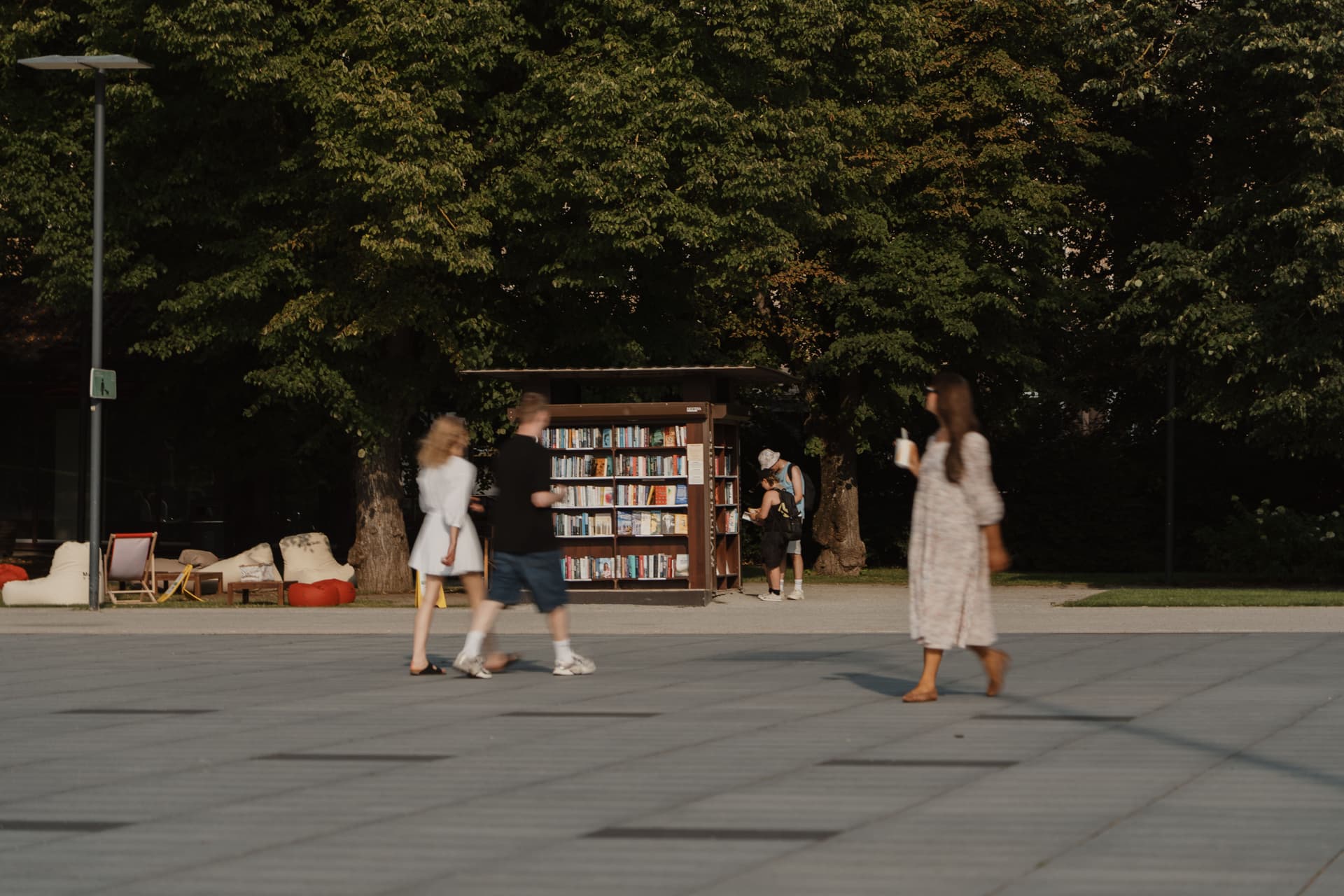
Perhaps this is why the square is visited by those who are comfortable with such ‘harshness’ – the bohemian clientele of the ‘CVI parkas’ bar, members of youth subcultures, older people, and, more generally, visitors from a wider range of social backgrounds.
As one interviewee put it: ‘All sorts of people come here – musicians, down-and-outs, construction workers. Nobody gets in anybody’s way here.’
The atmosphere in Petras Cvirka Square is free and relaxed. In the corners of the square, sheltered by trees, even unusual and almost intimate practices occur – ones tied less to a sense of a public space than to a sense of home. For example, two dogs were groomed in public in this part of the square.
Yet such practices in Petras Cvirka Square do not seem ostentatious or intended to provoke. On the contrary – they do not stand out from the overall atmosphere of the space – this kind of eccentricity is seamlessly woven into the general mood of Petras Cvirka Square and reflects its relaxed atmosphere and informality rather than social tensions or the breaking of established norms.
A fridge for those in need in Sapiegų Park
Sapiegų Park stands out among the other spaces studied because of its reconstruction history. In 2017, a reconstruction project for the park was drawn up with the aim of restoring its Baroque design: it envisaged rearranging the greenery, removing some mature trees, and installing lighting, paths, an irrigation system, a fountain, benches and bins.
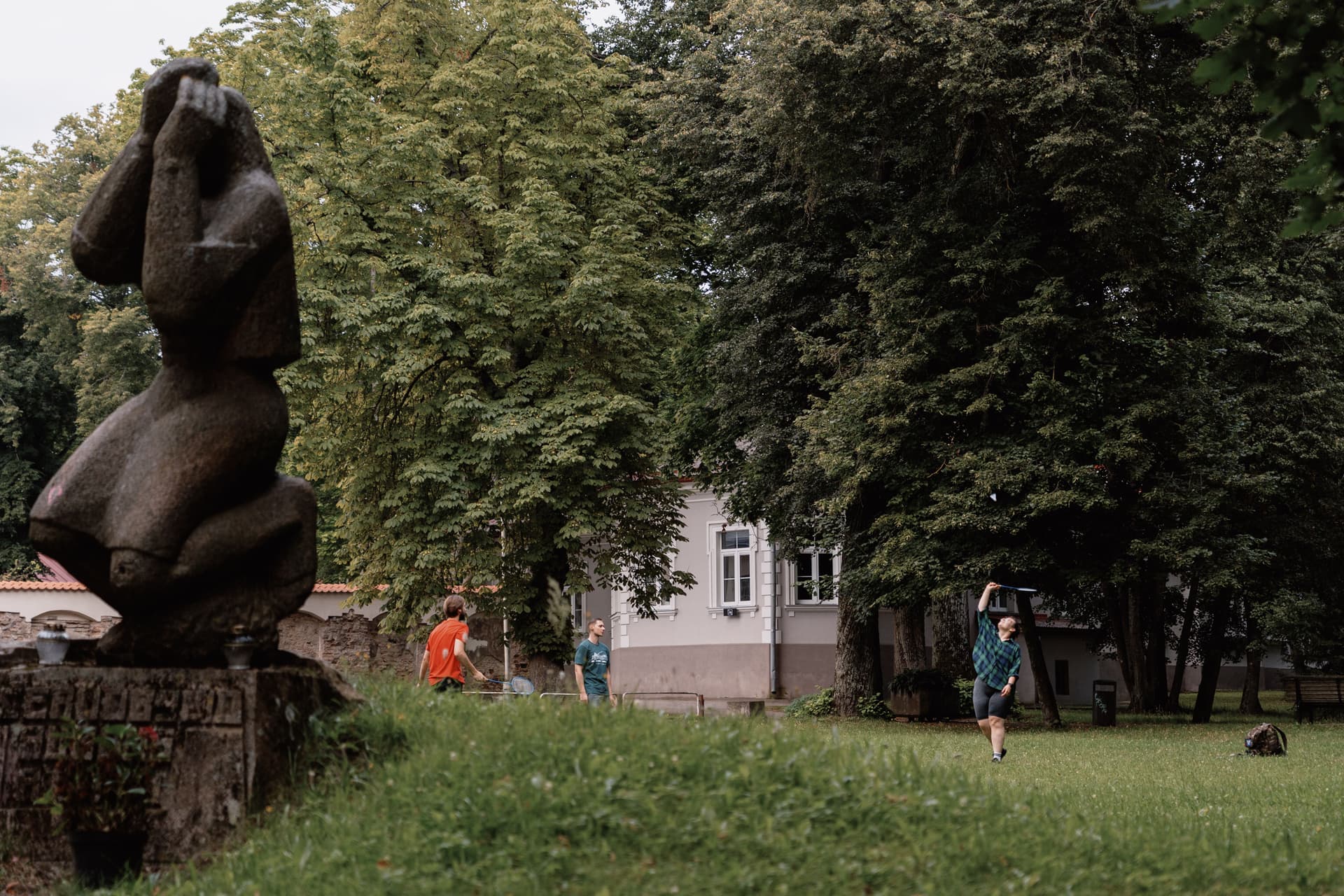
But the local community strongly opposed these plans, so the reconstruction was halted, and to this day, the park has retained a rather chaotic appearance in terms of its design. Despite this, Sapiegų Park is marked by an especially wide range of activities and functions: it has a large children’s playground, table-tennis tables, a community garden with a large greenhouse, and a community fridge where food can be left for those in need.
The buildings within the park also house several cafés, a private school, a kindergarten, the Antakalnis Eldership, and numerous startups that form part of the Tech Zity business complex. This whole diversity of functions attracts people of different ages, professions, and social groups, creating an especially vibrant everyday life in the park. Compared with the carefully renovated spaces in the city centre, the park has the calm, unhurried feel of a neighbourhood space. As in Petras Cvirka Square, there is less formal order in Sapiegų Park, yet greater social diversity, a more relaxed pace, and more spontaneous community life.
How is the notion of a ‘good park’ changing in Vilnius?
Radical renovation undoubtedly improves the physical condition of public spaces – they become tidier, more aesthetically pleasing and more functional. At the same time, however, they are standardised. Invisible norms of behaviour emerge, and social diversity and spontaneity decline.
Spaces that have been only partially renewed or left essentially unchanged, meanwhile, often look less presentable, but retain more everyday life, unpredictability, and social variety.
This raises the question: are we witnessing a certain turning point in Vilnius today?
After two decades in which newness, order, and representativeness were held to be the highest ideal for public spaces, are residents’ expectations of parks beginning to shift? Perhaps it is not sterile but lively spaces that are becoming increasingly valued – spaces with imperfections, wild nature, layers of urban memory, and unpredictable everyday life.
As visitors reflect on the physical and social changes that renovated parks have already undergone, they seek to tame them as much as possible by ‘climbing over the barriers and getting onto the grass’. Lukiškių Square, however, remains an exception for now.
As for public spaces that have escaped paving blocks, Baroque design, and radical redevelopment, the question arises – could their slightly grubby, not-quite-tidy, and untamed, yet socially vibrant and authentic atmosphere gradually be becoming the new ideal for Vilnius public spaces?
Because, in the end, a public space is not merely what the city builds. It is also what people create within it, and how they feel there.
The article was prepared as part of a project funded by the Research Council of Lithuania (RCL) entitled ‘Controversies in the Public Spaces of Vilnius: Conflict Structure and Transformation Pathways’ (in Lithuanian, Viešųjų Vilniaus erdvių kontroversijos: konfliktų struktūra ir transformacijos kryptys) (Research Group Projects, No. S-MIP-24-21).