- 31 July 2026
- Vilnius University information
Vilnius University Students Are Developing a Universal Bioengineering Platform to Be Presented at This Year’s International ‘iGEM’ Competition
Bacteria hide much greater potential than it might seem at first glance. Bacterial microcompartments (BMCs) – protein-based microscopic structures – found inside them can become an important tool in biotechnology in the future. However, to make it possible to adapt these natural systems beyond the bacterial cell, scientists first need to learn how to accurately manage their collection and modify their properties to meet specific needs.
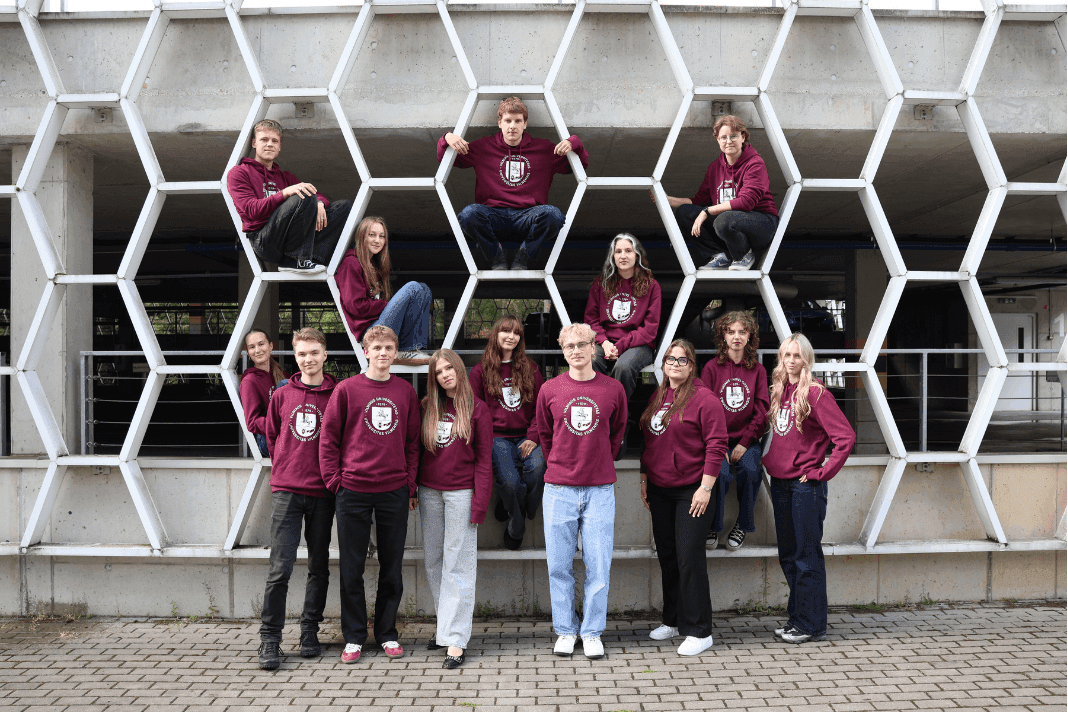
This is the challenge that is being addressed by this year’s ‘Vilnius-Lithuania iGEM’ student team of Vilnius University, which is carrying out the ‘BMClick’ project. The young researchers are developing a universal bioengineering platform that would enable bacterial microcompartments to be adapted for use with enzymes and biomolecules, and for the creation of functional surfaces. This November, the team will present the developed platform at the international synthetic biology competition ‘iGEM’ in Paris, which brings together over 400 teams from around the world every year.
Microscopic boxes for enzyme shielding and gene therapy
The platform being developed by the students is based on BMCs, protein structures naturally found in bacteria, which act as separate compartments within the cell, with specific chemical reactions taking place inside them. The goal of the team is to collect these structures from individual components in a test tube rather than within the bacteria and to transform them into a universal modular platform. It could be easily adapted to different applications, changing both the internal content and the surface properties.
One of the most important strands of the project is the encapsulation of enzymes, i.e., their containment inside the BMC. Enzymes are widely used in research, as well as the food, chemical and pharmaceutical industries, but they are sensitive to the effects of the environment, such as temperature changes, acidity or other adverse conditions. In such cases, BMCs would act as protective shells capable of shielding the enzymes from degradation and expanding their applicability to environments where they would otherwise lose activity quickly.
The team is looking for ways to introduce not only enzymes but also a wide range of other biomolecules, such as DNA, into the BMC. Short DNA chains can regulate gene expression, but they are unstable in the body. The young scientists expect the BMC to be able to act as a protective protein box, shielding these molecules and transporting them to the right place. If this can be proven, in the future the platform could be adapted not only for fundamental research but also for the development of gene therapy solutions.
The third strand of the project is functional surfaces, consisting of bacterial proteins, visible to the naked eye. Enzymes, antimicrobial proteins, or even single cells can be attached to them to provide the desired functions to the surface. In the future, such structures could be used to develop more efficient biocatalysts in industry, more sensitive biosensors in medicine and environmental monitoring, as well as antimicrobial coatings for medical devices or surfaces that need to be protected from pathogens.
The platform being developed by students could be useful in areas ranging from therapy to the biotechnology industry. Its strength lies in its versatility, which allows the same biological system to be adapted to different needs, making its potential not limited to one specific product.
‘Creating a tangible product is not our goal. We aim to design the proteins that make up bacterial microcompartments in such a way that they can be easily adapted for different tasks. In other words, we are developing a universal tool that other scientists could also use in the future,’ says Ema Ežerskytė, head of the laboratory of the ‘Vilnius-Lithuania iGEM’ team.
Science beyond the laboratory
The ‘Vilnius-Lithuania iGEM’ team is not limited to laboratory work. The students seek to promote synthetic biology by organising educational activities, participating in events and exploring new ways to present complex scientific topics in a comprehensible way to different groups of society. On 29 August, the team will take part in the discussion festival ‘BŪTENT’ (Lithuanian for ‘EXACTLY’), where they will discuss the links between science and everyday life with members of the public.
This year, the team’s educational activities were inspired by the so-called ‘third place theory’. It states that important conversations and communal ties are mostly born not at home or at work, but rather in informal settings such as cafés, libraries, parks, etc. Building on this idea, the team aims to discuss synthetic biology not only in academic settings, but also where people naturally meet, communicate, and share ideas.
‘When talking to people about science, being able to explain complex things easily is not the only important matter. It is equally important to hear what people think and what doubts they have. These conversations help us to better assess the meaning of the project being developed and remind us that real scientific progress only happens when innovations developed in a laboratory respond to real societal needs,’ says Oskaras Belousovas, leader of the ‘Vilnius-Lithuania iGEM’ team.
Vilnius University students have been representing Lithuania in the international competition ‘iGEM’ since 2015. During this period, the team has brought home the gold medal every year, while two of its projects – ‘SynORI’ (2017) and ‘FlavoFlow’ (2020) – were awarded the main prize of the competition. In 2023, the ‘Vilnius-Lithuania iGEM’ team also achieved a strong result and ranked second.
For more information on the ‘BMClick’ project and the opportunities to contribute to its implementation, please visit the Vilnius University Foundation website.