- 18 September 2026
- Vilnius University information
VU LSC Researchers Develop Technology for Faster Antibiotic Susceptibility Detection
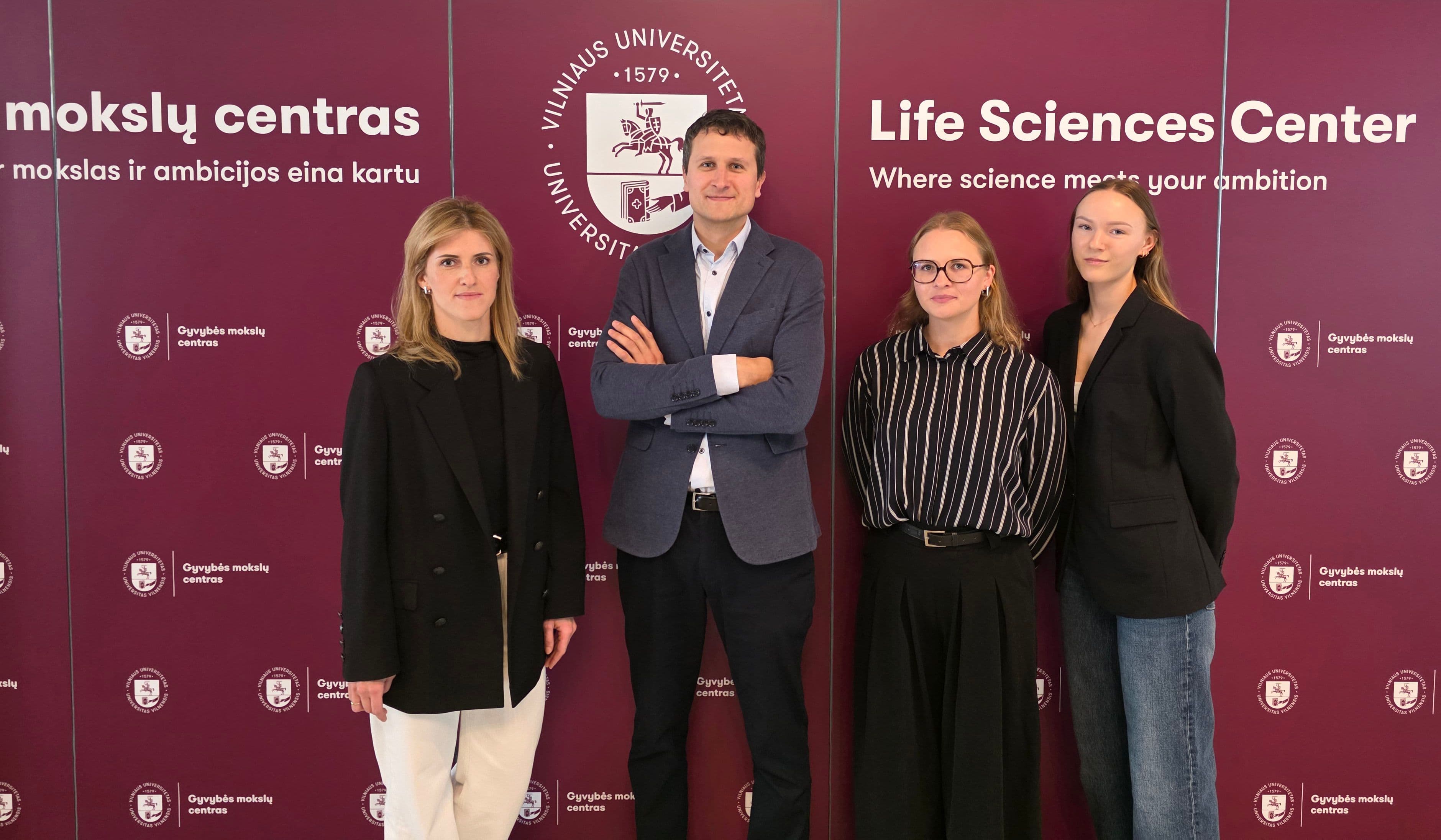
It can often take several days to determine which antibiotic will be effective for a specific patient. Researchers at the Life Sciences Center of Vilnius University (VU LSC), together with their partners, are developing technology that could reduce this time to just a few hours. For this, they are using the bacteria themselves: the researchers aim to use biofilms that bacteria form as natural biological indicators that can show, in real time, whether a selected antibiotic is effective.
Dr Rokas Žalnėravičius, leader of the VU LSC research team, says that making diagnosis more convenient is not the only reason why faster determination of bacterial susceptibility to antibiotics is important. The sooner it is determined which drug will be effective against the pathogen causing a particular patient’s infection, the sooner targeted treatment can be prescribed, avoiding unnecessary antibiotic use.
‘Today, it often takes one to three days to receive the results of an antibiotic susceptibility test. When treating a severe infection, this is a long time. Our goal is to take advantage of the natural biological processes of bacteria to obtain these results within a few hours and thus help doctors select the right antibiotic for a particular patient more quickly,’ said Dr Žalnėravičius.
The research is being carried out as part of a project funded by the Research Council of Lithuania, with researchers from the Center for Physical Sciences and Technology, the Nature Research Centre (NRC), and the Biofilms Research Center for Biointerfaces of Malmö University in Sweden working alongside VU LSC researchers. Young researchers are also involved in the project: Dr Eglė Malachovskienė, research assistant at LSC, Bachelor’s student at VU LSC Rugilė Jonaitytė, and Master’s student at VU LSC Evelina Lukaitė.
Bacterial ‘fortresses’ hinder treatment
Bacterial biofilms are one of the key areas of the researchers’ work. These are communities naturally formed by bacteria, in which the microorganisms are embedded in a protective polymeric matrix. It acts as a barrier, helping bacteria protect themselves against adverse environmental conditions, the human immune response, and antibiotics.
Biofilms can form on a wide range of surfaces, such as glass, metal, plastic, and tissue. As a result, they can also be found on medical devices, such as catheters, infusion systems, and implants. They become particularly dangerous when they form inside the human body or in wounds, as it can lead to difficult-to-heal infections and other serious complications.
‘An individual bacterium and bacteria living in a biofilm can be compared to a person in an open field and a person in a well-fortified fortress. The biofilm matrix provides bacteria with additional protection, making them much more difficult to reach and destroy with antibiotics. This is exactly why such infections are one of the most complex problems in clinical microbiology,’ explained Dr Žalnėravičius.
The antibiotic resistance of bacteria in biofilms can be up to a thousand times greater than that of individual bacteria. Therefore, antibiotics alone are often insufficient to treat such infections; repeated wound cleaning or surgical removal of damaged tissue may be required.
Are antibiotics effective? Bacteria reveal the answer
Currently, an antibiotic susceptibility test is typically performed to select the appropriate antibiotic for a patient. Bacteria in a biological sample taken from the patient are first cultured and identified, after which their susceptibility to different antibiotics is determined. Such testing usually takes one to three days.
The method being developed by VU LSC researchers is based on an entirely different principle – the natural ability of bacteria to transfer electrons into their surroundings.
Metabolic reactions constantly take place in bacterial cells, generating electrons. Under certain conditions, some of these electrons are transferred outside the cell. If bacteria grow on an electrically conductive surface, for example, an electrode, this movement of electrons can be recorded by electromechanical methods.
This gives researchers the opportunity to monitor in real time how active the bacteria in a biofilm are.
‘For bacteria, electron transfer is part of their natural metabolism, but for us, it is a biological signal. We can monitor bacterial activity and, by introducing an antibiotic into the system, observe how the bacteria respond to it. If metabolic activity decreases, we receive a signal that the antibiotic is inhibiting or inactivating the bacteria,’ told Dr Žalnėravičius.
In this way, the bacterial biofilm itself becomes a kind of biological indicator, making it possible to assess the effect of an antibiotic in real time rather than after several days.
The goal: the right antibiotic for the right patient
The research is still ongoing, and its results have not yet been published; the researchers, therefore, note that considerable work remains before the technology can be used in clinical practice. Nevertheless, the first results have been encouraging for the team.
‘These are only the first steps in developing the technology, but the results we have obtained so far have exceeded our initial expectations. What matters most to us is that the generated scientific knowledge could turn into an actual benefit for the patient in the future, making it possible to determine the effective antibiotic and start targeted treatment as soon as possible,’ said Dr Žalnėravičius.
According to the researcher, such an opportunity would be particularly relevant for patients for whom biofilm-related infections pose the greatest risk, including the elderly and patients with difficult-to-heal wounds.
Faster determination of antibiotic susceptibility could also have broader implications. A more precise selection of antibiotics could reduce their excessive use and, at the same time, slow the spread of antibiotic-resistant bacteria.
‘We would like to move towards a situation in which an antibiotic is prescribed not by trial and error, but on the basis of rapidly obtained information about the susceptibility of a specific pathogen. The more targeted the use of antibiotics, the more opportunities to preserve their effectiveness in the future,’ said Dr Žalnėravičius.
The project being implemented by VU LSC and funded by the Research Council of Lithuania (No. P-PD-24-155) demonstrates that, in the future, antibiotic use will be individualised and based on susceptibility determined in advance.