- 21 October 2026
- Eglė Misiūtė, Jonas Žurauskas
VU Researchers Invite Collaboration on a Method for Modifying New Drug Molecules
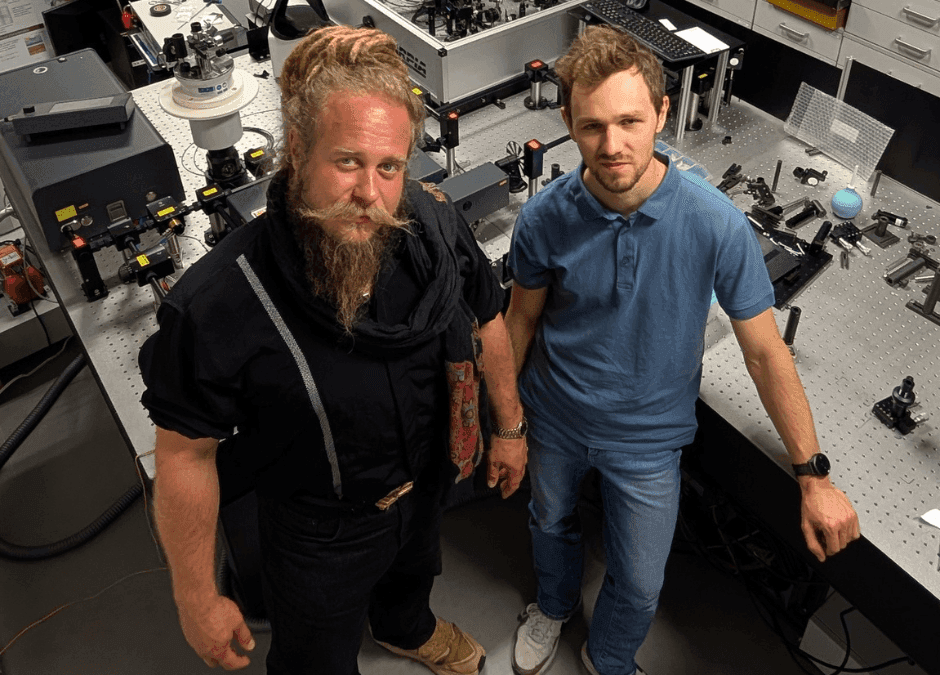
Sometimes a single extra methyl group can significantly change the properties of a drug molecule. It can boost its biological activity, slow its breakdown in the body or reduce unwanted side effects. Attaching this small chemical group to a complex molecule, however, is far from simple. Young researchers at Vilnius University (VU) aim to develop a method that would make this possible using visible light.
Jonas Žurauskas, a PhD student at the VU Faculty of Chemistry and Geosciences (FCHG), has won the 2026 call of the VU Science Promotion Fund for implementing young researchers' scientific ideas. Together with Manvydas Dapkevičius, a PhD student at the Institute of Photonics and Nanotechnology of the Faculty of Physics, he will develop a method that makes it easier to modify drug molecules. The team also invites other researchers and students interested in photoredox catalysis and its applications in drug discovery to join the project.
A long-known phenomenon
The "magic methyl effect" is a term used in medicinal chemistry to describe how a single additional methyl group can significantly change a molecule's biological activity, how quickly it breaks down in the body, or its side effects. It is important to note that this is not a rule that applies to every molecule. The effect is not universal – in some molecules a methyl group can have a major impact, in others almost none. That is why it matters for researchers to be able to quickly test different modifications of a molecule and identify the most promising ones.
Until now, adding such a group to an already prepared, complex molecule usually meant redesigning and carrying out a multi-step synthesis from scratch. J. Žurauskas, who works in Prof. Edvinas Orentas's photoredox catalysis research group at VU FCHG, is developing an alternative together with his colleagues. It is a method that will allow a methyl group to be attached directly to an existing molecular scaffold, reducing the number of synthesis steps required. Chemists call this approach late-stage functionalization. The idea can be compared to editing a text – to change one word in a sentence, you do not need to rewrite the whole book. Adjusting a molecule should work in a similar way.
Why light, and where it could lead
The method is based on photoredox catalysis, a field of chemistry in which reactions are driven not by high temperatures or heavy metals, but by visible light. A catalyst excited by light transfers to the molecule the precise amount of energy needed to form a new chemical bond.
Although the principle sounds simple, controlling such reactions in practice requires very precise tuning of conditions. The main technical challenge is to create a system that attaches a methyl group in a single step instead of through a multi-step synthesis. Photoredox catalysis is one of the fastest-growing areas of modern chemistry, with research groups around the world actively competing in it. In this internationally competitive field, the VU team aims to offer a distinctive, practical technical solution that would allow a methyl group to be attached to a complex molecule in a single step.
"Modern chemistry can no longer rely on test tubes and traditional reactions alone. To understand and control processes as complex as photoredox catalysis, we need to combine organic synthesis with ultrafast spectroscopy and computational chemistry. Only then can we see what happens to a molecule in those few picoseconds after it absorbs a photon," says M. Dapkevičius, highlighting the interdisciplinary nature of the project.
If the project succeeds in developing and validating the planned method, it would become a new tool for further research. It would make it possible to test how a specific structural modification changes a molecule's properties more efficiently than through conventional multi-step synthesis. This would be a significant methodological contribution to a field on which later, industrial-scale solutions in pharmaceutical chemistry depend – although the path from a laboratory method to its use in real-world drug development is usually long and separate, involving additional validation, scale-up and regulatory stages.
16 months of research
The project, running from September 2026 to December 2027, will be carried out by a joint team from VU FCHG and the Institute of Photonics and Nanotechnology: project leader J. Žurauskas and M. Dapkevičius, who is responsible for the spectroscopic studies. A bachelor's or master's student will also join the team.
The first months of the project will focus on synthesising a new chemical reagent and studying its mechanism of action. In later stages, the method will be tested on drug molecules, and by the end of the project the team aims to demonstrate that it works on a gram scale – an important, though intermediate, step towards broader application. The results are to be published in an international scientific journal and presented at scientific conferences.
The team invites biochemists interested in studying the biological activity of the newly developed drug analogues to collaborate. This is an opportunity to contribute to research that brings together synthetic chemistry and pharmacological evaluation. Bachelor's and master's students who would like to join the project and gain hands-on experience in photoredox catalysis are also welcome.
The project builds on J. Žurauskas's research on the DiPyM reagent and arene C–H functionalization, published in the "Journal of the American Chemical Society" (JACS). To apply this knowledge to modifying drug molecules, the team combines organic synthesis with advanced spectroscopy methods ("Nature Communications", M. Dapkevičius).
Project leader: J. Žurauskas (U FCHG). Email: jonas.zurauskas@ff.vu.lt
The project is funded by the Vilnius University Science Promotion Fund.