- 26 October 2026
- Vilnius University
VU Students Came Back from the Academy with Experience, Contacts, and a New View of Their Own Research
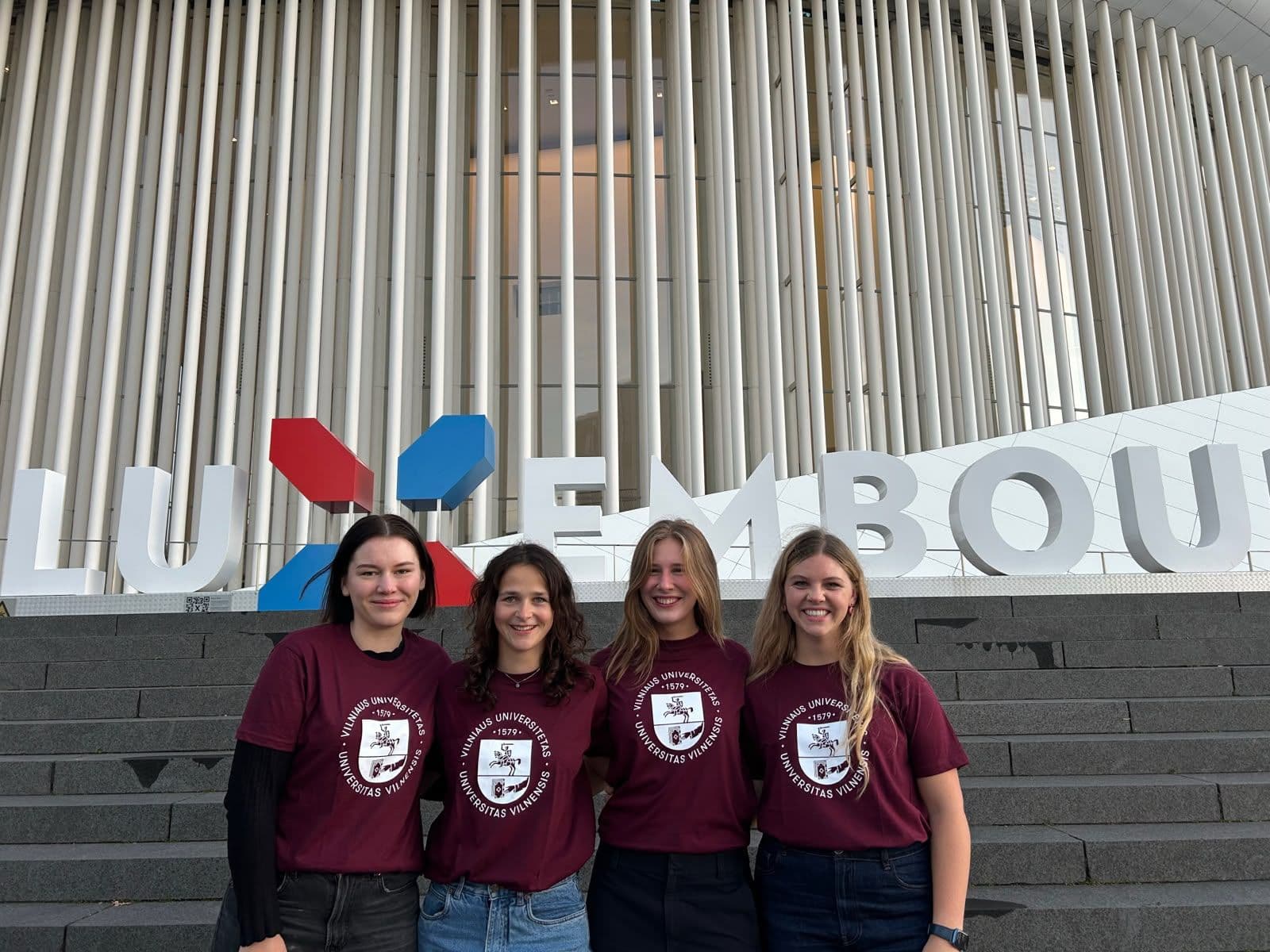
Four Vilnius University (VU) students took part in the Empowering Equity Academy programme organised by the European Investment Bank (EIB). It gave them the chance to get a closer look at the world of investment, talk to specialists in the field, and gain a better understanding of how scientific research turns into tangible products and innovations.
VU has become a partner of the Empowering Equity Academy programme. Four Master’s students took part in the practical component of the programme in Luxembourg: Urtė Minkevičiūtė, studying neurobiology at the VU Life Sciences Center, and three students from the Faculty of Mathematics and Informatics (MIF) – Mija Aneta Stasiulionytė, studying data science; Barbora Čeponytė, studying financial and actuarial mathematics; and Miglė Šimavičiūtė, studying computer modelling. There, they deepened their knowledge of investment, the financial sector, and its links with STEM (science, technology, engineering, and mathematics) fields.
From the laboratory to the market
One of the academy’s main aims is to show how scientific knowledge can be applied beyond the laboratory and how investment decisions contribute to the creation of new technologies and innovations.
Urtė Minkevičiūtė, who is studying neurobiology, was motivated to join the programme by a desire to understand how research reaches the market and the consumer. What impressed her most were the practical case studies, in which the financial history of companies or funds is assessed, and a decision is made on whether investing is worthwhile.
‘Until then, I did not know what criteria guide such decisions or how important the STEM expertise is in making them,’ said Minkevičiūtė.
The student was also intrigued by the story of a scientist who, after reading an article just two pages long about a drug, recognised its potential for treating a rare disease and founded a start-up. This experience also prompted her to see her own research in a new light.
‘Previously, I thought of it as a publication – a result that ends with an article. Now I ask myself what problem it solves and who needs it beyond the laboratory,’ said Minkevičiūtė.
Miglė Šimavičiūtė, a Master’s student in computer modelling, brought home similar insights. She said that the academy changed her view of career opportunities and showed that specialists in computer science and other STEM fields may be needed in the financial sector too.
‘I never thought that studying computer science could lead to a job at the European Investment Bank, but the academy changed my view. The bank needs specialists in particular fields to help understand the products that are being considered for investment,’ said Šimavičiūtė.
Practical knowledge and meetings with professionals
For the academy’s participants, what mattered was not only the opportunity to gain new knowledge but also the chance to meet specialists from the investment and financial sectors. Practical assignments, discussions, and answers to the questions they asked helped them better understand how investment decisions are made and the role sustainability plays in those decisions.
Barbora Čeponytė, a Master’s student in financial and actuarial mathematics, highlights the opportunity to meet specialists in the field. According to the student, in one lecture, a Lithuanian woman working at the European Investment Bank spoke about new projects in which the bank invests to build offshore wind farms in the European Union. ‘I found that very interesting. I became more familiar with how funds invest and their approach to sustainable and long-term investments,’ said Čeponytė.
In her words, the knowledge gained at the academy can come in handy in a variety of professional settings – from working in business or academia to creating her own start-up or helping one grow.
Self-confidence and new professional connections
Taking part in the academy was also beneficial for personal development. The students had to interact with representatives of various STEM fields, introduce themselves, build new connections, and engage more boldly during conversations with experienced specialists.
Čeponytė recalled an assignment in which she had to prepare a 30-second introduction for the other participants in the programme. This exercise helped her learn to convey the most important information concisely and to be more confident.
‘This assignment helped me select what information really matters and present myself with confidence,’ she said.
For Minkevičiūtė, the biggest challenge was the Empowering Equity Event at the end of the programme. There she had to approach scientists from various fields who already managed successful funds of their own, ask them for advice, and build professional contacts.
Šimavičiūtė had to step out of her comfort zone when interacting with new people whose fields of study and work differed considerably from her own. Yet it was precisely such experiences that allowed her to broaden her horizons, find common interests, and get to know specialists from other fields better.
More women in investment
According to Minkevičiūtė, one of the academy’s key ideas is the need to encourage greater involvement of women in investment. Statistics presented during the programme revealed that women remain underrepresented in this sector.
‘More of us are needed in this field, because decisions about which technologies receive funding are made by specific people,’ she stressed.
The student urged others not to be afraid to apply even without a background in finance or a clear plan to work in investment in future. Čeponytė encouraged other female students to make the most of such an opportunity: ‘Definitely apply for the programme! It is a wonderful experience that shows how much we still do not know and how exciting it is to discover new information and explore it.’
The Empowering Equity Academy is a unique programme designed to link STEM and sustainability studies with the European investment ecosystem. The programme combines online sessions with in-person activities, giving participants the opportunity to learn first-hand from the experience and insights of leaders in venture capital, private equity, and sustainable finance.