- 9 September 2026
- Eglė Misiūtė
The Faculty of Chemistry and Geosciences at VU team has won an RCL project titled “My First Research Team”
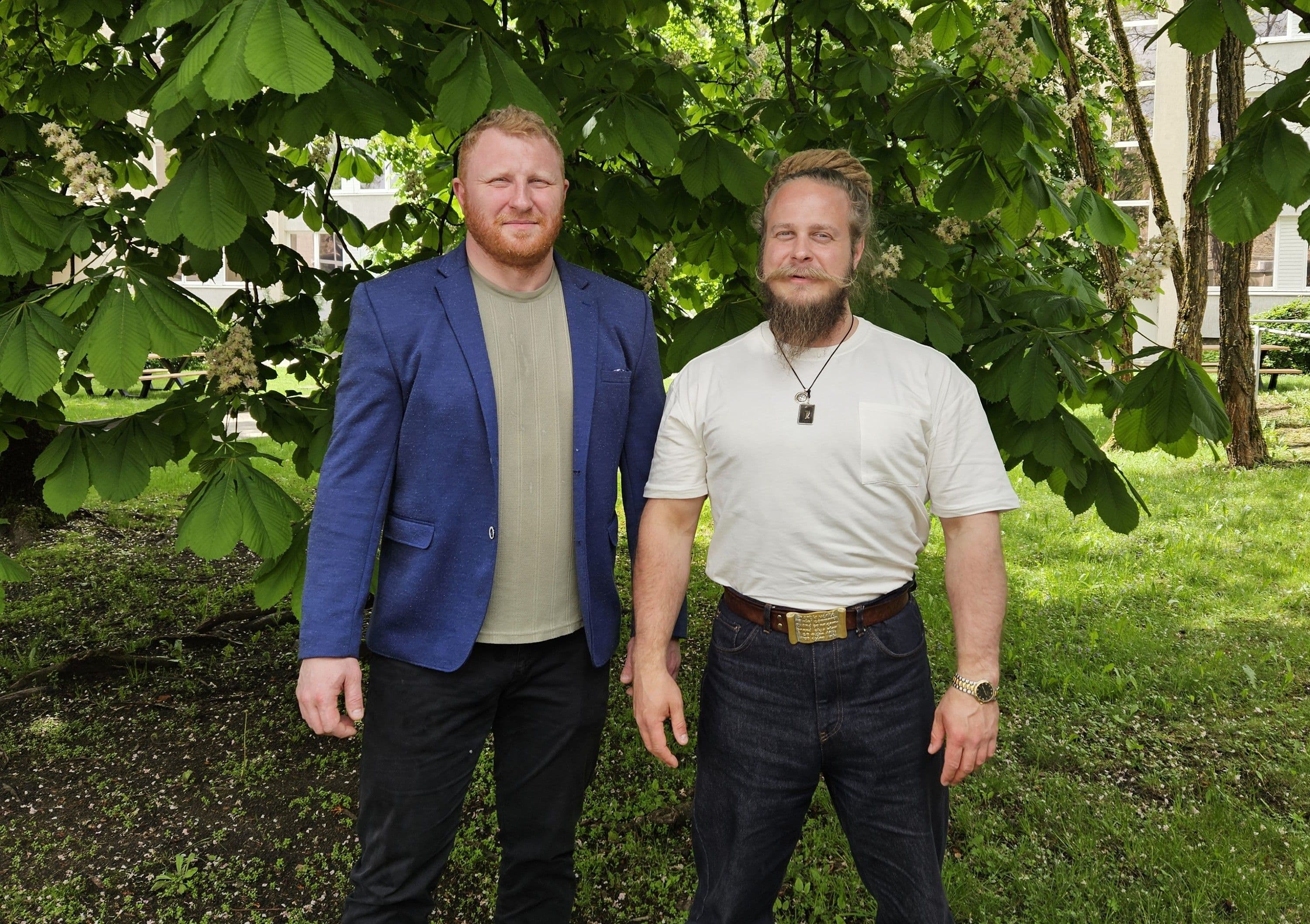
A young researchers' team from Vilnius University (VU), led by Dr. Denis Sokol and PhD student Jonas Žurauskas from the Faculty of Chemistry and Geosciences (FCHG), has won the Research Council of Lithuania (RCL) funding project titled “My First Research Team.” The team has been awarded 350,000 euros for three years of research aimed at developing an innovative method for destroying microplastics using light and sound. It is an idea developed by young scientists in the university's laboratory that could become an answer to one of today's most pressing global problems.
The project is funded by the Research Council of Lithuania's program “My First Research Team,” which helps promising young scientists build research groups and begin independent careers. The funding will be allocated for equipment and reagents. “This means undeniable success and security for our future scientific careers over the next three years,” the researchers say.
The research team's project topic – photocatalytic degradation of microplastics – is exceptionally relevant to today's world. Microplastic is becoming an increasingly prominent problem. Its particles are hazardous and accumulate in water, soil, and air, entering plant, animal, and human cells.
The team from VU Faculty of Chemistry and Geosciences proposes an innovative approach – photocatalytic degradation. This is a process in which a photocatalyst, activated by light, accelerates the breakdown of chemical compounds. Alongside light, the researchers will also employ sound waves, which will help the reactions proceed efficiently. Dr. Denis Sokol's expertise in surface chemistry and materials science, together with doctoral student Jonas Žurauskas's background in photocatalytic organic chemistry, formed a solid foundation for this collaboration. “We hypothesized that this combination of light and sound could be effectively used to degrade microplastics,” the researchers explain.
The researchers acknowledge that the combination of these two methods and its effective application are, in essence, not yet fully developed, but for now they are not revealing the details. What is known is this: “in tandem, we use medium-penetrating light and sound waves, which allow ever new layers of microplastic to be exposed for effective breakdown. All types of microplastic are an ambitious but clearly defined target.” The scientists are not disclosing the remaining details for now.
It is important to note that the project's scope extends far beyond just the chemical degradation of microplastic. The project includes a thorough chemical analysis of the post-degradation products of microplastic, as well as biochemical studies of their interaction with cells and their toxicity. “It is important not only to break down microplastic, but also to understand what remains afterward and whether it is safe for humans and the environment.”
The dream outcome is clear and concrete – two high-level scientific publications and an up-scaled process. This is not just a scientific ambition but a real step toward practical application. The team emphasizes that scientific discoveries should not remain confined to academic journals alone. The researchers are actively seeking collaboration with industry – companies in the water treatment, environmental, and recycling sectors, for whom the microplastic problem is a daily reality. “Our goal is not just publications, but a solution that actually works and could be applied on an industrial scale,” the team says. The researchers invite interested companies and organizations to reach out about potential partnership, since global problems can only be solved by combining scientific knowledge with industrial capabilities.
And to young people who are still considering a scientific career, the researchers wish just one thing – not to be afraid, and to pursue their goal persistently and with tremendous determination. This project shows that the ideas of young scientists at VU Faculty of Chemistry and Geosciences can change the world and solve global problems.