- 23 October 2026
- Vilnius University information
President of the CERN Council Visits VU: We Must Consider the Future
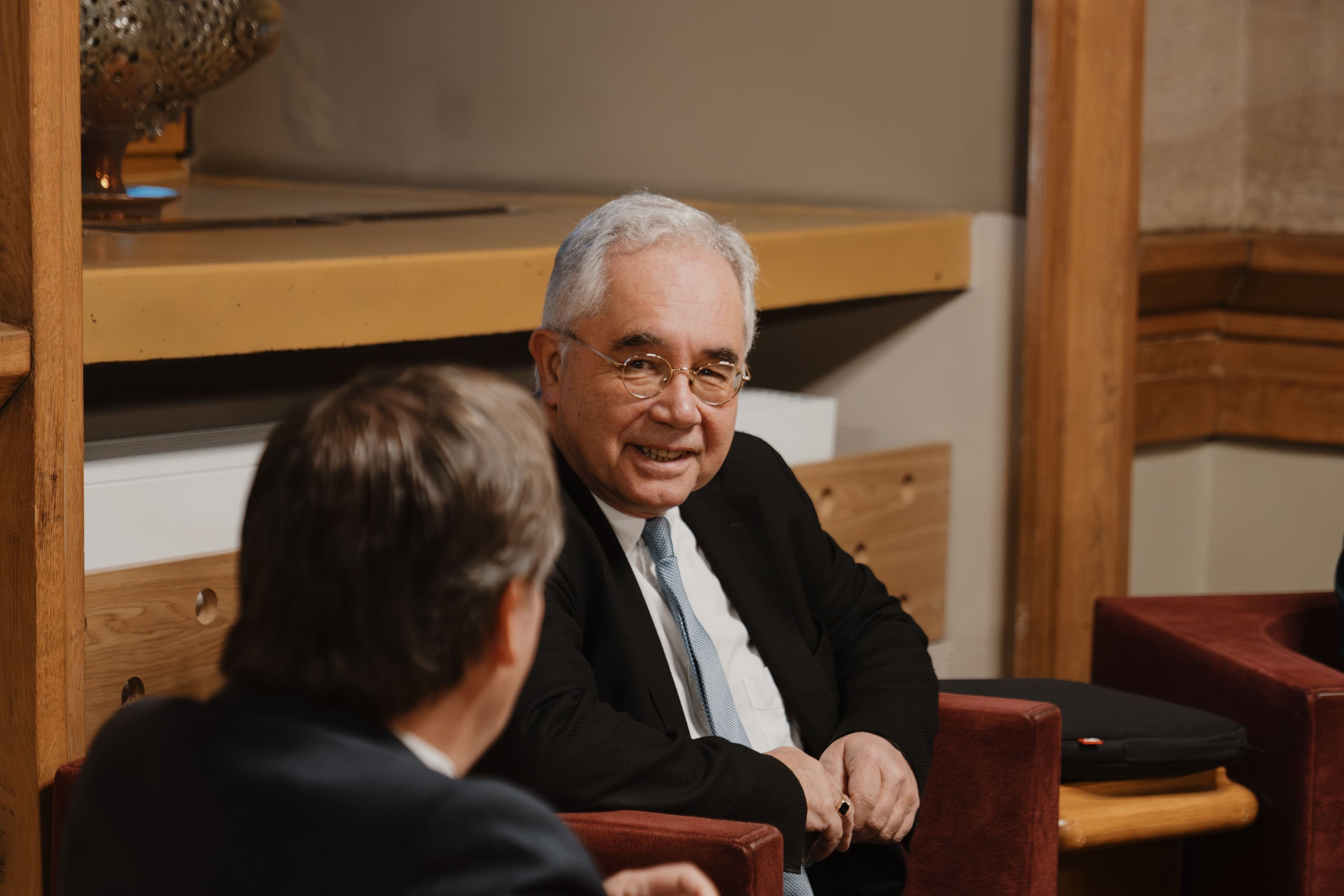
During a visit to Vilnius University (VU) on 20 October, Prof. Costas Fountas, President of the Council of the European Organization for Nuclear Research (CERN), emphasised that cooperation with CERN has an enormously positive impact on the development of both science and technology.
At a meeting with VU Rector Prof. Rimvydas Petrauskas, VU researchers, and students, the President of the CERN Council discussed cooperation between Lithuania and CERN, research conducted at VU, and the involvement of students and young talent in CERN activities.
At the VU Business School, the guest delivered a public lecture in English entitled ‘State-of-the-Art Technology at CERN and its Role in EU Industry’. The Saulėtekis campus was a fitting destination for his visit: it brings together researchers and students in the life sciences, physics, engineering, communication, business, and many other fields, whose expertise is directly relevant to CERN’s work.
The lecture covered CERN’s history and its major experiments: ATLAS (A Toroidal LHC ApparatuS), CMS (Compact Muon Solenoid), ALICE (A Large Ion Collider Experiment), and LHCb (Large Hadron Collider beauty). It also outlined CERN’s plans for the coming decades, including preparations for the construction of the 92-kilometre Future Circular Collider (FCC), which could eventually succeed the Large Hadron Collider (LHC) currently in operation. New detectors and superconducting magnets, substantially faster data-processing systems, and other advanced research infrastructure are already being developed for this purpose.
For more than half a century, CERN has been developing and applying cutting-edge technologies that subsequently find uses in research laboratories, industry, medicine, and many other fields worldwide. Technologies developed at CERN now make it possible to do what was impossible only yesterday. According to Prof. Fountas, every day we must think about the future we want to create.
During his visit to the Faculty of Physics, the guest met several dozen VU scientists and early-career researchers who contribute directly to research at CERN. Prof. Fountas took an interest not only in the work of the LHCb Vilnius group and VU’s involvement in the CMS experiment, but also in the development of detectors, software, and electronics, as well as research in photonics, lasers, and semiconductors. Students and professors from the Faculty of Physics presented their laboratory work to him.
Lithuania is seeking to become a full Member State of CERN: VU Strengthens Strategic Partnership with CERN. In September, VU brought together hundreds of scientists, engineers, and early-career researchers from around the world for the CERN LHCb experiment conference during LHCb Week Vilnius. At CERN, researchers conduct unique experiments unmatched anywhere else in the world. In 2025, Lithuanian higher education institutions, including VU, signed a memorandum with CERN on the feasibility study for the Future Circular Collider (FCC) project.