- 29 September 2026
- Aušra Kudirkaitė, Vilniaus universiteto informacija
VU Strengthens Strategic Partnership with CERN
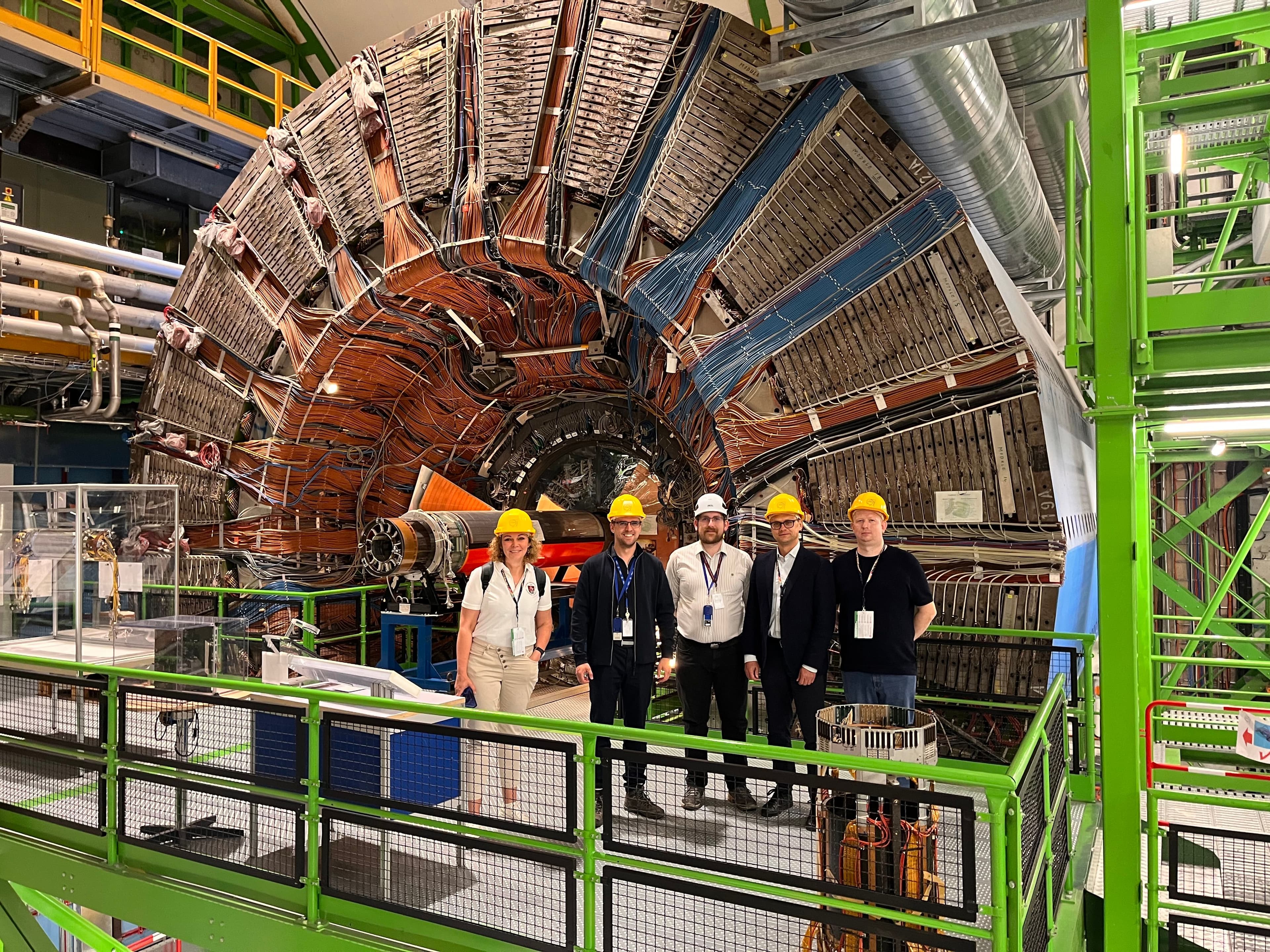
Last week, representatives of Vilnius University’s (VU) leadership and academic community visited the European Organization for Nuclear Research (CERN). Chairperson of the VU Senate, Prof. Eglė Lastauskienė, VU Chancellor Raimundas Balčiūnaitis, Executive Director of the Lithuanian Consortium for Particle Physics, Prof. Ramūnas Aleksiejūnas, and Head of Entrepreneurship and Innovation Development at the VU Business School, Prof. Saulė Mačiukaitė-Žvinienė, met with CERN’s leadership.
‘CERN is a cradle of fundamental research and innovation, where rapidly evolving ideas and technologies are driving breakthroughs not only in physics but also in the life sciences, biotechnology, medicine, computing, engineering, and many other fields,’ said Prof. Lastauskienė, underlining the importance of VU’s strategic partnership with CERN.
During meetings with President of the CERN Council, Prof. Costas Fountas, Director for Stakeholder Relations, Dr Ursula Bassler, and Head of Relations with Associate Member States at CERN, Prof. Christoph Schäfer, discussions focused mainly on strengthening Lithuania’s involvement in CERN’s activities and on opportunities for talent development, scientific collaboration, and innovation.
According to Prof. Aleksiejūnas, full membership of CERN is an investment in the country’s future. It would give Lithuania the opportunity to participate in the organisation’s strategic decision-making, strengthen the international role of Lithuanian scientists and institutions, and open up wider opportunities not only for students and researchers, but also for business and the innovation ecosystem.
‘Research at CERN is carried out by international teams, and most scientists work at their own universities or research institutes in various countries. CERN brings us together, gives us access to unique scientific infrastructure and the most advanced technologies, and creates the conditions not only for carrying out ambitious scientific projects, but also for developing innovations and technology prototypes,’ he said.
Education and talent development are an integral part of CERN’s work. The organisation gives schoolchildren, students, teachers, and young researchers the opportunity to learn from world-class experts, gain practical experience, and contribute to cutting-edge science and technology projects.
Prof. Saulė Mačiukaitė-Žvinienė emphasised that CERN fosters the ability to think boldly, broadly, and innovatively. As one excellent example of this, she cited a project carried out by students from the VU Business School, VU Faculty of Physics, and Kaunas University of Technology at CERN’s IdeaSquare.
‘From 21 to 26 September, 27 Lithuanian students visited IdeaSquare, CERN’s innovation laboratory, where they learnt to tackle complex global challenges through an interdisciplinary approach. There, students of business, physics, and engineering worked together, while being encouraged to think outside the box, question established truths, and look for unexpected solutions to future global issues,’ she said.
During the visit, meetings were held with the students taking part in the project and with Lithuanian scientists. The delegation also visited the CERN Data Centre; the detector for LHCb, one of the four main experiments at the Large Hadron Collider (LHC); its control centre; the Antimatter Factory; the CERN Magnet Laboratory; the Synchrocyclotron (CERN’s first particle accelerator, which operated from 1957 to 1990); and other facilities.
CERN infrastructure used not only for particle physics but also for medicine – the ISOLDE and MEDICIS experiments – made a particularly strong impression on the delegation. These facilities produce radioactive isotopes that help develop new solutions for cancer diagnosis and treatment.
The Head of the LHCb Vilnius group, Dr Mindaugas Šarpis, was pleased that the collaboration between CERN and Lithuania is creating significant added value in various fields. According to him, the LHCb experiment collaboration conference, ‘LHCb Week 2026’, held in Vilnius from 14 to 18 September, was one of the largest and most successful international events in the history of fundamental research in Lithuania. ‘This event raised Lithuania’s international profile and highlighted to key institutions the involvement of Vilnius University and the LHCb Vilnius group in CERN and LHCb activities,’ he said.
Based in Geneva, CERN is the world’s largest centre for particle physics research, bringing together scientists from more than 100 countries. Unique experiments are carried out there that have no equivalent anywhere else in the world (available in Lithuanian). Lithuania has been an Associate Member State of CERN since 2018 and is actively seeking full membership.